

68
surface light (Papageorgiou and Govindjee, 1968) due to a low rate of vertical mixing. The
relation between cellular photoadaptation and vertical mixing has been explored by Lewis et
al. (1984) in order to calculate mixing rates. In general, in situ measurements of chlorophyll
fluorescence should only be used as a method to obtain a quick look of the distribution of
phytoplankton and to get an impression of patchiness on a smaller scale than sampling usually
permits. Profiles should be calibrated frequently with measurements of chlorophyll made in
a different way, preferably by methanol or acetone extracts of suspended matter samples at
discrete depths.
0
50
[100
.r:;
12
Q)
"D
NIGHT
150
200
250
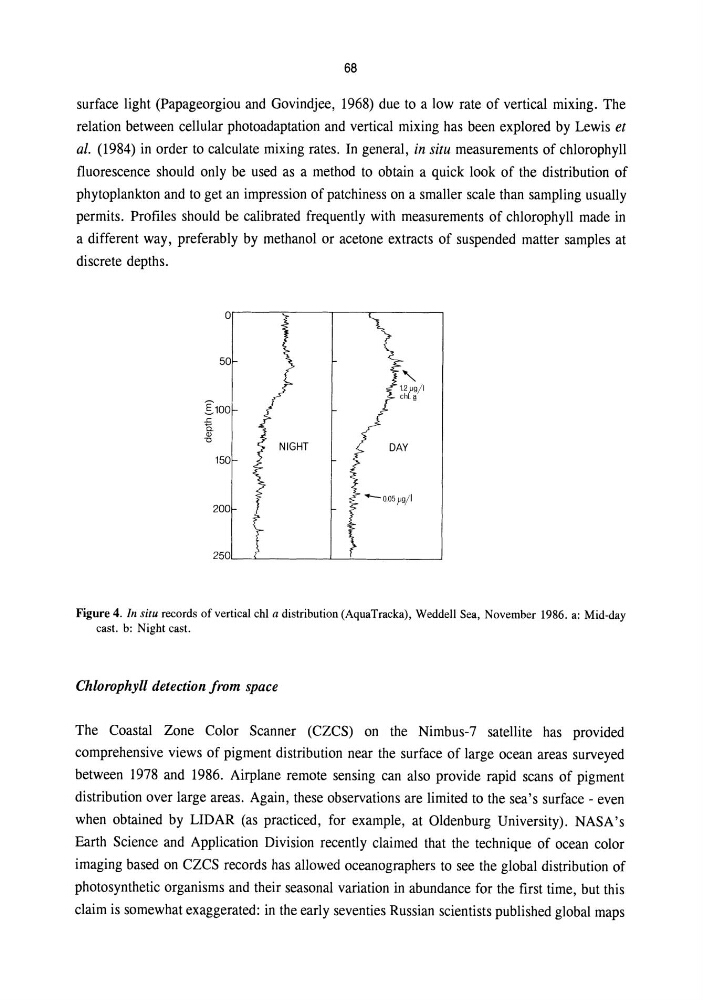
Figure 4. In situ records of vertical chI a distribution (AquaTracka), Weddell Sea, November 1986. a: Mid-day
cast. b: Night cast.
Chlorophyll detection from space
The Coastal Zone Color Scanner (CZCS) on the Nimbus-7 satellite has provided
comprehensive views of pigment distribution near the surface of large ocean areas surveyed
between 1978 and 1986. Airplane remote sensing can also provide rapid scans of pigment
distribution over large areas. Again, these observations are limited to the sea's surface - even
when obtained by LIDAR (as practiced, for example, at Oldenburg University). NASA's
Earth Science and Application Division recently claimed that the technique of ocean color
imaging based on CZCS records has allowed oceanographers to see the global distribution of
photosynthetic organisms and their seasonal variation in abundance for the first time, but this
claim is somewhat exaggerated: in the early seventies Russian scientists published global maps
surface light (Papageorgiou and Govindjee, 1968) due to a low rate of vertical mixing. The
relation between cellular photoadaptation and vertical mixing has been explored by Lewis et
al. (1984) in order to calculate mixing rates. In general, in situ measurements of chlorophyll
fluorescence should only be used as a method to obtain a quick look of the distribution of
phytoplankton and to get an impression of patchiness on a smaller scale than sampling usually
permits. Profiles should be calibrated frequently with measurements of chlorophyll made in
a different way, preferably by methanol or acetone extracts of suspended matter samples at
discrete depths.
0
50
[100
.r:;
12
Q)
"D
NIGHT
150
200
250
Figure 4. In situ records of vertical chI a distribution (AquaTracka), Weddell Sea, November 1986. a: Mid-day
cast. b: Night cast.
Chlorophyll detection from space
The Coastal Zone Color Scanner (CZCS) on the Nimbus-7 satellite has provided
comprehensive views of pigment distribution near the surface of large ocean areas surveyed
between 1978 and 1986. Airplane remote sensing can also provide rapid scans of pigment
distribution over large areas. Again, these observations are limited to the sea's surface - even
when obtained by LIDAR (as practiced, for example, at Oldenburg University). NASA's
Earth Science and Application Division recently claimed that the technique of ocean color
imaging based on CZCS records has allowed oceanographers to see the global distribution of
photosynthetic organisms and their seasonal variation in abundance for the first time, but this
claim is somewhat exaggerated: in the early seventies Russian scientists published global maps