

63
Correlations between our chlorophyll, irradiance, and primary production estimates were less
than satisfactory. It occurred to us that in order to accurately model production rates one
should take into account not only the intensity but also the spectral composition and angular
distribution of underwater light. In addition, not only the light absorbed by chlorophyll a
should be considered, but also absorption by the other pigments that are directly active in
photosynthesis through efficient light energy transfer to chlorophyll a (ChI b, the
fucoxanthins, the ChI c's, (Jeffrey, 1989); violaxanthin, peridinin (Owens et al., 1987», or
indirectly by having a protective function through interaction in photochemically induced
oxidation reactions at high light intensities (lutein, zeaxanthin (Bidigare et al., 1989». The
remarkable abundance of the photosynthetically inefficient zeaxanthin recorded by us in the
open tropical and subtropical ocean (Gieskes and Kraay, 1983; Gieskes et al., 1988) obviously
called for a new approach in the thinking of absorption of light by pigments. Indeed, over
much of the world's oceans there appeared to be as much zeaxanthin as chlorophyll!
10'
:~j~
!102~
~
L,.
'O~DO 500
700
wQvelenglh(nm)
wQvelengthlnm)
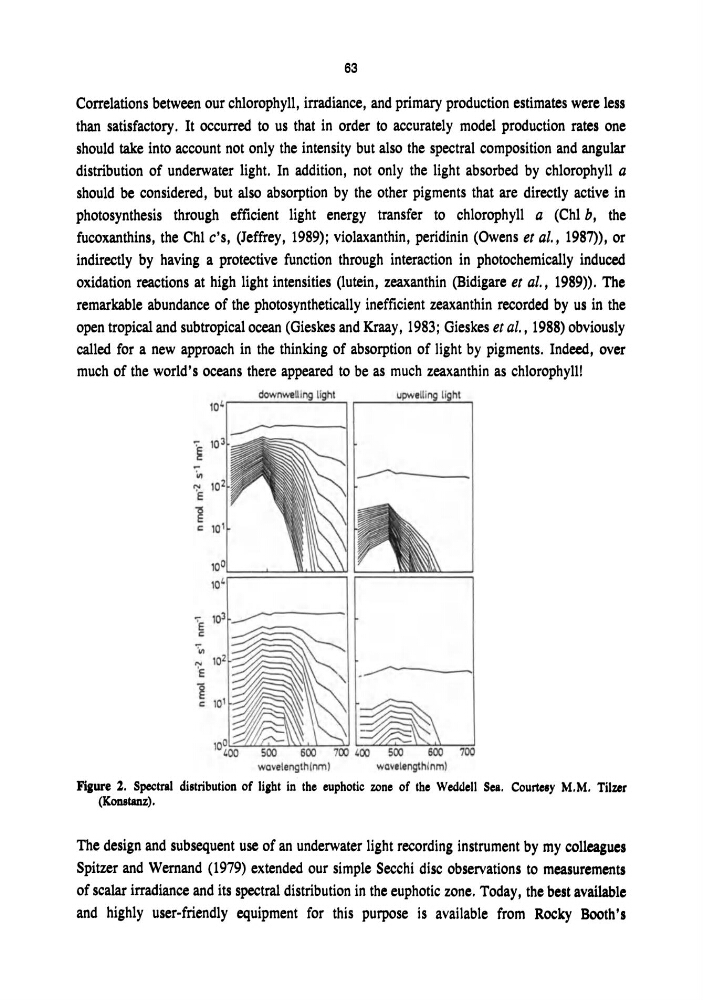
Figure 2. Spectral distribution of light in the euphotic zone of the Weddell Sea. Courte.y M.M. Tilzer
(Konstanz).
The design and subsequent use of an underwater light recording instrument by my colleagues
Spitzer and Wernand (1979) extended our simple Secchi disc observations to measurements
of scalar irradiance and its spectral distribution in the euphotic zone. Today, the best available
and highly user-friendly equipment for this purpose is available from Rocky Booth's
Correlations between our chlorophyll, irradiance, and primary production estimates were less
than satisfactory. It occurred to us that in order to accurately model production rates one
should take into account not only the intensity but also the spectral composition and angular
distribution of underwater light. In addition, not only the light absorbed by chlorophyll a
should be considered, but also absorption by the other pigments that are directly active in
photosynthesis through efficient light energy transfer to chlorophyll a (ChI b, the
fucoxanthins, the ChI c's, (Jeffrey, 1989); violaxanthin, peridinin (Owens et al., 1987», or
indirectly by having a protective function through interaction in photochemically induced
oxidation reactions at high light intensities (lutein, zeaxanthin (Bidigare et al., 1989». The
remarkable abundance of the photosynthetically inefficient zeaxanthin recorded by us in the
open tropical and subtropical ocean (Gieskes and Kraay, 1983; Gieskes et al., 1988) obviously
called for a new approach in the thinking of absorption of light by pigments. Indeed, over
much of the world's oceans there appeared to be as much zeaxanthin as chlorophyll!
10'
:~j~
!102~
~
L,.
'O~DO 500
700
wQvelenglh(nm)
wQvelengthlnm)
Figure 2. Spectral distribution of light in the euphotic zone of the Weddell Sea. Courte.y M.M. Tilzer
(Konstanz).
The design and subsequent use of an underwater light recording instrument by my colleagues
Spitzer and Wernand (1979) extended our simple Secchi disc observations to measurements
of scalar irradiance and its spectral distribution in the euphotic zone. Today, the best available
and highly user-friendly equipment for this purpose is available from Rocky Booth's