

375
scatter from field studies may in fact be reasonable. It is worth noting that for phytoplankters
that are far from spherical (e.g., pennate diatoms that are long and narrow), distinctive
angular light scattering patterns have been observed (Olson et al. 1989; Buonnacorsi and
Cunningham 1990) that may be useful as discriminating factors, especially if an independent
measure of size such as time-of-flight is also available.
5
4
o
2
10
__ ~~_--=-::-:::::::::::-::::C' 1.09
----" ... 'i~ 07
----JJ:~I+-"I
----__
---. ,
~.--;--.?_,-4+---'_.
_,'
~
... -
4
6
8
10
Differential forward scattering cross section (x 10- 3 )
---...... ........ ,
___ ~ . . ,
----1.03
12
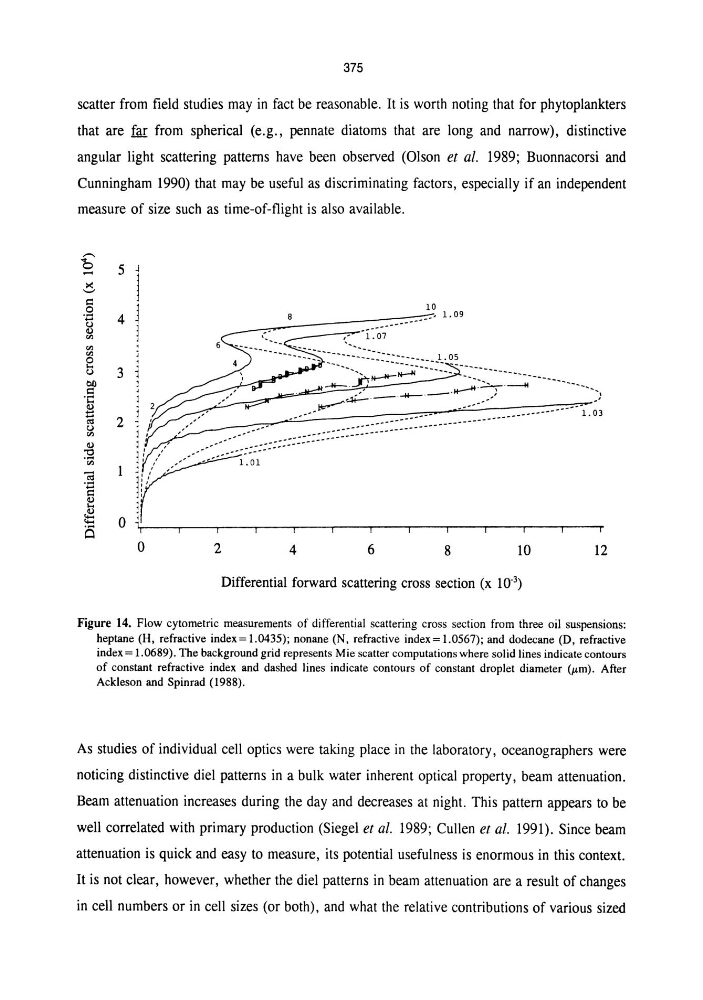
Figure 14. Flow cytometric measurements of differential scattering cross section from three oil suspensions:
heptane (H, refractive index = 1.0435); nonane (N, refractive index = 1.0567); and dodecane (D, refractive
index = 1.0689). The background grid represents Mie scatter computations where solid lines indicate contours
of constant refractive index and dashed lines indicate contours of constant droplet diameter (/lm). After
Ackleson and Spinrad (1988).
As studies of individual cell optics were taking place in the laboratory, oceanographers were
noticing distinctive diel patterns in a bulk water inherent optical property, beam attenuation.
Beam attenuation increases during the day and decreases at night. This pattern appears to be
well correlated with primary production (Siegel et al. 1989; Cullen et al. 1991). Since beam
attenuation is quick and easy to measure, its potential usefulness is enormous in this context.
It is not clear, however, whether the diel patterns in beam attenuation are a result of changes
in cell numbers or in cell sizes (or both), and what the relative contributions of various sized
scatter from field studies may in fact be reasonable. It is worth noting that for phytoplankters
that are far from spherical (e.g., pennate diatoms that are long and narrow), distinctive
angular light scattering patterns have been observed (Olson et al. 1989; Buonnacorsi and
Cunningham 1990) that may be useful as discriminating factors, especially if an independent
measure of size such as time-of-flight is also available.
5
4
o
2
10
__ ~~_--=-::-:::::::::::-::::C' 1.09
----" ... 'i~ 07
----JJ:~I+-"I
----__
---. ,
~.--;--.?_,-4+---'_.
_,'
~
... -
4
6
8
10
Differential forward scattering cross section (x 10- 3 )
---...... ........ ,
___ ~ . . ,
----1.03
12
Figure 14. Flow cytometric measurements of differential scattering cross section from three oil suspensions:
heptane (H, refractive index = 1.0435); nonane (N, refractive index = 1.0567); and dodecane (D, refractive
index = 1.0689). The background grid represents Mie scatter computations where solid lines indicate contours
of constant refractive index and dashed lines indicate contours of constant droplet diameter (/lm). After
Ackleson and Spinrad (1988).
As studies of individual cell optics were taking place in the laboratory, oceanographers were
noticing distinctive diel patterns in a bulk water inherent optical property, beam attenuation.
Beam attenuation increases during the day and decreases at night. This pattern appears to be
well correlated with primary production (Siegel et al. 1989; Cullen et al. 1991). Since beam
attenuation is quick and easy to measure, its potential usefulness is enormous in this context.
It is not clear, however, whether the diel patterns in beam attenuation are a result of changes
in cell numbers or in cell sizes (or both), and what the relative contributions of various sized