

370
the polarized laser light is depolarized as it is scattered by these structures (Olson et al. 1989).
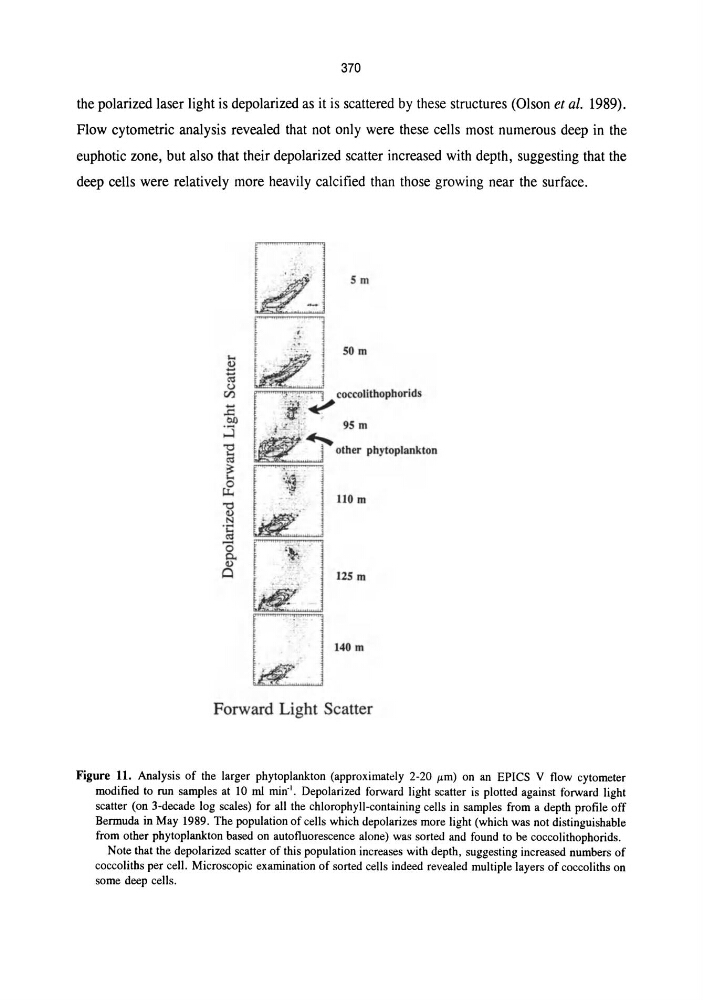
Flow cytometric analysis revealed that not only were these cells most numerous deep in the
euphotic zone, but also that their depolarized scatter increased with depth, suggesting that the
deep cells were relatively more heavily calcified than those growing near the surface.
I ',~l 5m
~
I .' : ' I
I-B 1 SOm
[~l
~
' . ,
coccolithophorids
'it: ' '';;
I ,c' ~
95 m
,
.- ~
~ ] other phytoplankton
lIJ "'m
~
.~~
~ ~~,
125 m
:
_.:.
~~_" I
[:J l~m
Forward Light Scatter
Figure 11. Analysis of the larger phytoplankton (approximately 2-20 J.lm) on an EPICS V flow cytometer
modified to run samples at 10 ml min" . Depolarized forward light scatter is plotted against forward light
scatter (on 3-decade log scales) for all the chlorophyll-containing cells in samples from a depth profile off
Bermuda in May 1989. The population of ceJIs which depolarizes more light (which was not distinguishable
from other phytoplankton based on autofluorescence alone) was sorted and found to be coccolithophorids,
Note that the depolarized scatter of this popUlation increases with depth, suggesting increased numbers of
coccoliths per cell, Microscopic examination of sorted ceJIs indeed revealed multiple layers of coccoliths on
some deep cells,
the polarized laser light is depolarized as it is scattered by these structures (Olson et al. 1989).
Flow cytometric analysis revealed that not only were these cells most numerous deep in the
euphotic zone, but also that their depolarized scatter increased with depth, suggesting that the
deep cells were relatively more heavily calcified than those growing near the surface.
I ',~l 5m
~
I .' : ' I
I-B 1 SOm
[~l
~
' . ,
coccolithophorids
'it: ' '';;
I ,c' ~
95 m
,
.- ~
~ ] other phytoplankton
lIJ "'m
~
.~~
~ ~~,
125 m
:
_.:.
~~_" I
[:J l~m
Forward Light Scatter
Figure 11. Analysis of the larger phytoplankton (approximately 2-20 J.lm) on an EPICS V flow cytometer
modified to run samples at 10 ml min" . Depolarized forward light scatter is plotted against forward light
scatter (on 3-decade log scales) for all the chlorophyll-containing cells in samples from a depth profile off
Bermuda in May 1989. The population of ceJIs which depolarizes more light (which was not distinguishable
from other phytoplankton based on autofluorescence alone) was sorted and found to be coccolithophorids,
Note that the depolarized scatter of this popUlation increases with depth, suggesting increased numbers of
coccoliths per cell, Microscopic examination of sorted ceJIs indeed revealed multiple layers of coccoliths on
some deep cells,