

356
conditions, and after suitable calibration (McDuff and Chisholm 1982; Carpenter and Chang
1988) may provide absolute growth rates. This technique is especially attractive because it can
be used with natural samples and does not require bottle incubations.
Grazing: Another early application of flow cytometry to oceanographic questions was the
analysis of grazing selectivity by planktivorous herbivores. Traditionally, grazing rates have
been estimated indirectly by observing the loss of food particles from the experimental volume
or directly by observing food particle accumulation in the grazers (Peters 1984). Both
approaches have been used in conjunction with flow cytometric analysis. Although in some
cases flow cytometry is simply a way of automating cell enumeration, which is usually done
microscopically, in other cases it allows one to discriminate between cells and particles which
would be difficult to distinguish under the microscope.
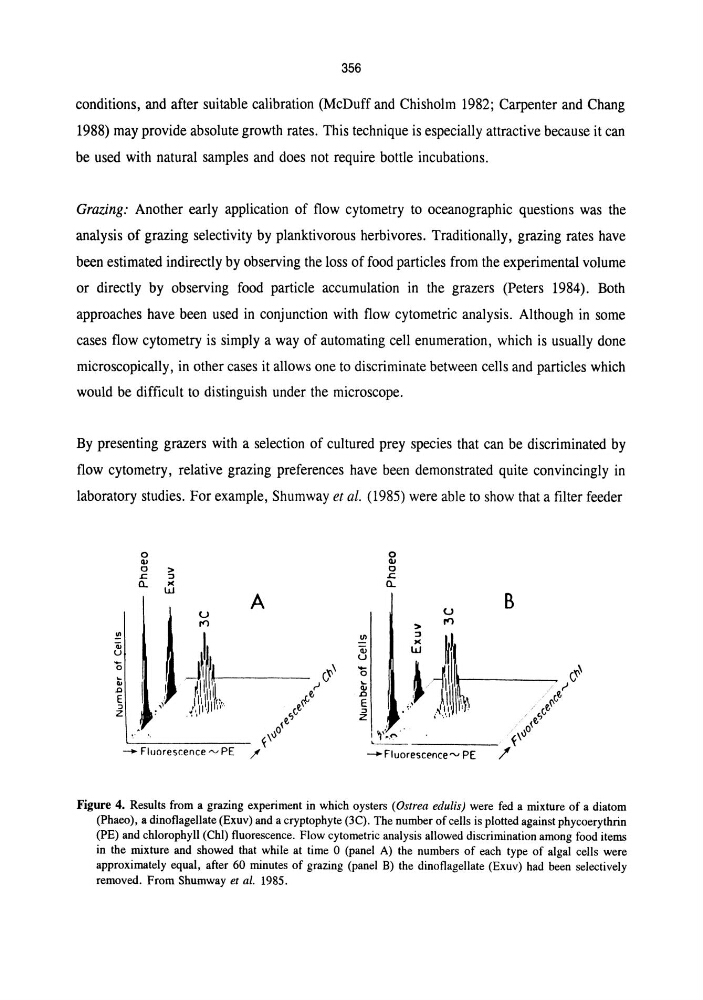
By presenting grazers with a selection of cultured prey species that can be discriminated by
flow cytometry, relative grazing preferences have been demonstrated quite convincingly in
laboratory studies. For example, Shumway et al. (1985) were able to show that a filter feeder
0
0
III
III
0
>
0
.t::
:::J
.t::
0J(
0W
A
B
u
U
rtl
>
,..,
!!!
)/1
~
~ ~
"ii
Qj
u
u
'0
,J c,' t-'
'5
~i'IL
c, Y;-'
..
. .
OJ
,J
.0
~IIIIII
III
E
,
l'
.c
" .111
.. (,,,
, . l' ..I"llh.
"
Ihlll fl •.
E
"f:' .
:J
,{,.II' II"
(,t
::>
Z
,
,,"
z
. . . . ,,"c
o(
,
. . o(
~,\\
I I), ........
~,\\
~
_ Fluorescence "V PE /
-Fluorescence'" PE
/
Figure 4. Results from a grazing experiment in which oysters (Ostrea edulis) were fed a mixture of a diatom
(Phaeo), a dinoflagellate (Exuv) and a cryptophyte (3C). The number of cells is plotted against phycoerythrin
(PE) and chlorophyll (ChI) fluorescence. Flow cytometric analysis allowed discrimination among food items
in the mixture and showed that while at time 0 (panel A) the numbers of each type of algal cells were
approximately equal, after 60 minutes of grazing (panel B) the dinoflagellate (Exuv) had been selectively
removed. From Shumway et al. 1985.
conditions, and after suitable calibration (McDuff and Chisholm 1982; Carpenter and Chang
1988) may provide absolute growth rates. This technique is especially attractive because it can
be used with natural samples and does not require bottle incubations.
Grazing: Another early application of flow cytometry to oceanographic questions was the
analysis of grazing selectivity by planktivorous herbivores. Traditionally, grazing rates have
been estimated indirectly by observing the loss of food particles from the experimental volume
or directly by observing food particle accumulation in the grazers (Peters 1984). Both
approaches have been used in conjunction with flow cytometric analysis. Although in some
cases flow cytometry is simply a way of automating cell enumeration, which is usually done
microscopically, in other cases it allows one to discriminate between cells and particles which
would be difficult to distinguish under the microscope.
By presenting grazers with a selection of cultured prey species that can be discriminated by
flow cytometry, relative grazing preferences have been demonstrated quite convincingly in
laboratory studies. For example, Shumway et al. (1985) were able to show that a filter feeder
0
0
III
III
0
>
0
.t::
:::J
.t::
0J(
0W
A
B
u
U
rtl
>
,..,
!!!
)/1
~
~ ~
"ii
Qj
u
u
'0
,J c,' t-'
'5
~i'IL
c, Y;-'
..
. .
OJ
,J
.0
~IIIIII
III
E
,
l'
.c
" .111
.. (,,,
, . l' ..I"llh.
"
Ihlll fl •.
E
"f:' .
:J
,{,.II' II"
(,t
::>
Z
,
,,"
z
. . . . ,,"c
o(
,
. . o(
~,\\
I I), ........
~,\\
~
_ Fluorescence "V PE /
-Fluorescence'" PE
/
Figure 4. Results from a grazing experiment in which oysters (Ostrea edulis) were fed a mixture of a diatom
(Phaeo), a dinoflagellate (Exuv) and a cryptophyte (3C). The number of cells is plotted against phycoerythrin
(PE) and chlorophyll (ChI) fluorescence. Flow cytometric analysis allowed discrimination among food items
in the mixture and showed that while at time 0 (panel A) the numbers of each type of algal cells were
approximately equal, after 60 minutes of grazing (panel B) the dinoflagellate (Exuv) had been selectively
removed. From Shumway et al. 1985.