

354
wavelengths, so that several constituents can be measured simultaneously. The intensity of
fluorescence is related to the amount of each constituent.
Pulse peak heights or integrated signals from each detector are typically stored as a list of
multiparameter data for each cell, and visualized in one-, two-, or three-dimensional plots in
which populations of similar cells form characteristic flow cytometric "signatures. " For
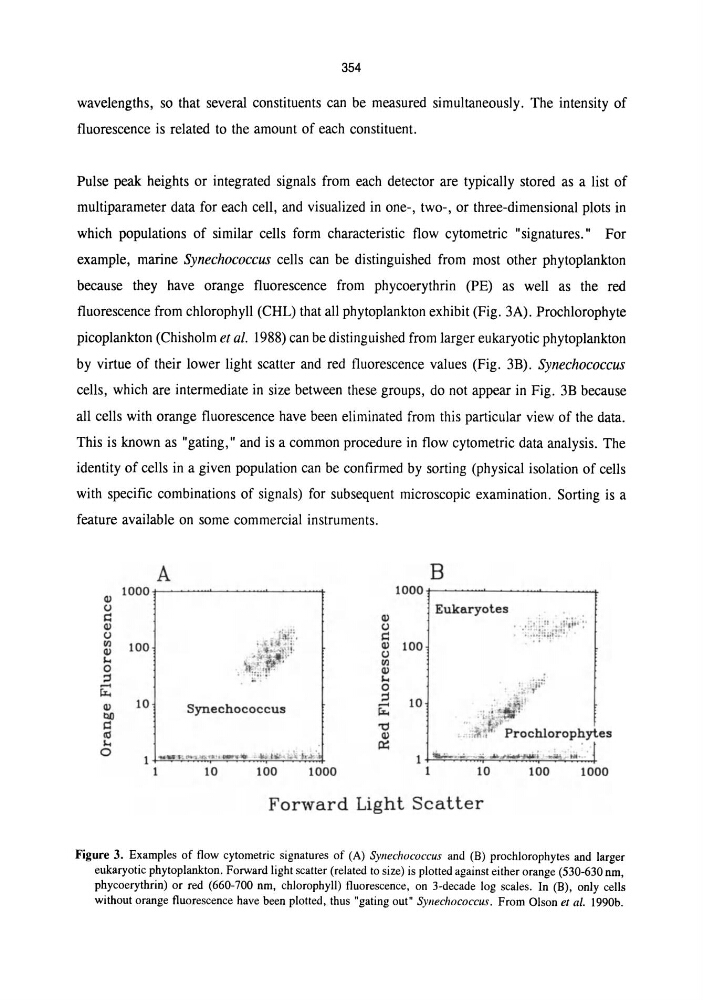
example, marine Synechococcus cells can be distinguished from most other phytoplankton
because they have orange fluorescence from phycoerythrin (PE) as well as the red
fluorescence from chlorophyll (CHL) that all phytoplankton exhibit (Fig . 3A). Prochlorophyte
picoplankton (Chisholm et ai. 1988) can be distinguished from larger eukaryotic phytoplankton
by virtue of their lower light scatter and red fluorescence values (Fig. 3B). Synechococcus
cells, which are intermediate in size between these groups, do not appear in Fig. 3B because
all cells with orange fluorescence have been eliminated from this particular view of the data.
This is known as "gating," and is a common procedure in flow cytometric data analysis. The
identity of cells in a given population can be confirmed by sorting (physical isolation of cells
with specific combinations of signals) for subsequent microscopic examination. Sorting is a
feature available on some commercial instruments.
A
1000~----~------~-----+
100
10
Synechococcus
10
100
1000
B
1000r-----~----~----~
Q)
o
~
Q)
100
o
CIl
Q)
~
o
~ 10
ex..
'0
Q)
~
Eukaryotes
,
.
• : ;, ,.!: • ~ III ~ .c :.
... : ;:z 0 ; ;;;:. ~z .
1 """." '""' ... -
... .
1
10
100
1000
Fo rward Light Scatter
Figure 3. Examples of flow cytometric signatures of (A) Synechococcus and (B) prochlorophytes and larger
eukaryotic phytoplankton. Forward light scatter (related to size) is plotted against either orange (530-630 nm,
phycoerythrin) or red (660-700 nm, chlorophyll) fluorescence, on 3-decade log scales. In (B), only cells
without orange fluorescence have been plotted, thus "gating out" Synechococcus. From Olson et al. 1990b.
wavelengths, so that several constituents can be measured simultaneously. The intensity of
fluorescence is related to the amount of each constituent.
Pulse peak heights or integrated signals from each detector are typically stored as a list of
multiparameter data for each cell, and visualized in one-, two-, or three-dimensional plots in
which populations of similar cells form characteristic flow cytometric "signatures. " For
example, marine Synechococcus cells can be distinguished from most other phytoplankton
because they have orange fluorescence from phycoerythrin (PE) as well as the red
fluorescence from chlorophyll (CHL) that all phytoplankton exhibit (Fig . 3A). Prochlorophyte
picoplankton (Chisholm et ai. 1988) can be distinguished from larger eukaryotic phytoplankton
by virtue of their lower light scatter and red fluorescence values (Fig. 3B). Synechococcus
cells, which are intermediate in size between these groups, do not appear in Fig. 3B because
all cells with orange fluorescence have been eliminated from this particular view of the data.
This is known as "gating," and is a common procedure in flow cytometric data analysis. The
identity of cells in a given population can be confirmed by sorting (physical isolation of cells
with specific combinations of signals) for subsequent microscopic examination. Sorting is a
feature available on some commercial instruments.
A
1000~----~------~-----+
100
10
Synechococcus
10
100
1000
B
1000r-----~----~----~
Q)
o
~
Q)
100
o
CIl
Q)
~
o
~ 10
ex..
'0
Q)
~
Eukaryotes
,
.
• : ;, ,.!: • ~ III ~ .c :.
... : ;:z 0 ; ;;;:. ~z .
1 """." '""' ... -
... .
1
10
100
1000
Fo rward Light Scatter
Figure 3. Examples of flow cytometric signatures of (A) Synechococcus and (B) prochlorophytes and larger
eukaryotic phytoplankton. Forward light scatter (related to size) is plotted against either orange (530-630 nm,
phycoerythrin) or red (660-700 nm, chlorophyll) fluorescence, on 3-decade log scales. In (B), only cells
without orange fluorescence have been plotted, thus "gating out" Synechococcus. From Olson et al. 1990b.