

24
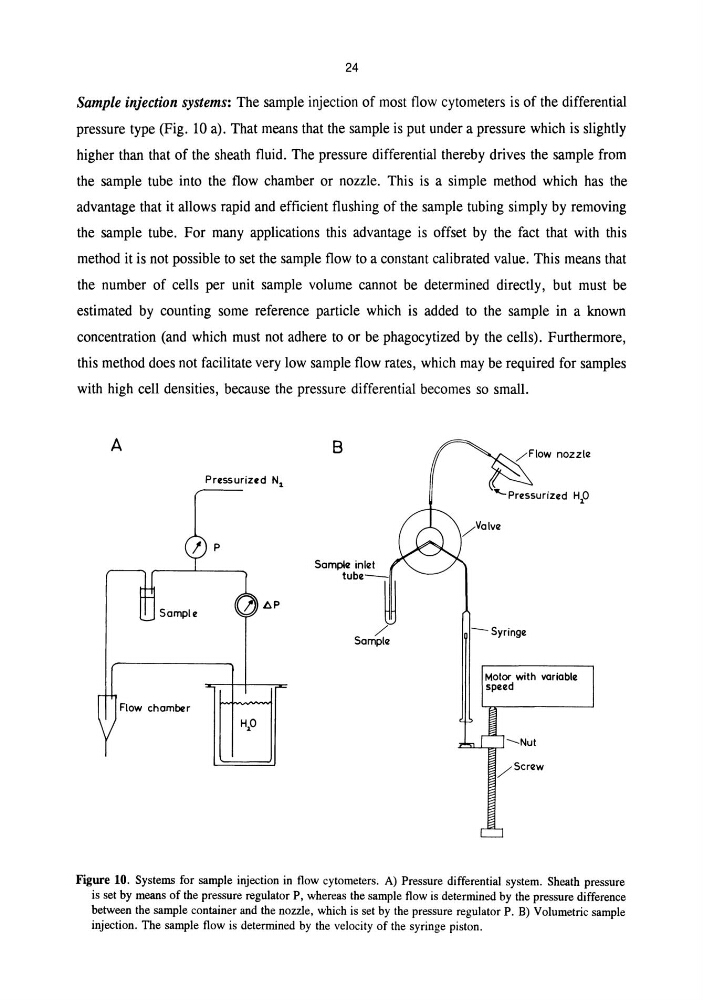
Sample injection systems: The sample injection of most flow cytometers is of the differential
pressure type (Fig. 10 a). That means that the sample is put under a pressure which is slightly
higher than that of the sheath fluid. The pressure differential thereby drives the sample from
the sample tube into the flow chamber or nozzle. This is a simple method which has the
advantage that it allows rapid and efficient flushing of the sample tubing simply by removing
the sample tube. For many applications this advantage is offset by the fact that with this
method it is not possible to set the sample flow to a constant calibrated value. This means that
the number of cells per unit sample volume cannot be determined directly, but must be
estimated by counting some reference particle which is added to the sample in a known
concentration (and which must not adhere to or be phagocytized by the cells). Furthermore,
this method does not facilitate very low sample flow rates, which may be required for samples
with high cell densities, because the pressure differential becomes so small.
A
Pressurized N1
Flow chamber
H,o
B
Sample inlet
tube/
Sample
-Syringe
=LJ.--,=-,---Nut
Figure 10. Systems for sample injection in flow cytometers. A) Pressure differential system. Sheath pressure
is set by means of the pressure regulator P, whereas the sample flow is determined by the pressure difference
between the sample container and the nozzle, which is set by the pressure regulator P. B) Volumetric sample
injection. The sample flow is determined by the velocity of the syringe piston.
Sample injection systems: The sample injection of most flow cytometers is of the differential
pressure type (Fig. 10 a). That means that the sample is put under a pressure which is slightly
higher than that of the sheath fluid. The pressure differential thereby drives the sample from
the sample tube into the flow chamber or nozzle. This is a simple method which has the
advantage that it allows rapid and efficient flushing of the sample tubing simply by removing
the sample tube. For many applications this advantage is offset by the fact that with this
method it is not possible to set the sample flow to a constant calibrated value. This means that
the number of cells per unit sample volume cannot be determined directly, but must be
estimated by counting some reference particle which is added to the sample in a known
concentration (and which must not adhere to or be phagocytized by the cells). Furthermore,
this method does not facilitate very low sample flow rates, which may be required for samples
with high cell densities, because the pressure differential becomes so small.
A
Pressurized N1
Flow chamber
H,o
B
Sample inlet
tube/
Sample
-Syringe
=LJ.--,=-,---Nut
Figure 10. Systems for sample injection in flow cytometers. A) Pressure differential system. Sheath pressure
is set by means of the pressure regulator P, whereas the sample flow is determined by the pressure difference
between the sample container and the nozzle, which is set by the pressure regulator P. B) Volumetric sample
injection. The sample flow is determined by the velocity of the syringe piston.