

23
in air flow cytometer is that in order to maintain a laminar jet, the flow velocity cannot be
reduced below a certain limit, i.e. a few m/s.
A closed flow chamber (Fig. 8b) with a rectangular cross section is much better in this regard
although it exhibits four reflecting surfaces, i.e. the air/glass and the glass/water interface on
each side of the flow. Such flow chambers are used with excitation and fluorescence detection
at perpendicular directions. Although sorting can be performed in instruments with closed
flow chambers, it needs more fine tuning and is less stable than with jet in air instruments.
Furthermore, closed flow chambers are cumbersome and time consuming to clean.
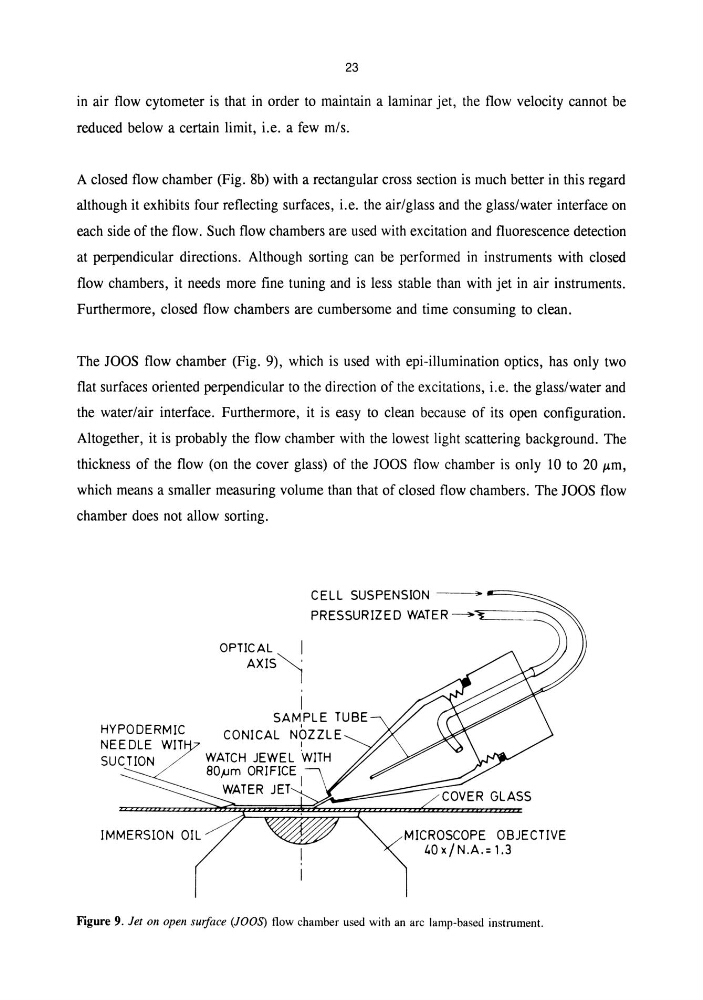
The JOOS flow chamber (Fig. 9), which is used with epi-illumination optics, has only two
flat surfaces oriented perpendicular to the direction of the excitations, i.e. the glass/water and
the water/air interface. Furthermore, it is easy to clean because of its open configuration.
Altogether, it is probably the flow chamber with the lowest light scattering background. The
thickness of the flow (on the cover glass) of the JOOS flow chamber is only 10 to 20 14m,
which means a smaller measuring volume than that of closed flow chambers. The JOOS flow
chamber does not allow sorting.
HYPODERMIC
NEEDLE WIT
SUCTION
IMMERSION OIL
CELL SUSPENSION ~-~ .c==:::::----.PRESSURIZED WATER-OPTICAL
I
AXIS~
I
SAMPLE TUBE
,
CONICAL NOZZLE
I
WATCH JEWEL 'WITH
80J-lm ORIFICE
WATER JET I
MICROSCOPE OBJECTIVE
t.Ox/N.A.: 1.3
Figure 9. Jet on open sUrface (lOOS) flow chamber used with an arc lamp-based instrument.
in air flow cytometer is that in order to maintain a laminar jet, the flow velocity cannot be
reduced below a certain limit, i.e. a few m/s.
A closed flow chamber (Fig. 8b) with a rectangular cross section is much better in this regard
although it exhibits four reflecting surfaces, i.e. the air/glass and the glass/water interface on
each side of the flow. Such flow chambers are used with excitation and fluorescence detection
at perpendicular directions. Although sorting can be performed in instruments with closed
flow chambers, it needs more fine tuning and is less stable than with jet in air instruments.
Furthermore, closed flow chambers are cumbersome and time consuming to clean.
The JOOS flow chamber (Fig. 9), which is used with epi-illumination optics, has only two
flat surfaces oriented perpendicular to the direction of the excitations, i.e. the glass/water and
the water/air interface. Furthermore, it is easy to clean because of its open configuration.
Altogether, it is probably the flow chamber with the lowest light scattering background. The
thickness of the flow (on the cover glass) of the JOOS flow chamber is only 10 to 20 14m,
which means a smaller measuring volume than that of closed flow chambers. The JOOS flow
chamber does not allow sorting.
HYPODERMIC
NEEDLE WIT
SUCTION
IMMERSION OIL
CELL SUSPENSION ~-~ .c==:::::----.PRESSURIZED WATER-OPTICAL
I
AXIS~
I
SAMPLE TUBE
,
CONICAL NOZZLE
I
WATCH JEWEL 'WITH
80J-lm ORIFICE
WATER JET I
MICROSCOPE OBJECTIVE
t.Ox/N.A.: 1.3
Figure 9. Jet on open sUrface (lOOS) flow chamber used with an arc lamp-based instrument.