

316
There have been various studies of the effects of calcium carbonate formation in the sea on
the level of CO 2 in the atmosphere over the timescales of the main geological cycles
(Chamberlin, 1898; Yolk, 1989) and of glacial-interglacial cycles (Berger, 1982; Dymond and
Lyle, 1985). All conclude that an increase in the ratio of carbonate-carbon to organic carbon
sedimentation will lead to an increase in atmospheric CO2, due to the assimilation of
bicarbonate:
Ca 2 + + 2HC0 3 - = CaC0 3 + CO 2 + H 2 0
The details of the mechanisms in terms of changes in the rates of exchange of C~ between
the atmosphere, surface ocean and deep ocean are uncertain, and for this reason, studies of
the effects of coccolithophore productivity on the state of the CO 2 system in surface ocean
waters are needed.
% coc0 3 (I)
Or-~IO~~20~~T-~~r-~~r-ro~_
/
20
40
100
10
I
,
\
\
It
/
\
\
A
I
I
I
,
A
I
I
I
I
I
I
/
/
2
3
4
5
6
10' FOtom,n,'.rO(9 d wi r' (A)
- - - '" IO.CXXl y.
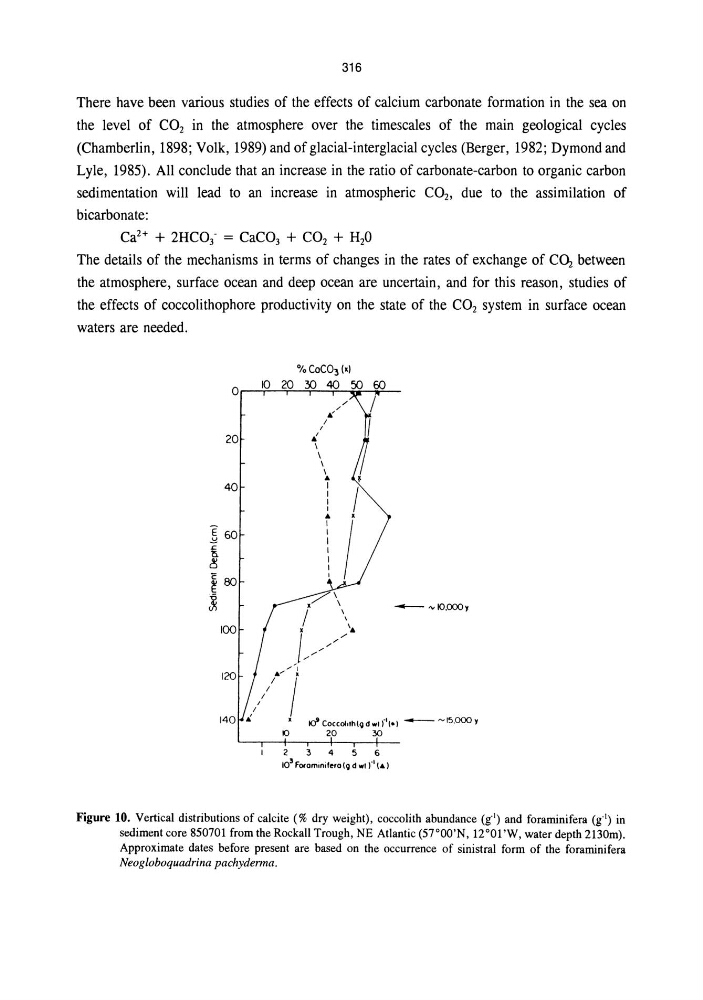
Figure 10. Vertical distributions of calcite (% dry weight), coccolith abundance (g"') and foraminifera (g.l) in
sediment core 850701 from the Rockall Trough, NE Atlantic (5rOO'N, 12°0I'W, water depth 2130m).
Approximate dates before present are based on the occurrence of sinistral form of the foraminifera
Neogloboquadrina pachyderma.
There have been various studies of the effects of calcium carbonate formation in the sea on
the level of CO 2 in the atmosphere over the timescales of the main geological cycles
(Chamberlin, 1898; Yolk, 1989) and of glacial-interglacial cycles (Berger, 1982; Dymond and
Lyle, 1985). All conclude that an increase in the ratio of carbonate-carbon to organic carbon
sedimentation will lead to an increase in atmospheric CO2, due to the assimilation of
bicarbonate:
Ca 2 + + 2HC0 3 - = CaC0 3 + CO 2 + H 2 0
The details of the mechanisms in terms of changes in the rates of exchange of C~ between
the atmosphere, surface ocean and deep ocean are uncertain, and for this reason, studies of
the effects of coccolithophore productivity on the state of the CO 2 system in surface ocean
waters are needed.
% coc0 3 (I)
Or-~IO~~20~~T-~~r-~~r-ro~_
/
20
40
100
10
I
,
\
\
It
/
\
\
A
I
I
I
,
A
I
I
I
I
I
I
/
/
2
3
4
5
6
10' FOtom,n,'.rO(9 d wi r' (A)
- - - '" IO.CXXl y.
Figure 10. Vertical distributions of calcite (% dry weight), coccolith abundance (g"') and foraminifera (g.l) in
sediment core 850701 from the Rockall Trough, NE Atlantic (5rOO'N, 12°0I'W, water depth 2130m).
Approximate dates before present are based on the occurrence of sinistral form of the foraminifera
Neogloboquadrina pachyderma.