

315
are known to be synthesised by this group of organisms (Brassell et al., 1986; Prahl et al.,
1989).
200
A
150
%
· ..
0
· .
E 100
. .
E
,.
11."
CJ)
::::ii
.
0
50
.
0
0
0.5
1.0
1.5
2.0
40
B
30
· .
..,
'E
.
0
.
20
. .
E
E
. .
CJ)
::::ii 10
0
0
0
0.5
1.0
1.5
2.0
Chlorophyll a
-3
mgm
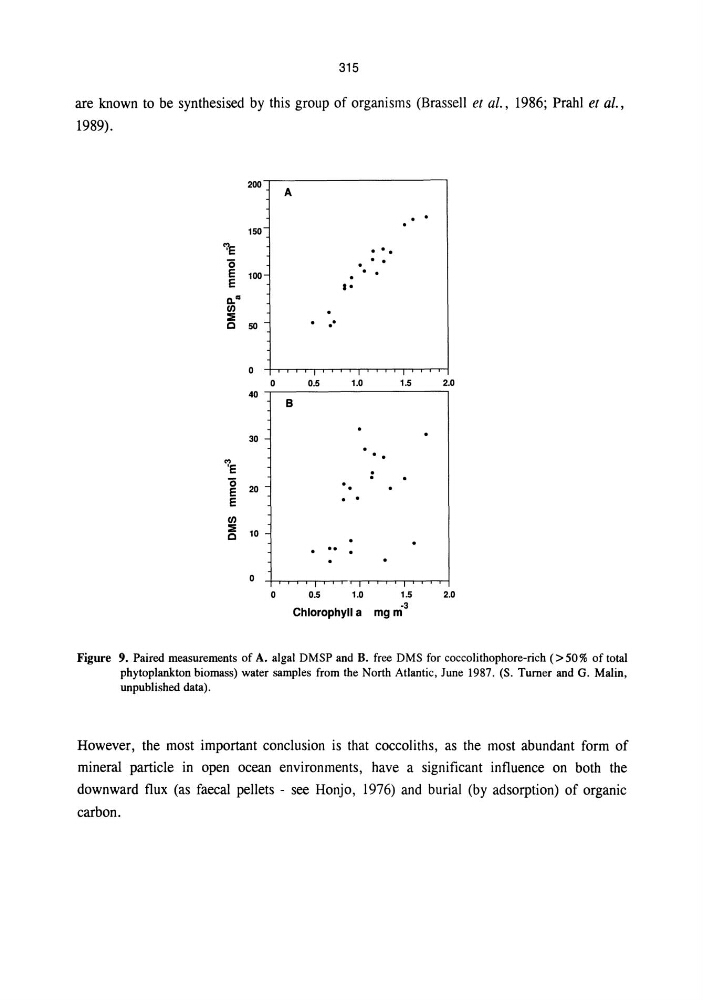
Figure 9. Paired measurements of A. algal DMSP and B. free DMS for coccolithophore-rich (>50% of total
phytoplankton biomass) water samples from the North Atlantic, June 1987. (S. Turner and G. Malin,
unpublished data).
However, the most important conclusion is that coccoliths, as the most abundant form of
mineral particle in open ocean environments, have a significant influence on both the
downward flux (as faecal pellets - see Honjo, 1976) and burial (by adsorption) of organic
carbon.
are known to be synthesised by this group of organisms (Brassell et al., 1986; Prahl et al.,
1989).
200
A
150
%
· ..
0
· .
E 100
. .
E
,.
11."
CJ)
::::ii
.
0
50
.
0
0
0.5
1.0
1.5
2.0
40
B
30
· .
..,
'E
.
0
.
20
. .
E
E
. .
CJ)
::::ii 10
0
0
0
0.5
1.0
1.5
2.0
Chlorophyll a
-3
mgm
Figure 9. Paired measurements of A. algal DMSP and B. free DMS for coccolithophore-rich (>50% of total
phytoplankton biomass) water samples from the North Atlantic, June 1987. (S. Turner and G. Malin,
unpublished data).
However, the most important conclusion is that coccoliths, as the most abundant form of
mineral particle in open ocean environments, have a significant influence on both the
downward flux (as faecal pellets - see Honjo, 1976) and burial (by adsorption) of organic
carbon.