

7
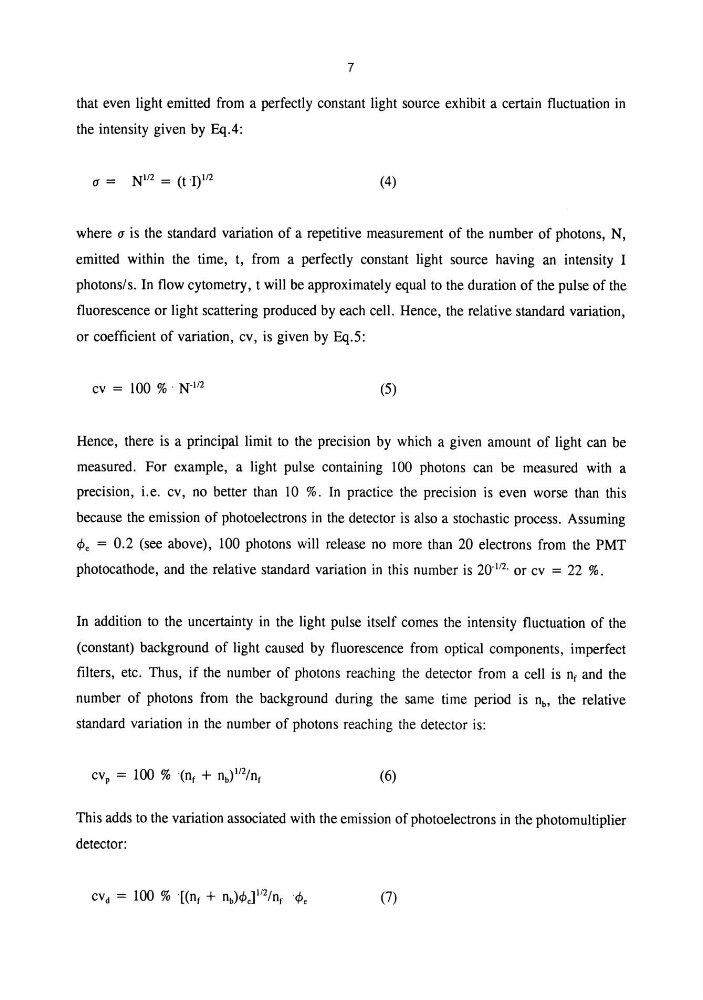
that even light emitted from a perfectly constant light source exhibit a certain fluctuation in
the intensity given by Eq.4:
(4)
where (f is the standard variation of a repetitive measurement of the number of photons, N,
emitted within the time, t, from a perfectly constant light source having an intensity I
photons/so In flow cytometry, t will be approximately equal to the duration of the pulse of the
fluorescence or light scattering produced by each cell. Hence, the relative standard variation,
or coefficient of variation, cv, is given by Eq.5:
cv = 100 % . N-" 2
(5)
Hence, there is a principal limit to the precision by which a given amount of light can be
measured. For example, a light pulse containing 100 photons can be measured with a
precision, i.e. cv, no better than 10 %. In practice the precision is even worse than this
because the emission of photoelectrons in the detector is also a stochastic process. Assuming
tPe = 0.2 (see above), 100 photons will release no more than 20 electrons from the PMT
photocathode, and the relative standard variation in this number is 20- 112 , or cv = 22 %.
In addition to the uncertainty in the light pulse itself comes the intensity fluctuation of the
(constant) background of light caused by fluorescence from optical components, imperfect
filters, etc. Thus, if the number of photons reaching the detector from a cell is n f and the
number of photons from the background during the same time period is n b , the relative
standard variation in the number of photons reaching the detector is:
(6)
This adds to the variation associated with the emission of photoelectrons in the photomultiplier
detector:
(7)
that even light emitted from a perfectly constant light source exhibit a certain fluctuation in
the intensity given by Eq.4:
(4)
where (f is the standard variation of a repetitive measurement of the number of photons, N,
emitted within the time, t, from a perfectly constant light source having an intensity I
photons/so In flow cytometry, t will be approximately equal to the duration of the pulse of the
fluorescence or light scattering produced by each cell. Hence, the relative standard variation,
or coefficient of variation, cv, is given by Eq.5:
cv = 100 % . N-" 2
(5)
Hence, there is a principal limit to the precision by which a given amount of light can be
measured. For example, a light pulse containing 100 photons can be measured with a
precision, i.e. cv, no better than 10 %. In practice the precision is even worse than this
because the emission of photoelectrons in the detector is also a stochastic process. Assuming
tPe = 0.2 (see above), 100 photons will release no more than 20 electrons from the PMT
photocathode, and the relative standard variation in this number is 20- 112 , or cv = 22 %.
In addition to the uncertainty in the light pulse itself comes the intensity fluctuation of the
(constant) background of light caused by fluorescence from optical components, imperfect
filters, etc. Thus, if the number of photons reaching the detector from a cell is n f and the
number of photons from the background during the same time period is n b , the relative
standard variation in the number of photons reaching the detector is:
(6)
This adds to the variation associated with the emission of photoelectrons in the photomultiplier
detector:
(7)