

173
10
- 4
" "'I
, , ,
(B)
,
§
-I
10
a tot
(440)
(415)
-2
10
- 2
-I
0
10
10
10
10
rng rn 3
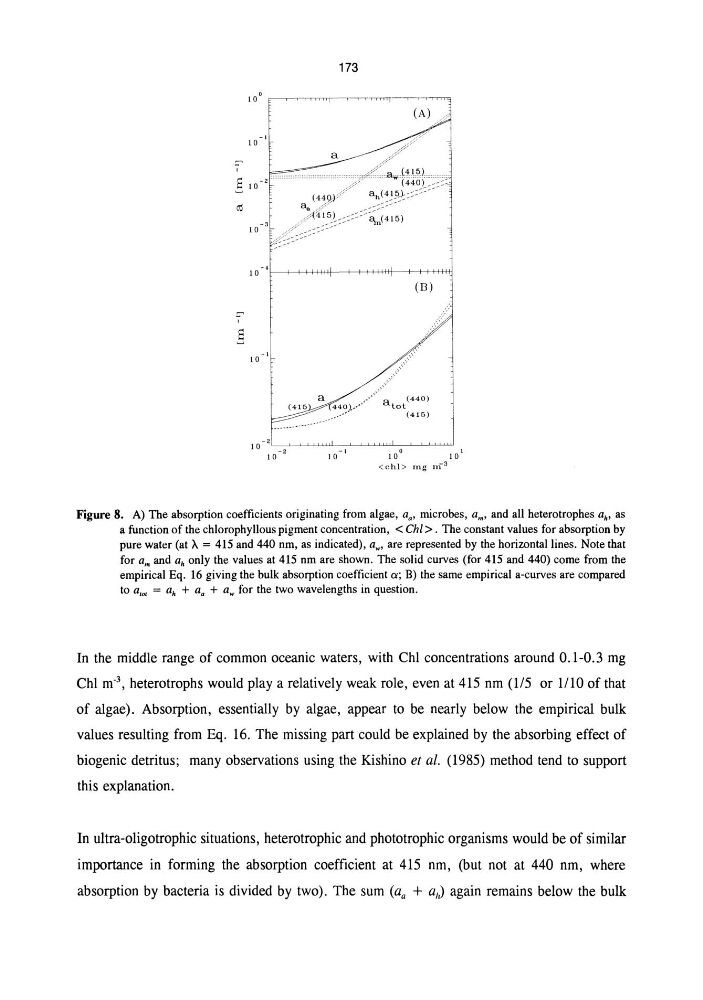
Figure 8. A) The absorption coefficients originating from algae, aQ' microbes, am' and all heterotrophes ah, as
a function of the chlorophyllous pigment concentration, < Chi>. The constant values for absorption by
pure water (at A = 415 and 440 nm, as indicated), aw , are represented by the horizontal lines. Note that
for am and a h only the values at 415 nm are shown. The solid curves (for 415 and 440) come from the
empirical Eq. 16 giving the bulk absorption coefficient a; B) the same empirical a-curves are compared
to a,a, = a h + aQ + aw for the two wavelengths in question.
In the middle range of common oceanic waters, with ChI concentrations around 0.1-0.3 mg
ChI m- 3 , heterotrophs would playa relatively weak role, even at 415 nm (1/5 or 1110 of that
of algae). Absorption, essentially by algae, appear to be nearly below the empirical bulk
values resulting from Eq. 16. The missing part could be explained by the absorbing effect of
biogenic detritus; many observations using the Kishino et al. (1985) method tend to support
this explanation.
In ultra-oligotrophic situations, heterotrophic and phototrophic organisms would be of similar
importance in forming the absorption coefficient at 415 nm, (but not at 440 nm, where
absorption by bacteria is divided by two). The sum (aa + a,,) again remains below the bulk
10
- 4
" "'I
, , ,
(B)
,
§
-I
10
a tot
(440)
(415)
-2
10
- 2
-I
0
10
10
10
10
Figure 8. A) The absorption coefficients originating from algae, aQ' microbes, am' and all heterotrophes ah, as
a function of the chlorophyllous pigment concentration, < Chi>. The constant values for absorption by
pure water (at A = 415 and 440 nm, as indicated), aw , are represented by the horizontal lines. Note that
for am and a h only the values at 415 nm are shown. The solid curves (for 415 and 440) come from the
empirical Eq. 16 giving the bulk absorption coefficient a; B) the same empirical a-curves are compared
to a,a, = a h + aQ + aw for the two wavelengths in question.
In the middle range of common oceanic waters, with ChI concentrations around 0.1-0.3 mg
ChI m- 3 , heterotrophs would playa relatively weak role, even at 415 nm (1/5 or 1110 of that
of algae). Absorption, essentially by algae, appear to be nearly below the empirical bulk
values resulting from Eq. 16. The missing part could be explained by the absorbing effect of
biogenic detritus; many observations using the Kishino et al. (1985) method tend to support
this explanation.
In ultra-oligotrophic situations, heterotrophic and phototrophic organisms would be of similar
importance in forming the absorption coefficient at 415 nm, (but not at 440 nm, where
absorption by bacteria is divided by two). The sum (aa + a,,) again remains below the bulk