

172
also phototrophic organisms with comparable biomasses (see discussion in Beers et al., 1982).
With this reservation in mind, the absorption coefficient for the bacterial compartment alone
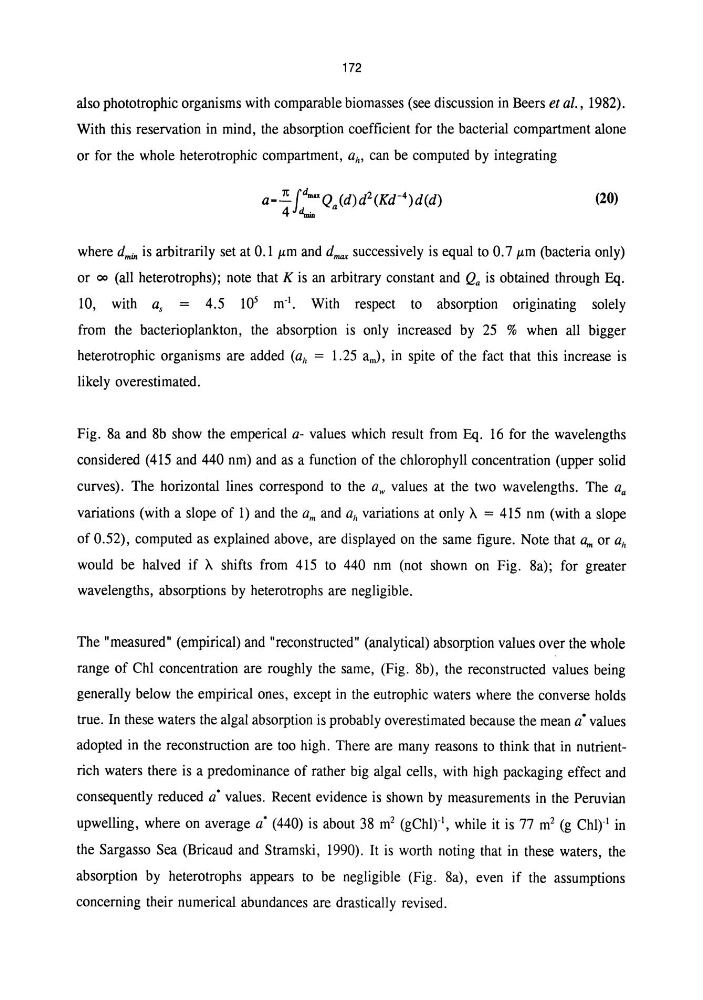
or for the whole heterotrophic compartment, a h , can be computed by integrating
(20)
where d min is arbitrarily set at 0.1 J.tm and d max successively is equal to 0.7 J.tm (bacteria only)
or 00 (all heterotrophs); note that K is an arbitrary constant and Qa is obtained through Eq.
10, with as = 4.5 HP m-l. With respect to absorption originating solely
from the bacterioplankton, the absorption is only increased by 25 % when all bigger
heterotrophic organisms are added (a h = 1.25 am>, in spite of the fact that this increase is
likely overestimated.
Fig. 8a and 8b show the emperical a- values which result from Eq. 16 for the wavelengths
considered (415 and 440 nm) and as a function of the chlorophyll concentration (upper solid
curves). The horizontal lines correspond to the a w values at the two wavelengths. The aa
variations (with a slope of 1) and the am and a h variations at only A. = 415 nm (with a slope
of 0.52), computed as explained above, are displayed on the same figure. Note that Om or a h
would be halved if A. shifts from 415 to 440 nm (not shown on Fig. 8a); for greater
wavelengths, absorptions by heterotrophs are negligible.
The "measured" (empirical) and "reconstructed" (analytical) absorption values over the whole
range of ChI concentration are roughly the same, (Fig. 8b), the reconstructed values being
generally below the empirical ones, except in the eutrophic waters where the converse holds
true. In these waters the algal absorption is probably overestimated because the mean aO values
adopted in the reconstruction are too high. There are many reasons to think that in nutrientrich waters there is a predominance of rather big algal cells, with high packaging effect and
consequently reduced a ° values. Recent evidence is shown by measurements in the Peruvian
upwelling, where on average aO (440) is about 38 m 2 (gChl),l, while it is 77 m 2 (g Chl)'l in
the Sargasso Sea (Bricaud and Stramski, 1990). It is worth noting that in these waters, the
absorption by heterotrophs appears to be negligible (Fig. 8a), even if the assumptions
concerning their numerical abundances are drastically revised.
also phototrophic organisms with comparable biomasses (see discussion in Beers et al., 1982).
With this reservation in mind, the absorption coefficient for the bacterial compartment alone
or for the whole heterotrophic compartment, a h , can be computed by integrating
(20)
where d min is arbitrarily set at 0.1 J.tm and d max successively is equal to 0.7 J.tm (bacteria only)
or 00 (all heterotrophs); note that K is an arbitrary constant and Qa is obtained through Eq.
10, with as = 4.5 HP m-l. With respect to absorption originating solely
from the bacterioplankton, the absorption is only increased by 25 % when all bigger
heterotrophic organisms are added (a h = 1.25 am>, in spite of the fact that this increase is
likely overestimated.
Fig. 8a and 8b show the emperical a- values which result from Eq. 16 for the wavelengths
considered (415 and 440 nm) and as a function of the chlorophyll concentration (upper solid
curves). The horizontal lines correspond to the a w values at the two wavelengths. The aa
variations (with a slope of 1) and the am and a h variations at only A. = 415 nm (with a slope
of 0.52), computed as explained above, are displayed on the same figure. Note that Om or a h
would be halved if A. shifts from 415 to 440 nm (not shown on Fig. 8a); for greater
wavelengths, absorptions by heterotrophs are negligible.
The "measured" (empirical) and "reconstructed" (analytical) absorption values over the whole
range of ChI concentration are roughly the same, (Fig. 8b), the reconstructed values being
generally below the empirical ones, except in the eutrophic waters where the converse holds
true. In these waters the algal absorption is probably overestimated because the mean aO values
adopted in the reconstruction are too high. There are many reasons to think that in nutrientrich waters there is a predominance of rather big algal cells, with high packaging effect and
consequently reduced a ° values. Recent evidence is shown by measurements in the Peruvian
upwelling, where on average aO (440) is about 38 m 2 (gChl),l, while it is 77 m 2 (g Chl)'l in
the Sargasso Sea (Bricaud and Stramski, 1990). It is worth noting that in these waters, the
absorption by heterotrophs appears to be negligible (Fig. 8a), even if the assumptions
concerning their numerical abundances are drastically revised.