

170
It is worth recalling that a(A) is similar to, but differs from, K(A); nevertheless the general
spectral trends exhibited by both these coefficients are essentially the same.
Yellow substance absorption (possibly filterable particle absorption) appears as a
complementary term in Eq. 16. It partly compensates for the implicit ignorance of the detrital
contribution, since it intervenes as a multiplied "correction", applied even on the pure water
absorption a w (becoming a dominant term at low C concentration). With the steep absorption
increase toward the short wavelengths (as implied by Eq. 17), this corrective term actually
modifies the shape of the global a(A) spectrum.
Agreement between analytical and empirical approaches
In order to comparing these approaches, the absorption values to be attributed to each
component in Eq. 14 have to be specified. This is possible for algae and for heterotrophic
protists. The sum of both these contributions has to be at least compatible with the empirical
expression (Eq. 16, 17). The differences could be tentatively interpreted as the effect of the
ignored compartment (detritus and other unidentified substances).
The chlorophyll-specific absorption spectrum for living algae is computed as being the average
of 14 spectra determined for algae grown in culture (Morel, 1988; see also discussion in
Bricaud, 1989). Two particular a' values, 40 and 45 m 2 (g Chi ayl for A = 415 and 440 nm,
respectively, are selected and aa at these wavelengths will be linearly related to the chlorophyll
concentration according to Eq. 15 (see Fig. 8a).
The heterotrophic organisms are weakly but significantly absorbing at A = 415 nm. Among
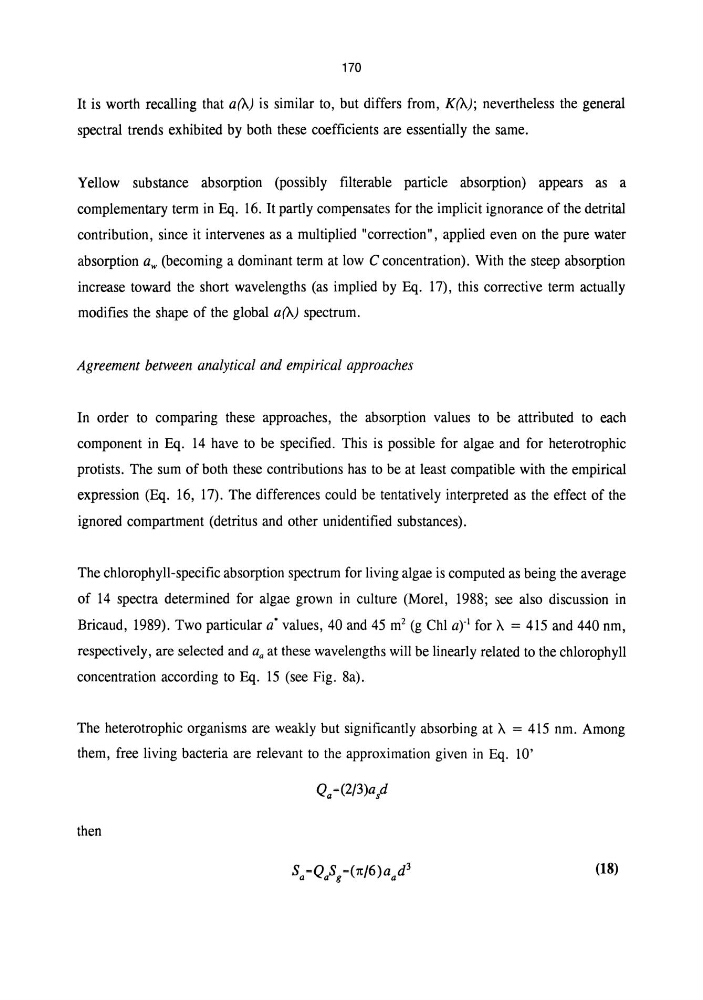
them, free living bacteria are relevant to the approximation given in Eq. 10'
then
(18)
It is worth recalling that a(A) is similar to, but differs from, K(A); nevertheless the general
spectral trends exhibited by both these coefficients are essentially the same.
Yellow substance absorption (possibly filterable particle absorption) appears as a
complementary term in Eq. 16. It partly compensates for the implicit ignorance of the detrital
contribution, since it intervenes as a multiplied "correction", applied even on the pure water
absorption a w (becoming a dominant term at low C concentration). With the steep absorption
increase toward the short wavelengths (as implied by Eq. 17), this corrective term actually
modifies the shape of the global a(A) spectrum.
Agreement between analytical and empirical approaches
In order to comparing these approaches, the absorption values to be attributed to each
component in Eq. 14 have to be specified. This is possible for algae and for heterotrophic
protists. The sum of both these contributions has to be at least compatible with the empirical
expression (Eq. 16, 17). The differences could be tentatively interpreted as the effect of the
ignored compartment (detritus and other unidentified substances).
The chlorophyll-specific absorption spectrum for living algae is computed as being the average
of 14 spectra determined for algae grown in culture (Morel, 1988; see also discussion in
Bricaud, 1989). Two particular a' values, 40 and 45 m 2 (g Chi ayl for A = 415 and 440 nm,
respectively, are selected and aa at these wavelengths will be linearly related to the chlorophyll
concentration according to Eq. 15 (see Fig. 8a).
The heterotrophic organisms are weakly but significantly absorbing at A = 415 nm. Among
them, free living bacteria are relevant to the approximation given in Eq. 10'
then
(18)