

169
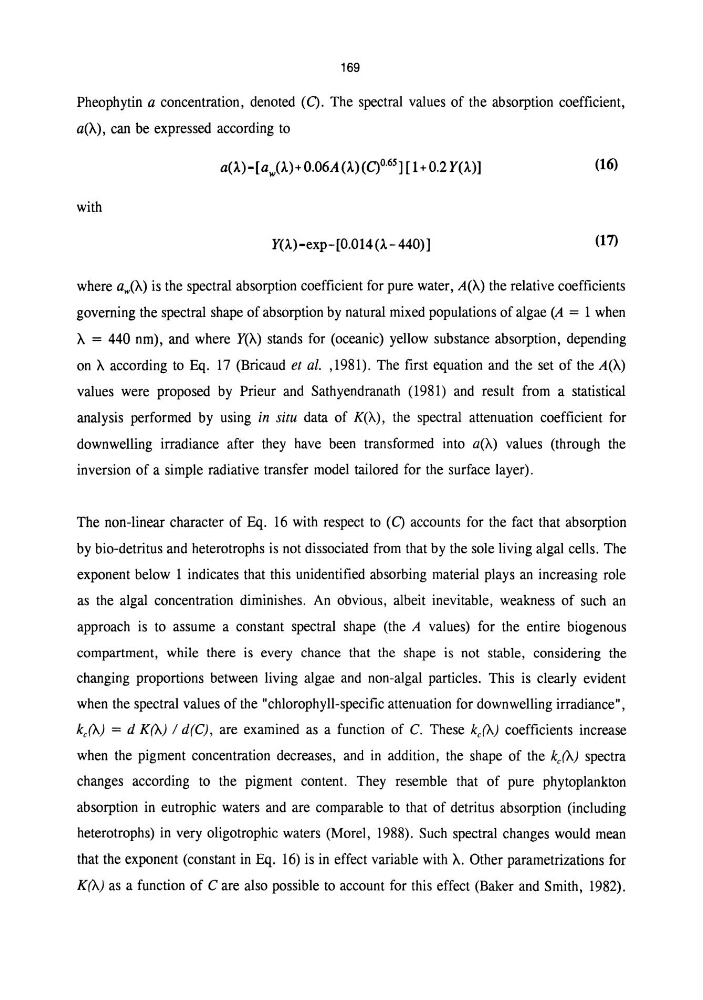
Pheophytin a concentration, denoted (C). The spectral values of the absorption coefficient,
a(A), can be expressed according to
a(A)-[aw(A)+ 0.06A (A) (C)0.65] [1 + 0.2 yeA)]
(16)
with
Y(A)-exp-[0.014(A- 440)]
(17)
where aw(A) is the spectral absorption coefficient for pure water, A(A) the relative coefficients
governing the spectral shape of absorption by natural mixed populations of algae (A = 1 when
A = 440 nm), and where yeA) stands for (oceanic) yellow substance absorption, depending
on A according to Eq. 17 (Bricaud et al. ,1981). The first equation and the set of the A(A)
values were proposed by Prieur and Sathyendranath (1981) and result from a statistical
analysis performed by using in situ data of K(A) , the spectral attenuation coefficient for
downwelling irradiance after they have been transformed into a(A) values (through the
inversion of a simple radiative transfer model tailored for the surface layer).
The non-linear character of Eq. 16 with respect to (C) accounts for the fact that absorption
by bio-detritus and heterotrophs is not dissociated from that by the sole living algal cells. The
exponent below 1 indicates that this unidentified absorbing material plays an increasing role
as the algal concentration diminishes. An obvious, albeit inevitable, weakness of such an
approach is to assume a constant spectral shape (the A values) for the entire biogenous
compartment, while there is every chance that the shape is not stable, considering the
changing proportions between living algae and non-algal particles. This is clearly evident
when the spectral values of the "chlorophyll-specific attenuation for downwelling irradiance",
kJI-.) = d K(A) / d(C) , are examined as a function of C. These kc(A) coefficients increase
when the pigment concentration decreases, and in addition, the shape of the kc(A) spectra
changes according to the pigment content. They resemble that of pure phytoplankton
absorption in eutrophic waters and are comparable to that of detritus absorption (including
heterotrophs) in very oligotrophic waters (Morel, 1988). Such spectral changes would mean
that the exponent (constant in Eq. 16) is in effect variable with A. Other parametrizations for
K(A) as a function of C are also possible to account for this effect (Baker and Smith, 1982).
Pheophytin a concentration, denoted (C). The spectral values of the absorption coefficient,
a(A), can be expressed according to
a(A)-[aw(A)+ 0.06A (A) (C)0.65] [1 + 0.2 yeA)]
(16)
with
Y(A)-exp-[0.014(A- 440)]
(17)
where aw(A) is the spectral absorption coefficient for pure water, A(A) the relative coefficients
governing the spectral shape of absorption by natural mixed populations of algae (A = 1 when
A = 440 nm), and where yeA) stands for (oceanic) yellow substance absorption, depending
on A according to Eq. 17 (Bricaud et al. ,1981). The first equation and the set of the A(A)
values were proposed by Prieur and Sathyendranath (1981) and result from a statistical
analysis performed by using in situ data of K(A) , the spectral attenuation coefficient for
downwelling irradiance after they have been transformed into a(A) values (through the
inversion of a simple radiative transfer model tailored for the surface layer).
The non-linear character of Eq. 16 with respect to (C) accounts for the fact that absorption
by bio-detritus and heterotrophs is not dissociated from that by the sole living algal cells. The
exponent below 1 indicates that this unidentified absorbing material plays an increasing role
as the algal concentration diminishes. An obvious, albeit inevitable, weakness of such an
approach is to assume a constant spectral shape (the A values) for the entire biogenous
compartment, while there is every chance that the shape is not stable, considering the
changing proportions between living algae and non-algal particles. This is clearly evident
when the spectral values of the "chlorophyll-specific attenuation for downwelling irradiance",
kJI-.) = d K(A) / d(C) , are examined as a function of C. These kc(A) coefficients increase
when the pigment concentration decreases, and in addition, the shape of the kc(A) spectra
changes according to the pigment content. They resemble that of pure phytoplankton
absorption in eutrophic waters and are comparable to that of detritus absorption (including
heterotrophs) in very oligotrophic waters (Morel, 1988). Such spectral changes would mean
that the exponent (constant in Eq. 16) is in effect variable with A. Other parametrizations for
K(A) as a function of C are also possible to account for this effect (Baker and Smith, 1982).