

155
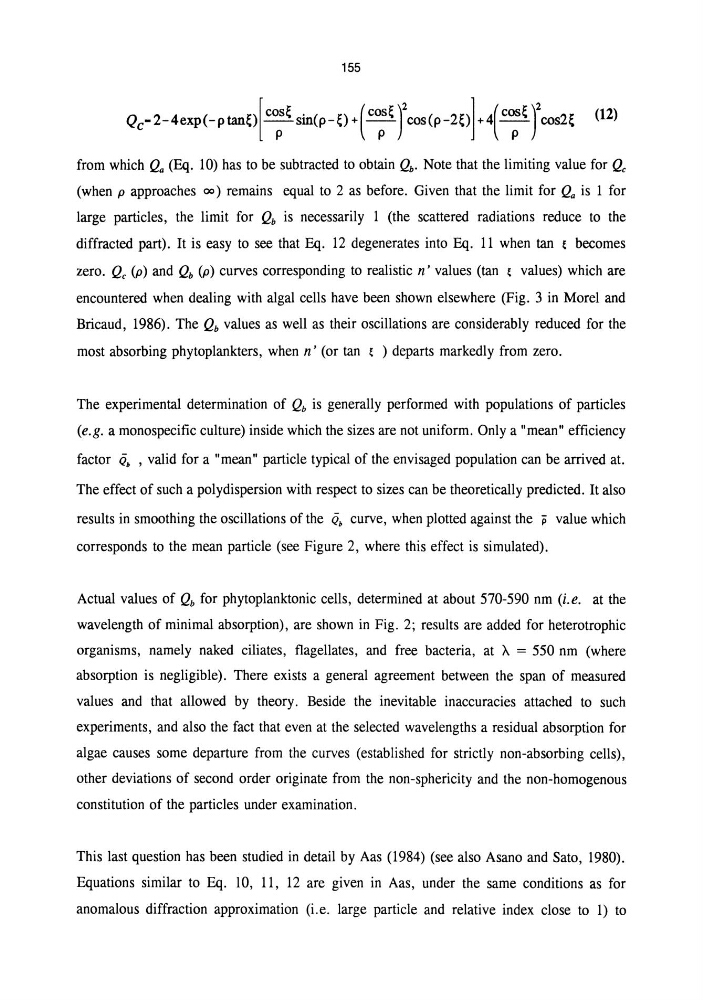
Qc- 2-4exp( -Ptan~)[ co:~ sin(p-~) +( co:~ rCOS(p -2~)l +4( c~~ rCOS2~ (12)
from which Qa (Eq. 10) has to be subtracted to obtain Qb' Note that the limiting value for Qc
(when p approaches (0) remains equal to 2 as before. Given that the limit for Qa is 1 for
large particles, the limit for Qb is necessarily 1 (the scattered radiations reduce to the
diffracted part). It is easy to see that Eq. 12 degenerates into Eq. 11 when tan ~ becomes
zero. Qc (P) and Qb (p) curves corresponding to realistic n' values (tan ~ values) which are
encountered when dealing with algal cells have been shown elsewhere (Fig. 3 in Morel and
Bricaud, 1986). The Qb values as well as their oscillations are considerably reduced for the
most absorbing phytoplankters, when n' (or tan ~ ) departs markedly from zero.
The experimental determination of Qb is generally performed with populations of particles
(e.g. a mono specific culture) inside which the sizes are not uniform. Only a "mean" efficiency
factor Q, ,valid for a "mean" particle typical of the envisaged popUlation can be arrived at.
The effect of such a polydispersion with respect to sizes can be theoretically predicted. It also
results in smoothing the oscillations of the Q, curve, when plotted against the p value which
corresponds to the mean particle (see Figure 2, where this effect is simulated).
Actual values of Qb for phytoplanktonic cells, determined at about 570-590 nm (i.e. at the
wavelength of minimal absorption), are shown in Fig. 2; results are added for heterotrophic
organisms, namely naked ciliates, flagellates, and free bacteria, at A = 550 nm (where
absorption is negligible). There exists a general agreement between the span of measured
values and that allowed by theory. Beside the inevitable inaccuracies attached to such
experiments, and also the fact that even at the selected wavelengths a residual absorption for
algae causes some departure from the curves (established for strictly non-absorbing cells),
other deviations of second order originate from the non-sphericity and the non-homogenous
constitution of the particles under examination.
This last question has been studied in detail by Aas (1984) (see also Asano and Sato, 1980).
Equations similar to Eq. 10, 11, 12 are given in Aas, under the same conditions as for
anomalous diffraction approximation (i.e. large particle and relative index close to 1) to
Qc- 2-4exp( -Ptan~)[ co:~ sin(p-~) +( co:~ rCOS(p -2~)l +4( c~~ rCOS2~ (12)
from which Qa (Eq. 10) has to be subtracted to obtain Qb' Note that the limiting value for Qc
(when p approaches (0) remains equal to 2 as before. Given that the limit for Qa is 1 for
large particles, the limit for Qb is necessarily 1 (the scattered radiations reduce to the
diffracted part). It is easy to see that Eq. 12 degenerates into Eq. 11 when tan ~ becomes
zero. Qc (P) and Qb (p) curves corresponding to realistic n' values (tan ~ values) which are
encountered when dealing with algal cells have been shown elsewhere (Fig. 3 in Morel and
Bricaud, 1986). The Qb values as well as their oscillations are considerably reduced for the
most absorbing phytoplankters, when n' (or tan ~ ) departs markedly from zero.
The experimental determination of Qb is generally performed with populations of particles
(e.g. a mono specific culture) inside which the sizes are not uniform. Only a "mean" efficiency
factor Q, ,valid for a "mean" particle typical of the envisaged popUlation can be arrived at.
The effect of such a polydispersion with respect to sizes can be theoretically predicted. It also
results in smoothing the oscillations of the Q, curve, when plotted against the p value which
corresponds to the mean particle (see Figure 2, where this effect is simulated).
Actual values of Qb for phytoplanktonic cells, determined at about 570-590 nm (i.e. at the
wavelength of minimal absorption), are shown in Fig. 2; results are added for heterotrophic
organisms, namely naked ciliates, flagellates, and free bacteria, at A = 550 nm (where
absorption is negligible). There exists a general agreement between the span of measured
values and that allowed by theory. Beside the inevitable inaccuracies attached to such
experiments, and also the fact that even at the selected wavelengths a residual absorption for
algae causes some departure from the curves (established for strictly non-absorbing cells),
other deviations of second order originate from the non-sphericity and the non-homogenous
constitution of the particles under examination.
This last question has been studied in detail by Aas (1984) (see also Asano and Sato, 1980).
Equations similar to Eq. 10, 11, 12 are given in Aas, under the same conditions as for
anomalous diffraction approximation (i.e. large particle and relative index close to 1) to