

115
zeaxanthin (xanthophyll cycle) in higher plant chloroplasts (Demmig-Adams, 1990). A similar
cycling of carotenoids between diadinoxanthin and diatoxanthin has been identified in some
chromophyte algae (Stransky and Hager, 1970), although there have been no quantitative
reports correlating the changes in carotenoid composition with fluorescence quenching. The
smaller component(s) is independent of the xanthophyll cycle, saturates at low light intensity
and may involve quenching in the PS II antenna or reaction center. The reaction(s) that
accounts for this quenching of excited states must compete with the fast (efficient) transfer
of excitations between neighboring antenna pigments. Under these conditions, collisional
interactions between antenna chIs and quenching molecules (xanthophylls or otherwise) within
the antenna pigment-protein complexes are too slow to compete effectively with the fast (0.25 x 10- 12 s) excitation transfer reactions. Thus, quenching must be of the static type
(Lakowicz, 1986), in which the antenna chI and the quencher are bound in a complex at the
time the excitation arrives at the chI. The actual mechanism of excited-state quenching by
carotenoids remains under investigation (Demmig-Adams, 1990).
The term "fluorescence quenching" is in some ways misleading because the physiological
processes that result in changes in the fluorescence yield do not in fact have any direct effect
on lcr, the rate constant for fluorescence decay. Rather, those processes that are quantified in
measurements of ' 11' and 'IN affect the rate constants of processes that compete with
fluorescence for excited states in PS II. Equation 6 shows that the fluorescence yield
decreases ('11' increases) with increases in the fraction of reaction centers in which
photochemistry (kp) competes with lcr, k.J and ~ for excited states in the antenna. Similarly,
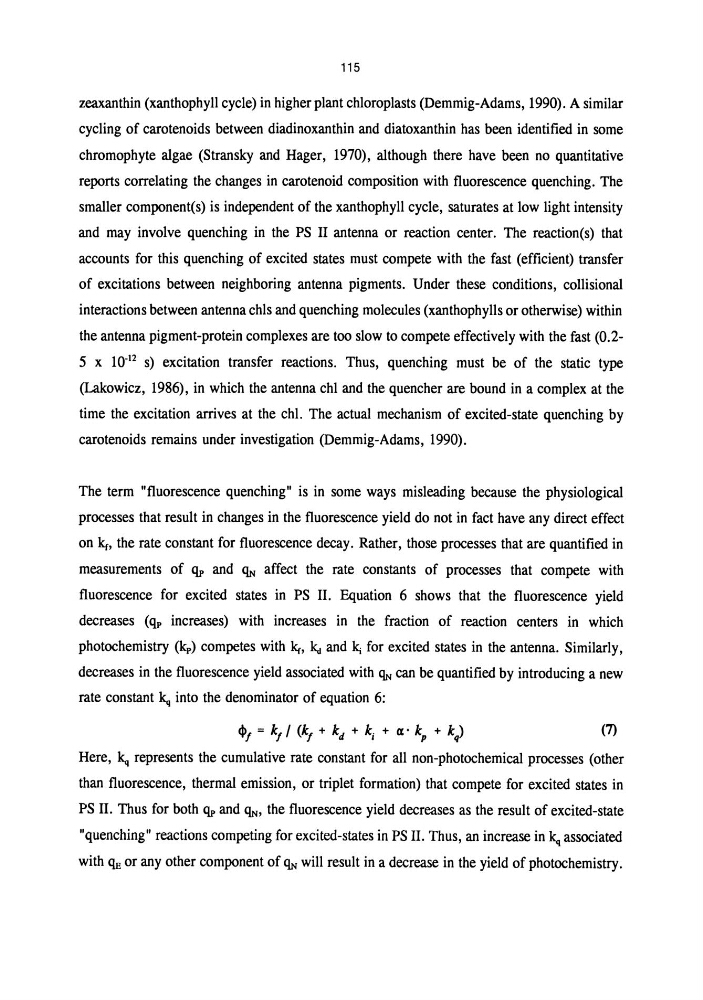
decreases in the fluorescence yield associated with 'IN can be quantified by introducing a new
rate constant kq into the denominator of equation 6:
(7)
Here, kq represents the cumulative rate constant for all non-photochemical processes (other
than fluorescence, thermal emission, or triplet formation) that compete for excited states in
PS II. Thus for both ' 11' and 'IN, the fluorescence yield decreases as the result of excited-state
"quenching" reactions competing for excited-states in PS II. Thus, an increase in kq associated
with ern or any other component of 'IN will result in a decrease in the yield of photochemistry.
zeaxanthin (xanthophyll cycle) in higher plant chloroplasts (Demmig-Adams, 1990). A similar
cycling of carotenoids between diadinoxanthin and diatoxanthin has been identified in some
chromophyte algae (Stransky and Hager, 1970), although there have been no quantitative
reports correlating the changes in carotenoid composition with fluorescence quenching. The
smaller component(s) is independent of the xanthophyll cycle, saturates at low light intensity
and may involve quenching in the PS II antenna or reaction center. The reaction(s) that
accounts for this quenching of excited states must compete with the fast (efficient) transfer
of excitations between neighboring antenna pigments. Under these conditions, collisional
interactions between antenna chIs and quenching molecules (xanthophylls or otherwise) within
the antenna pigment-protein complexes are too slow to compete effectively with the fast (0.25 x 10- 12 s) excitation transfer reactions. Thus, quenching must be of the static type
(Lakowicz, 1986), in which the antenna chI and the quencher are bound in a complex at the
time the excitation arrives at the chI. The actual mechanism of excited-state quenching by
carotenoids remains under investigation (Demmig-Adams, 1990).
The term "fluorescence quenching" is in some ways misleading because the physiological
processes that result in changes in the fluorescence yield do not in fact have any direct effect
on lcr, the rate constant for fluorescence decay. Rather, those processes that are quantified in
measurements of ' 11' and 'IN affect the rate constants of processes that compete with
fluorescence for excited states in PS II. Equation 6 shows that the fluorescence yield
decreases ('11' increases) with increases in the fraction of reaction centers in which
photochemistry (kp) competes with lcr, k.J and ~ for excited states in the antenna. Similarly,
decreases in the fluorescence yield associated with 'IN can be quantified by introducing a new
rate constant kq into the denominator of equation 6:
(7)
Here, kq represents the cumulative rate constant for all non-photochemical processes (other
than fluorescence, thermal emission, or triplet formation) that compete for excited states in
PS II. Thus for both ' 11' and 'IN, the fluorescence yield decreases as the result of excited-state
"quenching" reactions competing for excited-states in PS II. Thus, an increase in kq associated
with ern or any other component of 'IN will result in a decrease in the yield of photochemistry.