

104
The first excited state of chI is metastable, and will rapidly « 5 X 10- 9 s) decay back to the
ground state by one of several competing processes. For "isolated" chI molecules in a dilute
solution, the most important decay processes are fluorescence, thermal emission and decay
via triplet excited states (Figure 2). Fluorescence is a radiative decay process in which the
energy difference between the first excited state and the ground state is lost through emission
of a visible photon; the wavelength of the photon is again determined by the energy gap
between the initial and final states. In thermal decay (also called non-radiative decay) the
energy of the excited state is dissipated through vibrational modes of the chI without emission
of a visible photon. Decay via triplet excited states involves additional changes in the
characteristics (electron spin) of the pigment. For a chI molecule in dilute solution, the
relative yields of fluorescence, triplet formation and thermal decay are approximately 0.3,
0.65 and 0.05, respectively.
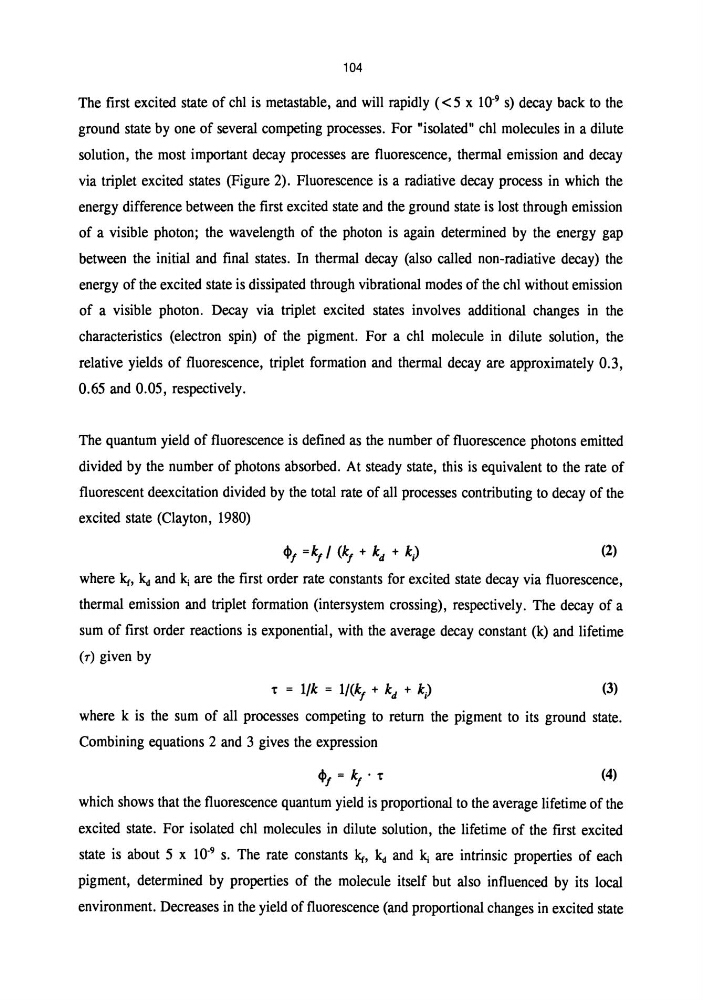
The quantum yield of fluorescence is defined as the number of fluorescence photons emitted
divided by the number of photons absorbed. At steady state, this is equivalent to the rate of
fluorescent deexcitation divided by the total rate of all processes contributing to decay of the
excited state (Clayton, 1980)
(2)
where kr, ~ and Ie; are the first order rate constants for excited state decay via fluorescence,
thermal emission and triplet formation (intersystem crossing), respectively. The decay of a
sum of first order reactions is exponential, with the average decay constant (k) and lifetime
(7) given by
(3)
where k is the sum of all processes competing to return the pigment to its ground state.
Combining equations 2 and 3 gives the expression
(4)
which shows that the fluorescence quantum yield is proportional to the average lifetime of the
excited state. For isolated chI molecules in dilute solution, the lifetime of the first excited
state is about 5 x 10- 9 s. The rate constants kr, k.i and Ie; are intrinsic properties of each
pigment, determined by properties of the molecule itself but also influenced by its local
environment. Decreases in the yield of fluorescence (and proportional changes in excited state
The first excited state of chI is metastable, and will rapidly « 5 X 10- 9 s) decay back to the
ground state by one of several competing processes. For "isolated" chI molecules in a dilute
solution, the most important decay processes are fluorescence, thermal emission and decay
via triplet excited states (Figure 2). Fluorescence is a radiative decay process in which the
energy difference between the first excited state and the ground state is lost through emission
of a visible photon; the wavelength of the photon is again determined by the energy gap
between the initial and final states. In thermal decay (also called non-radiative decay) the
energy of the excited state is dissipated through vibrational modes of the chI without emission
of a visible photon. Decay via triplet excited states involves additional changes in the
characteristics (electron spin) of the pigment. For a chI molecule in dilute solution, the
relative yields of fluorescence, triplet formation and thermal decay are approximately 0.3,
0.65 and 0.05, respectively.
The quantum yield of fluorescence is defined as the number of fluorescence photons emitted
divided by the number of photons absorbed. At steady state, this is equivalent to the rate of
fluorescent deexcitation divided by the total rate of all processes contributing to decay of the
excited state (Clayton, 1980)
(2)
where kr, ~ and Ie; are the first order rate constants for excited state decay via fluorescence,
thermal emission and triplet formation (intersystem crossing), respectively. The decay of a
sum of first order reactions is exponential, with the average decay constant (k) and lifetime
(7) given by
(3)
where k is the sum of all processes competing to return the pigment to its ground state.
Combining equations 2 and 3 gives the expression
(4)
which shows that the fluorescence quantum yield is proportional to the average lifetime of the
excited state. For isolated chI molecules in dilute solution, the lifetime of the first excited
state is about 5 x 10- 9 s. The rate constants kr, k.i and Ie; are intrinsic properties of each
pigment, determined by properties of the molecule itself but also influenced by its local
environment. Decreases in the yield of fluorescence (and proportional changes in excited state