

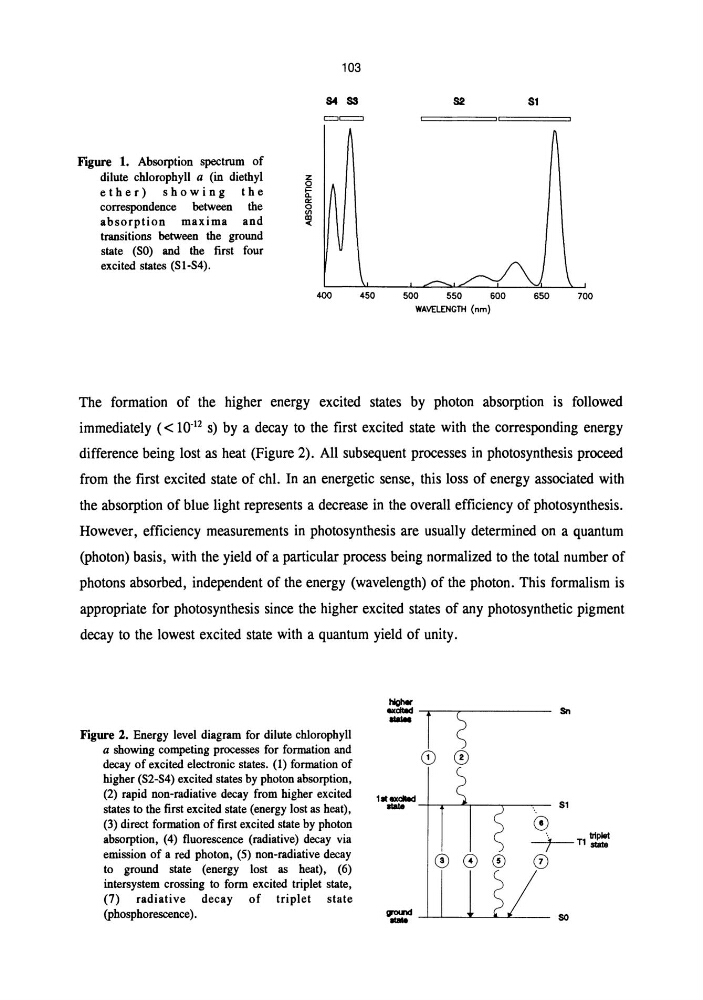
Figure 1. Absorption spectrum of
dilute chlorophyll a (in diethyl
ether) showing the
correspondence between the
absorption maxima and
transitions between the ground
state (SO) and the first four
excited states (S I-S4).
103
S483
= =
400
450
S2
81
500
550
600
650
700
WAVELENGTH (nm)
The formation of the higher energy excited states by photon absorption is followed
immediately « 10- 12 s) by a decay to the first excited state with the corresponding energy
difference being lost as heat (Figure 2). All subsequent processes in photosynthesis proceed
from the first excited state of chI. In an energetic sense, this loss of energy associated with
the absorption of blue light represents a decrease in the overall efficiency of photosynthesis.
However, efficiency measurements in photosynthesis are usually determined on a quantum
(photon) basis, with the yield of a particular process being normalized to the total number of
photons absorbed, independent of the energy (wavelength) of the photon. This formalism is
appropriate for photosynthesis since the higher excited states of any photosynthetic pigment
decay to the lowest excited state with a quantum yield of unity.
Figure 2. Energy level diagram for dilute chlorophyll
a showing competing processes for formation and
decay of excited electronic states. (1) formation of
higher (S2-S4) excited states by photon absorption.
(2) rapid non-radiative decay from higher excited
states to the first excited state (energy lost as heat).
(3) direct formation of first excited state by photon
absorption. (4) fluorescence (radiative) decay via
emission of a red photon. (5) non-radiative decay
to ground state (energy lost as heat). (6)
intersystem crossing to form excited triplet state.
(7) radiative decay of triplet state
(phosphorescence).
higher
exclt8d
aI8IM
111 exclled
-
IJIlWId
-
r
CD
0
~
Sn
®
Sl
0
--1-Tl:
0 ® 0
so
dilute chlorophyll a (in diethyl
ether) showing the
correspondence between the
absorption maxima and
transitions between the ground
state (SO) and the first four
excited states (S I-S4).
103
S483
= =
400
450
S2
81
500
550
600
650
700
WAVELENGTH (nm)
The formation of the higher energy excited states by photon absorption is followed
immediately « 10- 12 s) by a decay to the first excited state with the corresponding energy
difference being lost as heat (Figure 2). All subsequent processes in photosynthesis proceed
from the first excited state of chI. In an energetic sense, this loss of energy associated with
the absorption of blue light represents a decrease in the overall efficiency of photosynthesis.
However, efficiency measurements in photosynthesis are usually determined on a quantum
(photon) basis, with the yield of a particular process being normalized to the total number of
photons absorbed, independent of the energy (wavelength) of the photon. This formalism is
appropriate for photosynthesis since the higher excited states of any photosynthetic pigment
decay to the lowest excited state with a quantum yield of unity.
Figure 2. Energy level diagram for dilute chlorophyll
a showing competing processes for formation and
decay of excited electronic states. (1) formation of
higher (S2-S4) excited states by photon absorption.
(2) rapid non-radiative decay from higher excited
states to the first excited state (energy lost as heat).
(3) direct formation of first excited state by photon
absorption. (4) fluorescence (radiative) decay via
emission of a red photon. (5) non-radiative decay
to ground state (energy lost as heat). (6)
intersystem crossing to form excited triplet state.
(7) radiative decay of triplet state
(phosphorescence).
higher
exclt8d
aI8IM
111 exclled
-
IJIlWId
-
r
CD
0
~
Sn
®
Sl
0
--1-Tl:
0 ® 0
so