

NET AIR-SEA HEAT FLUX AND MERIDIONAL HEAT TRANSPORT
15
1.5
1.0
H&L
~
P-.
~
E--;
~
New
~
0.5
I&H
0.0
-35
o Latitude
35
70
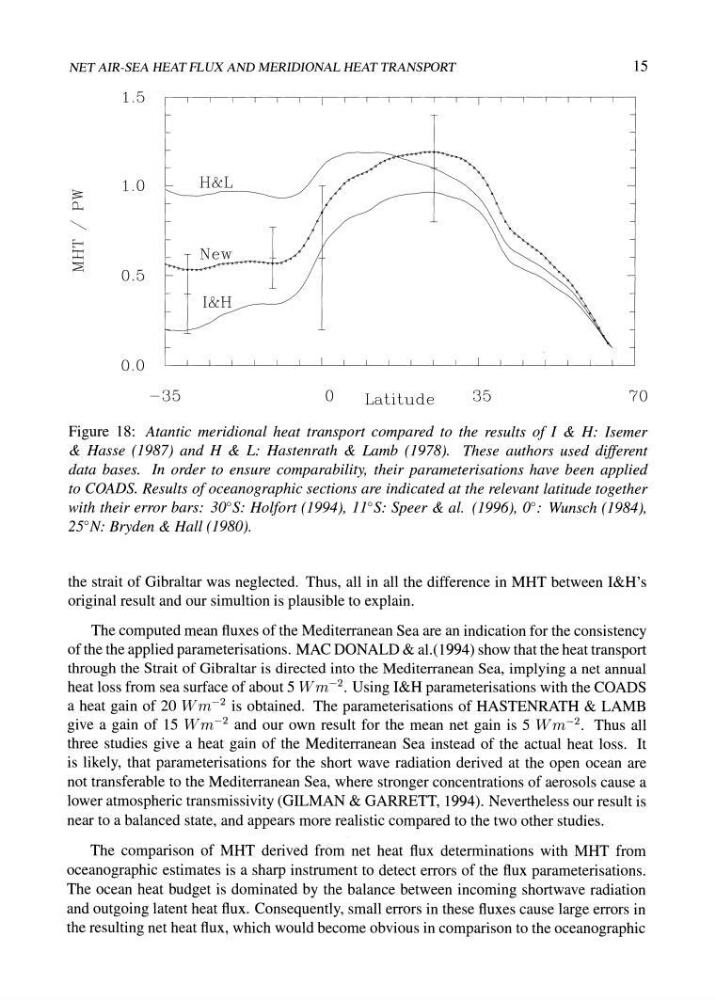
Figure 18: Atantic meridional heat transport compared to the results of I & H: Isemer
& Hasse (1987) and H & L: Hastenrath & Lamb (1978). These authors used different
data bases. In order to ensure comparability, their parameterisations have been applied
to COADS. Results of oceanographic sections are indicated at the relevant latitude together
with their error bars: 30
0
S: Holfort (1994), IrS: Speer & al. (1996), 0°: Wunsch (1984),
25° N: Bryden & Hall (1980).
the strait of Gibraltar was neglected. Thus, all in all the difference in MHT between I&H's
original result and our simultion is plausible to explain.
The computed mean fluxes of the Mediterranean Sea are an indication for the consistency
ofthe the applied parameterisations. MAC DONALD & a1.(1994) show that the heat transport
through the Strait of Gibraltar is directed into the Mediterranean Sea, implying a net annual
heat loss from sea surface of about 5 W m - 2 . Using I&H parameterisations with the COADS
a heat gain of 20 Wm- 2 is obtained. The parameterisations of HASTENRATH & LAMB
give a gain of 15 Wm- 2 and our own result for the mean net gain is 5 Wm- 2 • Thus all
three studies give a heat gain of the Mediterranean Sea instead of the actual heat loss. It
is likely, that parameterisations for the short wave radiation derived at the open ocean are
not transferable to the Mediterranean Sea, where stronger concentrations of aerosols cause a
lower atmospheric transmissivity (GILMAN & GARRETT, 1994). Nevertheless our result is
near to a balanced state, and appears more realistic compared to the two other studies.
The comparison of MHT derived from net heat flux determinations with MHT from
oceanographic estimates is a sharp instrument to detect errors of the flux parameterisations.
The ocean heat budget is dominated by the balance between incoming shortwave radiation
and outgoing latent heat flux. Consequently, small errors in these fluxes cause large errors in
the resulting net heat flux, which would become obvious in comparison to the oceanographic
15
1.5
1.0
H&L
~
P-.
~
E--;
~
New
~
0.5
I&H
0.0
-35
o Latitude
35
70
Figure 18: Atantic meridional heat transport compared to the results of I & H: Isemer
& Hasse (1987) and H & L: Hastenrath & Lamb (1978). These authors used different
data bases. In order to ensure comparability, their parameterisations have been applied
to COADS. Results of oceanographic sections are indicated at the relevant latitude together
with their error bars: 30
0
S: Holfort (1994), IrS: Speer & al. (1996), 0°: Wunsch (1984),
25° N: Bryden & Hall (1980).
the strait of Gibraltar was neglected. Thus, all in all the difference in MHT between I&H's
original result and our simultion is plausible to explain.
The computed mean fluxes of the Mediterranean Sea are an indication for the consistency
ofthe the applied parameterisations. MAC DONALD & a1.(1994) show that the heat transport
through the Strait of Gibraltar is directed into the Mediterranean Sea, implying a net annual
heat loss from sea surface of about 5 W m - 2 . Using I&H parameterisations with the COADS
a heat gain of 20 Wm- 2 is obtained. The parameterisations of HASTENRATH & LAMB
give a gain of 15 Wm- 2 and our own result for the mean net gain is 5 Wm- 2 • Thus all
three studies give a heat gain of the Mediterranean Sea instead of the actual heat loss. It
is likely, that parameterisations for the short wave radiation derived at the open ocean are
not transferable to the Mediterranean Sea, where stronger concentrations of aerosols cause a
lower atmospheric transmissivity (GILMAN & GARRETT, 1994). Nevertheless our result is
near to a balanced state, and appears more realistic compared to the two other studies.
The comparison of MHT derived from net heat flux determinations with MHT from
oceanographic estimates is a sharp instrument to detect errors of the flux parameterisations.
The ocean heat budget is dominated by the balance between incoming shortwave radiation
and outgoing latent heat flux. Consequently, small errors in these fluxes cause large errors in
the resulting net heat flux, which would become obvious in comparison to the oceanographic