

10
DERIVATION OF AIR SEA FLUXES BY PARAMETERISATIONS
hundred years against simultaneous individual pressure differences between reporting ships.
Assumming a constant relationship between wind speed and pressure gradient throughout the
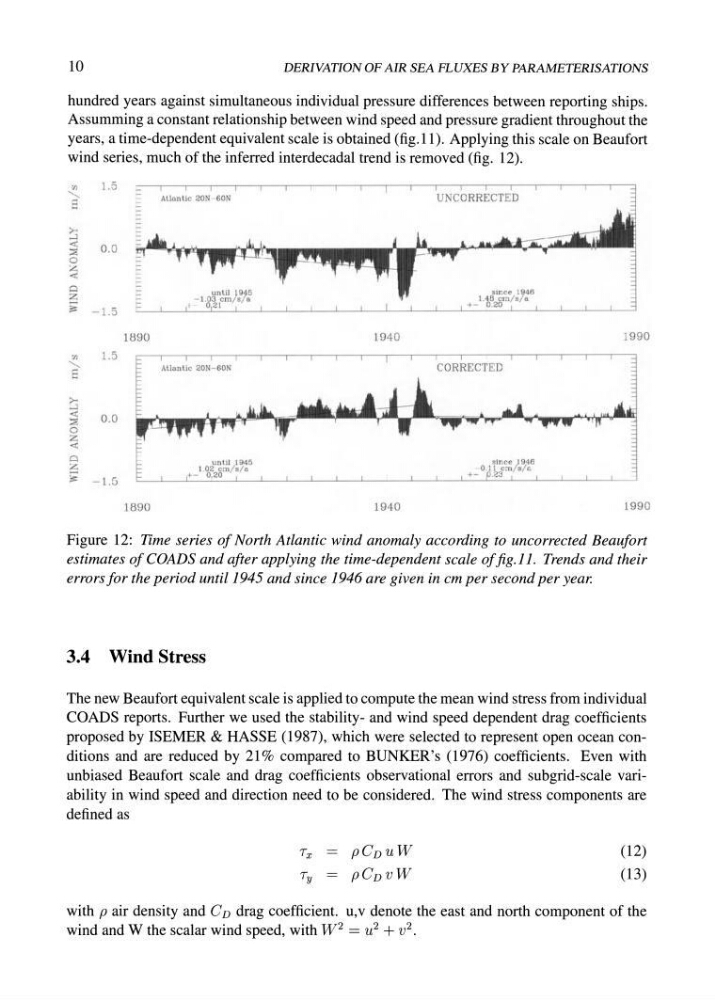
years, a time-dependent equivalent scale is obtained (fig. I 1 ). Applying this scale on Beaufort
wind series, much of the inferred interdecadal trend is removed (fig. 12).
til
1.5
-
.........
-
Atlantic 20N - 6ON
U CORRECTED
d
-
~
~
~
0
~
= -
smce 1J46
Z
-
1.46 cm/ . a
-
~
-
+- 0.20
-1. 5
1890
1940
1990
(tl
1. 5
.........
CORRECTED
S
:>....J
.:::;
0.0
0
Z
until 1945
since )~4e
~
102 em/ . / a
Olle:ns Q
~
+- 0,20
+- . 2~
- loS
1890
1940
1990
Figure 12: Time series of North Atlantic wind anomaly according to uncorrected Beaufort
estimates of COADS and after applying the time-dependent scale of fig. 11. Trends and their
errors for the period until 1945 and since 1946 are given in cm per second per year.
3.4 Wind Stress
The new Beaufort equivalent scale is applied to compute the mean wind stress from individual
COADS reports. Further we used the stability- and wind speed dependent drag coefficients
proposed by ISEMER & HASSE (1987), which were selected to represent open ocean conditions and are reduced by 21 % compared to BUNKER's (1976) coefficients. Even with
unbiased Beaufort scale and drag coefficients observational errors and subgrid-scale variability in wind speed and direction need to be considered. The wind stress components are
defined as
(12)
(13)
with p air density and CD drag coefficient. u, v denote the east and north component of the
wind and W the scalar wind speed, with W 2 = u 2 + v 2 •
DERIVATION OF AIR SEA FLUXES BY PARAMETERISATIONS
hundred years against simultaneous individual pressure differences between reporting ships.
Assumming a constant relationship between wind speed and pressure gradient throughout the
years, a time-dependent equivalent scale is obtained (fig. I 1 ). Applying this scale on Beaufort
wind series, much of the inferred interdecadal trend is removed (fig. 12).
til
1.5
-
.........
-
Atlantic 20N - 6ON
U CORRECTED
d
-
~
~
~
0
~
= -
smce 1J46
Z
-
1.46 cm/ . a
-
~
-
+- 0.20
-1. 5
1890
1940
1990
(tl
1. 5
.........
CORRECTED
S
:>....J
.:::;
0.0
0
Z
until 1945
since )~4e
~
102 em/ . / a
Olle:ns Q
~
+- 0,20
+- . 2~
- loS
1890
1940
1990
Figure 12: Time series of North Atlantic wind anomaly according to uncorrected Beaufort
estimates of COADS and after applying the time-dependent scale of fig. 11. Trends and their
errors for the period until 1945 and since 1946 are given in cm per second per year.
3.4 Wind Stress
The new Beaufort equivalent scale is applied to compute the mean wind stress from individual
COADS reports. Further we used the stability- and wind speed dependent drag coefficients
proposed by ISEMER & HASSE (1987), which were selected to represent open ocean conditions and are reduced by 21 % compared to BUNKER's (1976) coefficients. Even with
unbiased Beaufort scale and drag coefficients observational errors and subgrid-scale variability in wind speed and direction need to be considered. The wind stress components are
defined as
(12)
(13)
with p air density and CD drag coefficient. u, v denote the east and north component of the
wind and W the scalar wind speed, with W 2 = u 2 + v 2 •