

NET SHORTWAVE RADIATION
500
N
Phi 550~
I
Ta = H.UloI4Ul:
~
.~ 300
.,....,
ro
""C
CC
I- 200
>-.
.:,:
IF.
~ 100
o
Rtaal
r,lalevskii
/-\
/.
I \
I
Ju lian day
3
l= 1.0
C
....;
cc
'V
cc O.B
.,
~
CC
~ O.G
...J
~
0
~
Vl 04
"0
l=
0 0.2
55N
Heed
-oJ
0
;J
'V
365
0
2
6
8
Cloud co er / okLa ~
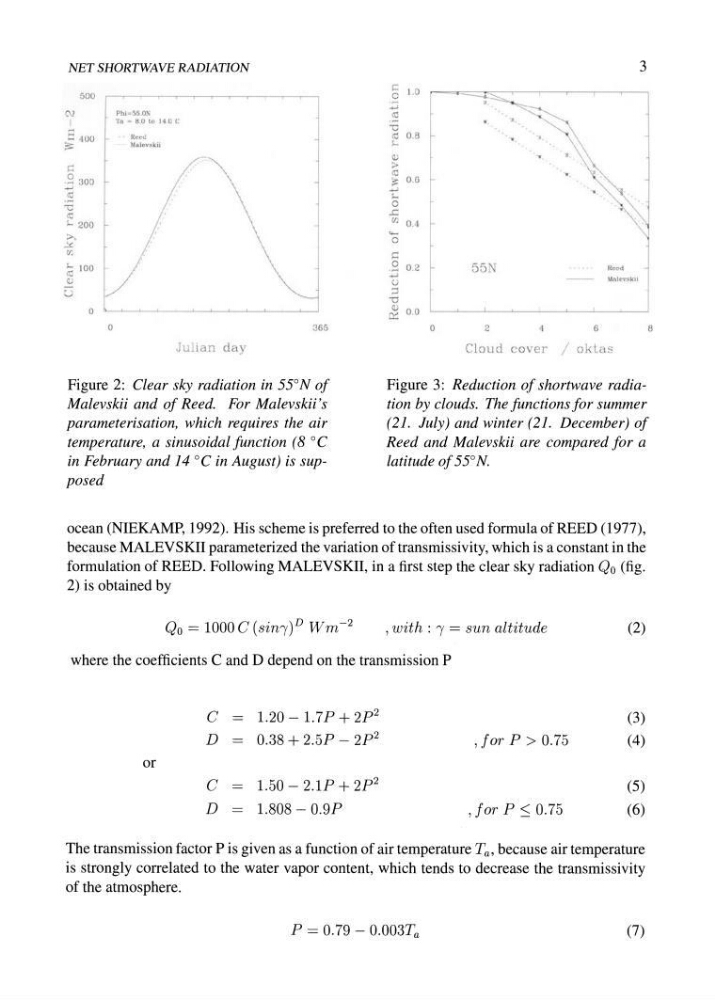
Figure 2: Clear sky radiation in 55° N of
Malevskii and of Reed. For Malevskii's
parameterisation, which requires the air
temperature, a sinusoidal junction (8°C
in February and 14 °C in August) is supposed
Figure 3: Reduction of shortwave radiation by clouds. The junctions for summer
(21. July) and winter (21. December) of
Reed and Malevskii are compared for a
latitude of 55° N.
ocean (NIEKAMP, 1992). His scheme is preferred to the often used formula of REED (1977),
because MALEVSKII parameterized the variation of transmissivity, which is a constant in the
formulation of REED. Following MALEVSKII, in a first step the clear sky radiation Qo (fig.
2) is obtained by
Qo = 1000 C (sinry)D Wm- 2
,with : 'Y = sun altitude
(2)
where the coefficients C and D depend on the transmission P
C
1.20 - 1.7P + 2p2
(3)
D
0.38 + 2.5P - 2p2
,for P > 0.75
(4)
or
C
1.50 - 2.lP + 2p2
(5)
D
1.808 - 0.9P
,for P :::; 0.75
(6)
The transmission factor P is given as a function of air temperature T a , because air temperature
is strongly correlated to the water vapor content, which tends to decrease the transmissivity
of the atmosphere.
P = 0.79 - 0.003Ta
(7)
500
N
Phi 550~
I
Ta = H.UloI4Ul:
~
.~ 300
.,....,
ro
""C
CC
I- 200
>-.
.:,:
IF.
~ 100
o
Rtaal
r,lalevskii
/-\
/.
I \
I
Ju lian day
3
l= 1.0
C
....;
cc
'V
cc O.B
.,
~
CC
~ O.G
...J
~
0
~
Vl 04
"0
l=
0 0.2
55N
Heed
-oJ
0
;J
'V
365
0
2
6
8
Cloud co er / okLa ~
Figure 2: Clear sky radiation in 55° N of
Malevskii and of Reed. For Malevskii's
parameterisation, which requires the air
temperature, a sinusoidal junction (8°C
in February and 14 °C in August) is supposed
Figure 3: Reduction of shortwave radiation by clouds. The junctions for summer
(21. July) and winter (21. December) of
Reed and Malevskii are compared for a
latitude of 55° N.
ocean (NIEKAMP, 1992). His scheme is preferred to the often used formula of REED (1977),
because MALEVSKII parameterized the variation of transmissivity, which is a constant in the
formulation of REED. Following MALEVSKII, in a first step the clear sky radiation Qo (fig.
2) is obtained by
Qo = 1000 C (sinry)D Wm- 2
,with : 'Y = sun altitude
(2)
where the coefficients C and D depend on the transmission P
C
1.20 - 1.7P + 2p2
(3)
D
0.38 + 2.5P - 2p2
,for P > 0.75
(4)
or
C
1.50 - 2.lP + 2p2
(5)
D
1.808 - 0.9P
,for P :::; 0.75
(6)
The transmission factor P is given as a function of air temperature T a , because air temperature
is strongly correlated to the water vapor content, which tends to decrease the transmissivity
of the atmosphere.
P = 0.79 - 0.003Ta
(7)