

2
DERIVATION OF AIR SEA FLUXES BY PARAMETERISATIONS
expected. Thus, we developped an adaptive interpolation scheme to account for the inhomogeneous data density.
The individual reports or values of derived
climate variables are averaged on a grid of
l°latitude by l°longitude. A minimum of 300
observations around the respective grid point
is required. If this number is reached in a surrounding of 111 km by 111 km, no interpolation
is performed and the arithmetic mean is taken
as the grid point value. Otherwise the radius
of influence is enlarged step by step from l °to
5° (measured as great circle distance) until 300
observations are enclosed. Then a least square
fit of a two-dimensional quadratic polynomial
yields the value for the considered grid point.
There is the possible problem that the reports
are non-uniformly distributed around a grid
point and the polynominal fit would perform
an extrapolation rather than an interpolation.
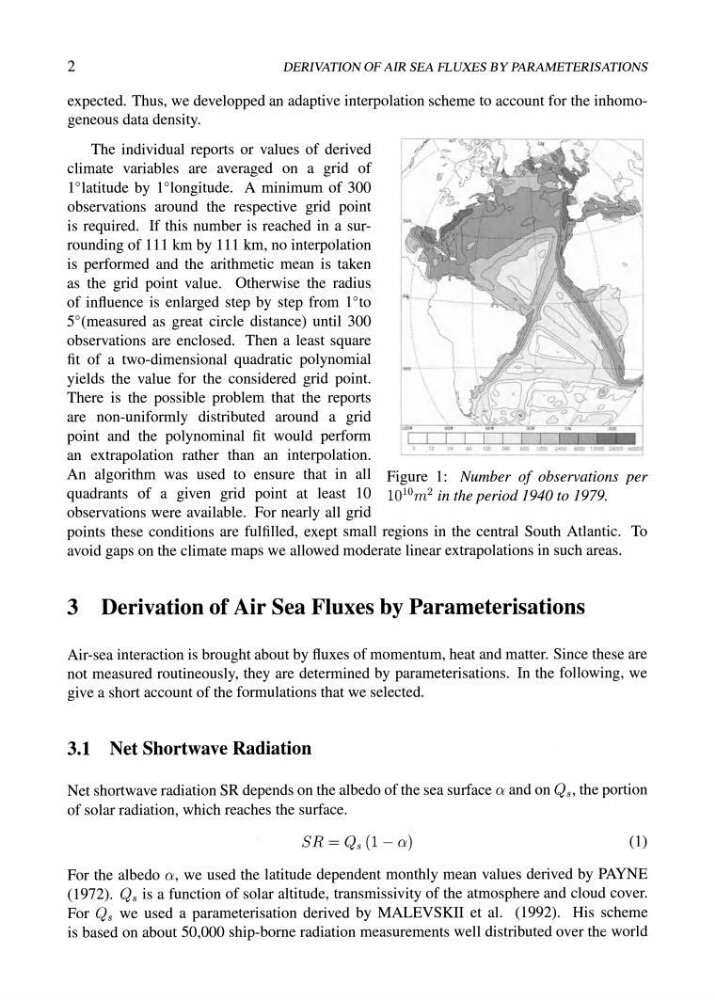
An algorithm was used to ensure that in all Figure I: Number of observations per
quadrants of a given grid point at least 10 lOlOm 2 in the period 1940 to 1979.
observations were available. For nearly all grid
points these conditions are fulfilled, exept small regions in the central South Atlantic. To
avoid gaps on the climate maps we allowed moderate linear extrapolations in such areas.
3 Derivation of Air Sea Fluxes by Parameterisations
Air-sea interaction is brought about by fluxes of momentum, heat and matter. Since these are
not measured routineously, they are determined by parameterisations. In the following, we
give a short account of the formulations that we selected.
3.1 Net Shortwave Radiation
Net shortwave radiation SR depends on the albedo of the sea surface a and on Qs, the portion
of solar radiation, which reaches the surface.
(1)
For the albedo a, we used the latitude dependent monthly mean values derived by PAYNE
(1972). Q s is a function of solar altitude, transmissivity of the atmosphere and cloud cover.
For Q s we used a parameterisation derived by MALEVSKII et al. (1992). His scheme
is based on about 50,000 ship-borne radiation measurements well distributed over the world
DERIVATION OF AIR SEA FLUXES BY PARAMETERISATIONS
expected. Thus, we developped an adaptive interpolation scheme to account for the inhomogeneous data density.
The individual reports or values of derived
climate variables are averaged on a grid of
l°latitude by l°longitude. A minimum of 300
observations around the respective grid point
is required. If this number is reached in a surrounding of 111 km by 111 km, no interpolation
is performed and the arithmetic mean is taken
as the grid point value. Otherwise the radius
of influence is enlarged step by step from l °to
5° (measured as great circle distance) until 300
observations are enclosed. Then a least square
fit of a two-dimensional quadratic polynomial
yields the value for the considered grid point.
There is the possible problem that the reports
are non-uniformly distributed around a grid
point and the polynominal fit would perform
an extrapolation rather than an interpolation.
An algorithm was used to ensure that in all Figure I: Number of observations per
quadrants of a given grid point at least 10 lOlOm 2 in the period 1940 to 1979.
observations were available. For nearly all grid
points these conditions are fulfilled, exept small regions in the central South Atlantic. To
avoid gaps on the climate maps we allowed moderate linear extrapolations in such areas.
3 Derivation of Air Sea Fluxes by Parameterisations
Air-sea interaction is brought about by fluxes of momentum, heat and matter. Since these are
not measured routineously, they are determined by parameterisations. In the following, we
give a short account of the formulations that we selected.
3.1 Net Shortwave Radiation
Net shortwave radiation SR depends on the albedo of the sea surface a and on Qs, the portion
of solar radiation, which reaches the surface.
(1)
For the albedo a, we used the latitude dependent monthly mean values derived by PAYNE
(1972). Q s is a function of solar altitude, transmissivity of the atmosphere and cloud cover.
For Q s we used a parameterisation derived by MALEVSKII et al. (1992). His scheme
is based on about 50,000 ship-borne radiation measurements well distributed over the world