

14
Study Area
-
Pacific
Atlantic _
14
12
10
"'
c:
~ 8
I
~E
6
:.<2
!!l
OJ
u 4
2
0
-
PacJfic
Atlantic _
60
50
!
.g
Oil
~
~
E 40
:.<2
Ol
2c:
(b)
0 30
-e
' "
u
20
10
0
o diatoms
CJ other flagellates Iillll coccolithophorids
Iillll dinoflagellates
II1II coccoid cells < 31.1m
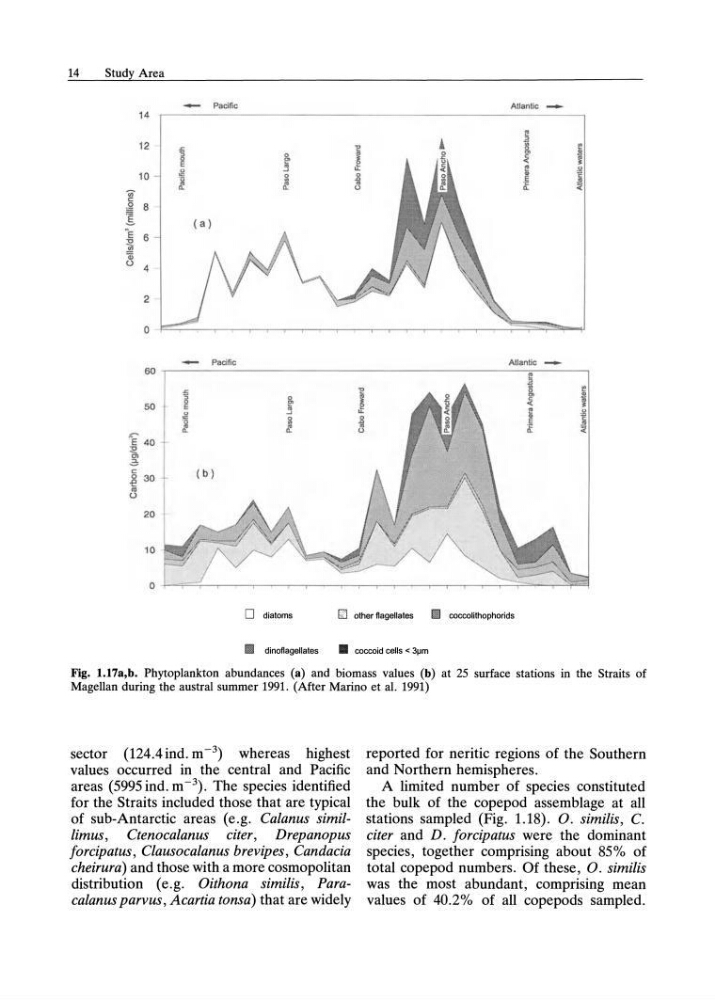
Fig. 1.17a,b. Phytoplankton abundances (a) and biomass values (b) at 25 surface stations in the Straits of
Magellan during the austral summer 1991. (After Marino et al. 1991)
sector (124.4ind. m- 3 ) whereas highest
values occurred in the central and Pacific
areas (5995 indo m- 3 ). The species identified
for the Straits included those that are typical
of sub-Antarctic areas (e .g. Calanus simillim us , Ctenocalanus citer, Drepanopus
Jorcipatus, Clausocalanus brevipes, Candacia
cheirura) and those with a more cosmopolitan
distribution (e.g. Oithona similis, Paracalanus parvus, Acartia tonsa) that are widely
reported for neritic regions of the Southern
and Northern hemispheres.
A limited number of species constituted
the bulk of the copepod assemblage at all
stations sampled (Fig. 1.18). O. similis, C.
citer and D. Jorcipatus were the dominant
species, together comprising about 85% of
total copepod numbers. Of these , O. similis
was the most abundant, comprising mean
values of 40.2% of all copepods sampled.
Study Area
-
Pacific
Atlantic _
14
12
10
"'
c:
~ 8
I
~E
6
:.<2
!!l
OJ
u 4
2
0
-
PacJfic
Atlantic _
60
50
!
.g
Oil
~
~
E 40
:.<2
Ol
2c:
(b)
0 30
-e
' "
u
20
10
0
o diatoms
CJ other flagellates Iillll coccolithophorids
Iillll dinoflagellates
II1II coccoid cells < 31.1m
Fig. 1.17a,b. Phytoplankton abundances (a) and biomass values (b) at 25 surface stations in the Straits of
Magellan during the austral summer 1991. (After Marino et al. 1991)
sector (124.4ind. m- 3 ) whereas highest
values occurred in the central and Pacific
areas (5995 indo m- 3 ). The species identified
for the Straits included those that are typical
of sub-Antarctic areas (e .g. Calanus simillim us , Ctenocalanus citer, Drepanopus
Jorcipatus, Clausocalanus brevipes, Candacia
cheirura) and those with a more cosmopolitan
distribution (e.g. Oithona similis, Paracalanus parvus, Acartia tonsa) that are widely
reported for neritic regions of the Southern
and Northern hemispheres.
A limited number of species constituted
the bulk of the copepod assemblage at all
stations sampled (Fig. 1.18). O. similis, C.
citer and D. Jorcipatus were the dominant
species, together comprising about 85% of
total copepod numbers. Of these , O. similis
was the most abundant, comprising mean
values of 40.2% of all copepods sampled.