

Phytoplankton
11
-
Pacific
AIIantic _
50
Chi a
I!
40
1
i
0
Ol
~
~
I
.8
~
~
it
..,
30
0
..><
~
'" .€
01
20
E
10
o
•
Total
+ > 10~m
•
1()'2~m
.to. 2-11.5 ~m
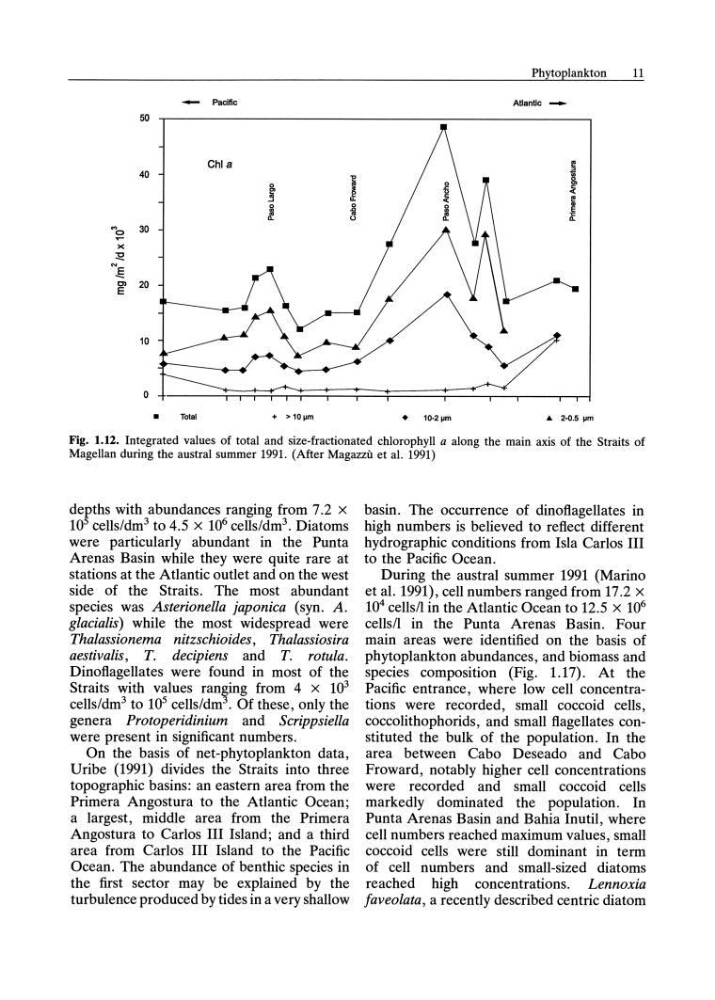
Fig. 1.12. Integrated values of total and size-fractionated chlorophyll a along the main axis of the Straits of
Magellan during the austral summer 1991. (After Magazzu et al. 1991)
depths with abundances ranging from 7.2 x
10 cells/dm 3 to 4.5 x 10 6 cells/dm 3 • Diatoms
were particularly abundant in the Punta
Arenas Basin while they were quite rare at
stations at the Atlantic outlet and on the west
side of the Straits. The most abundant
species was Asterionella japonica (syn. A.
glacialis) while the most widespread were
Thalassionema nitzschioides, Thalassiosira
aestivalis, T. decipiens and T. rotula.
Dinoflagellates were found in most of the
Straits with values ran§ing from 4 X 10 3
cells/dm 3 to 10 5 cells/dm . Of these, only the
genera Protoperidinium and Scrippsiella
were present in significant numbers.
On the basis of net-phytoplankton data,
Uribe (1991) divides the Straits into three
topographic basins: an eastern area from the
Primera Angostura to the Atlantic Ocean;
a largest, middle area from the Primera
Angostura to Carlos III Island; and a third
area from Carlos III Island to the Pacific
Ocean. The abundance of benthic species in
the first sector may be explained by the
turbulence produced by tides in a very shallow
basin. The occurrence of dinoflagellates in
high numbers is believed to reflect different
hydrographic conditions from Isla Carlos III
to the Pacific Ocean.
During the austral summer 1991 (Marino
et al. 1991), cell numbers ranged from 17.2 x
10 4 cells II in the Atlantic Ocean to 12.5 x 10 6
cellsll in the Punta Arenas Basin. Four
main areas were identified on the basis of
phytoplankton abundances, and biomass and
species composition (Fig. 1.17). At the
Pacific entrance, where low cell concentrations were recorded, small coccoid cells,
coccolithophorids, and small flagellates constituted the bulk of the population. In the
area between Cabo Deseado and Cabo
Froward, notably higher cell concentrations
were recorded and small coccoid cells
markedly dominated the population. In
Punta Arenas Basin and Bahia Inutil, where
cell numbers reached maximum values, small
coccoid cells were still dominant in term
of cell numbers and small-sized diatoms
reached high concentrations. Lennoxia
Javeolata, a recently described centric diatom
11
-
Pacific
AIIantic _
50
Chi a
I!
40
1
i
0
Ol
~
~
I
.8
~
~
it
..,
30
0
..><
~
'" .€
01
20
E
10
o
•
Total
+ > 10~m
•
1()'2~m
.to. 2-11.5 ~m
Fig. 1.12. Integrated values of total and size-fractionated chlorophyll a along the main axis of the Straits of
Magellan during the austral summer 1991. (After Magazzu et al. 1991)
depths with abundances ranging from 7.2 x
10 cells/dm 3 to 4.5 x 10 6 cells/dm 3 • Diatoms
were particularly abundant in the Punta
Arenas Basin while they were quite rare at
stations at the Atlantic outlet and on the west
side of the Straits. The most abundant
species was Asterionella japonica (syn. A.
glacialis) while the most widespread were
Thalassionema nitzschioides, Thalassiosira
aestivalis, T. decipiens and T. rotula.
Dinoflagellates were found in most of the
Straits with values ran§ing from 4 X 10 3
cells/dm 3 to 10 5 cells/dm . Of these, only the
genera Protoperidinium and Scrippsiella
were present in significant numbers.
On the basis of net-phytoplankton data,
Uribe (1991) divides the Straits into three
topographic basins: an eastern area from the
Primera Angostura to the Atlantic Ocean;
a largest, middle area from the Primera
Angostura to Carlos III Island; and a third
area from Carlos III Island to the Pacific
Ocean. The abundance of benthic species in
the first sector may be explained by the
turbulence produced by tides in a very shallow
basin. The occurrence of dinoflagellates in
high numbers is believed to reflect different
hydrographic conditions from Isla Carlos III
to the Pacific Ocean.
During the austral summer 1991 (Marino
et al. 1991), cell numbers ranged from 17.2 x
10 4 cells II in the Atlantic Ocean to 12.5 x 10 6
cellsll in the Punta Arenas Basin. Four
main areas were identified on the basis of
phytoplankton abundances, and biomass and
species composition (Fig. 1.17). At the
Pacific entrance, where low cell concentrations were recorded, small coccoid cells,
coccolithophorids, and small flagellates constituted the bulk of the population. In the
area between Cabo Deseado and Cabo
Froward, notably higher cell concentrations
were recorded and small coccoid cells
markedly dominated the population. In
Punta Arenas Basin and Bahia Inutil, where
cell numbers reached maximum values, small
coccoid cells were still dominant in term
of cell numbers and small-sized diatoms
reached high concentrations. Lennoxia
Javeolata, a recently described centric diatom