

30. HYPERSPECTRAL IMAGER SURVEY AND DEVELOPMENTS
FOR SCIENTIFIC AND OPERATIONAL LAND PROCESSES
MONITORING APPLICATIONS
315
lar system, planet Earth is the only one carrying higher developed forms of
life in a fragile environment. This makes the permanent monitoring of the
thin biosphere layer such an important task—this is where imaging spectrometers play an increasingly dominant role for environmental change processes, essentially changes of the biosphere, climate and cryosphere.
Of the requirements presented in Table 3 below, the ones defining the
instrument layout and dimensions are best expressed in the typically required
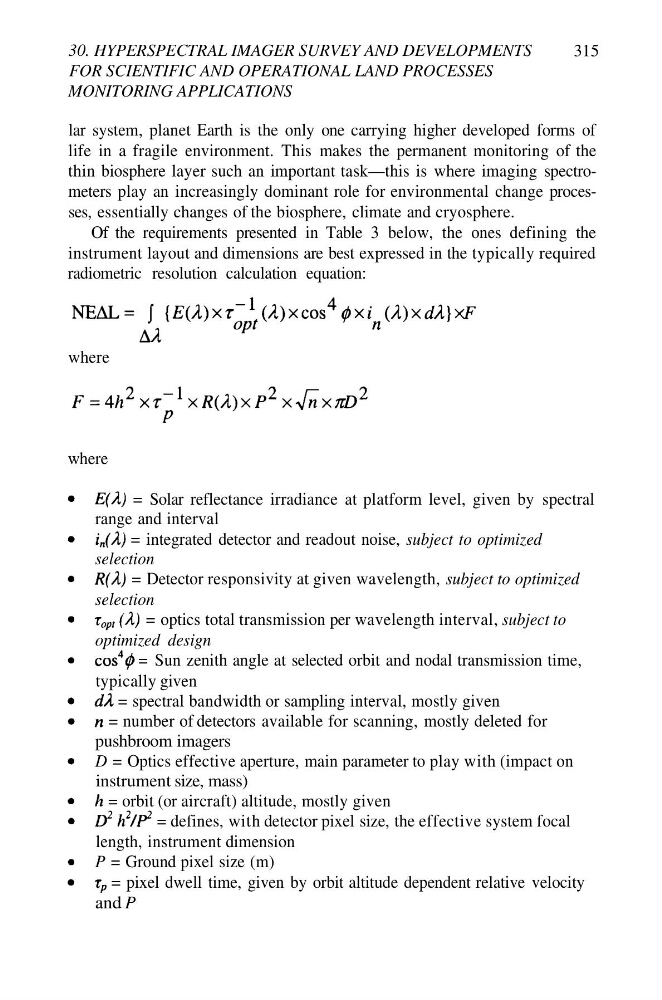
radiometric resolution calculation equation:
where
where
= Solar reflectance irradiance at platform level, given by spectral
range and interval
= integrated detector and readout noise, subject to optimized
selection
= Detector responsivity at given wavelength, subject to optimized
selection
= optics total transmission per wavelength interval, subject to
optimized design
= Sun zenith angle at selected orbit and nodal transmission time,
typically given
= spectral bandwidth or sampling interval, mostly given
= number of detectors available for scanning, mostly deleted for
pushbroom imagers
D = Optics effective aperture, main parameter to play with (impact on
instrument size, mass)
= orbit (or aircraft) altitude, mostly given
= defines, with detector pixel size, the effective system focal
length, instrument dimension
P = Ground pixel size (m)
= pixel dwell time, given by orbit altitude dependent relative velocity
and P
FOR SCIENTIFIC AND OPERATIONAL LAND PROCESSES
MONITORING APPLICATIONS
315
lar system, planet Earth is the only one carrying higher developed forms of
life in a fragile environment. This makes the permanent monitoring of the
thin biosphere layer such an important task—this is where imaging spectrometers play an increasingly dominant role for environmental change processes, essentially changes of the biosphere, climate and cryosphere.
Of the requirements presented in Table 3 below, the ones defining the
instrument layout and dimensions are best expressed in the typically required
radiometric resolution calculation equation:
where
where
= Solar reflectance irradiance at platform level, given by spectral
range and interval
= integrated detector and readout noise, subject to optimized
selection
= Detector responsivity at given wavelength, subject to optimized
selection
= optics total transmission per wavelength interval, subject to
optimized design
= Sun zenith angle at selected orbit and nodal transmission time,
typically given
= spectral bandwidth or sampling interval, mostly given
= number of detectors available for scanning, mostly deleted for
pushbroom imagers
D = Optics effective aperture, main parameter to play with (impact on
instrument size, mass)
= orbit (or aircraft) altitude, mostly given
= defines, with detector pixel size, the effective system focal
length, instrument dimension
P = Ground pixel size (m)
= pixel dwell time, given by orbit altitude dependent relative velocity
and P