

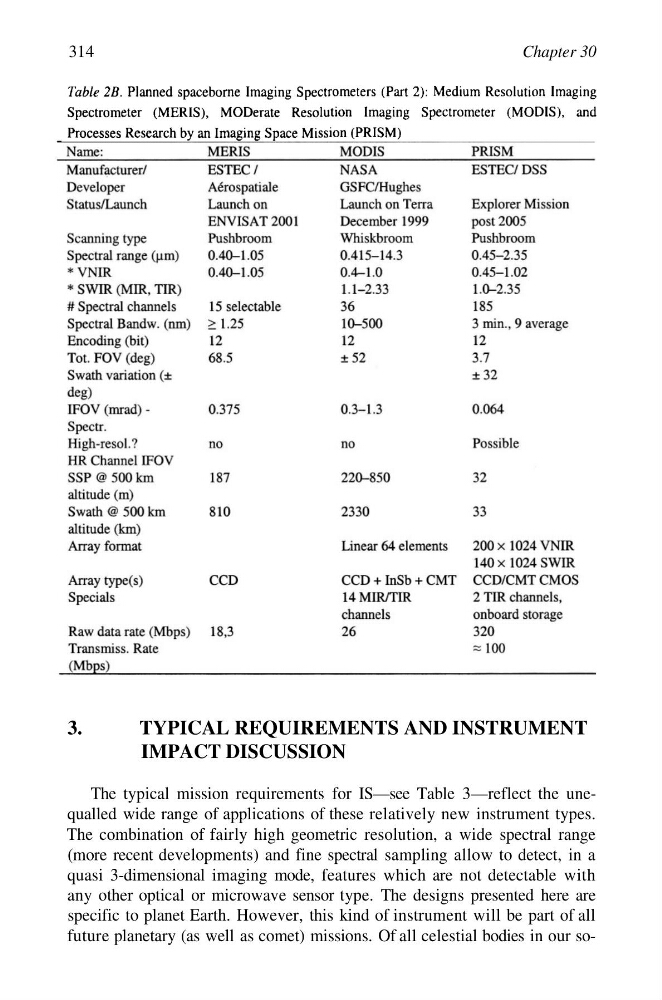
314
Chapter 30
3.
TYPICAL REQUIREMENTS AND INSTRUMENT
IMPACT DISCUSSION
The typical mission requirements for IS—see Table 3—reflect the unequalled wide range of applications of these relatively new instrument types.
The combination of fairly high geometric resolution, a wide spectral range
(more recent developments) and fine spectral sampling allow to detect, in a
quasi 3-dimensional imaging mode, features which are not detectable with
any other optical or microwave sensor type. The designs presented here are
specific to planet Earth. However, this kind of instrument will be part of all
future planetary (as well as comet) missions. Of all celestial bodies in our so-
Chapter 30
3.
TYPICAL REQUIREMENTS AND INSTRUMENT
IMPACT DISCUSSION
The typical mission requirements for IS—see Table 3—reflect the unequalled wide range of applications of these relatively new instrument types.
The combination of fairly high geometric resolution, a wide spectral range
(more recent developments) and fine spectral sampling allow to detect, in a
quasi 3-dimensional imaging mode, features which are not detectable with
any other optical or microwave sensor type. The designs presented here are
specific to planet Earth. However, this kind of instrument will be part of all
future planetary (as well as comet) missions. Of all celestial bodies in our so-