

310
Chapter 30
In addition, the spectrometer entrance slit in the front optics focus tends
to suggest a telecentric beam, which further limits the optics choice.
As a schematic example, the HRIS all-reflective optics and FPA concept
are shown in Fig. 7. This 3-mirror (aspheric, elliptic) optics concept is
currently realized by Carl Zeiss. Its peculiarity is the spatial and spectral slit
curvature correction by the elliptic primary and secondary optics mirrors.
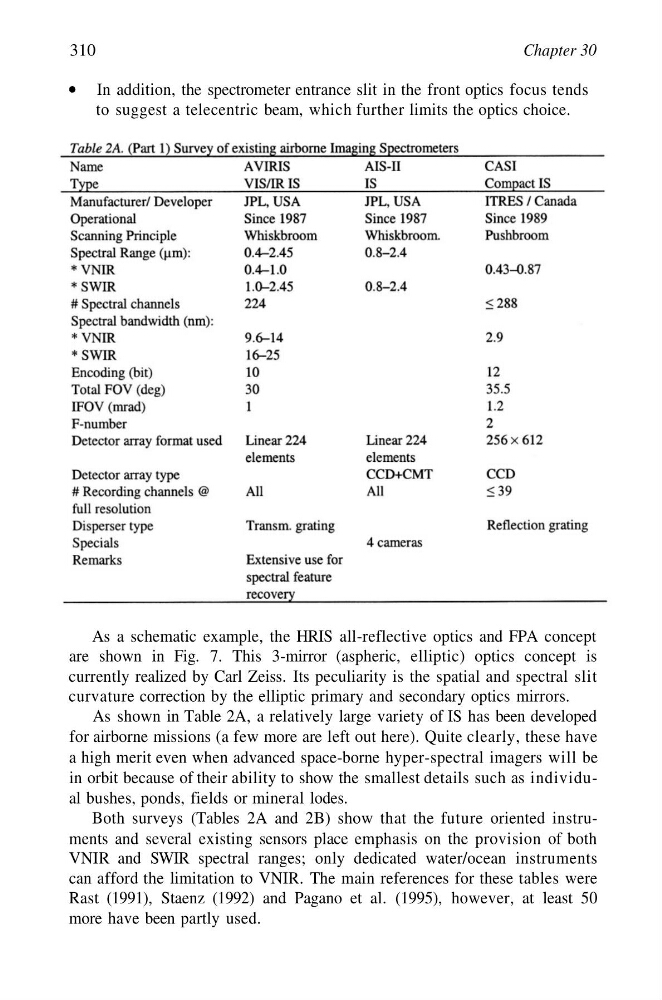
As shown in Table 2A, a relatively large variety of IS has been developed
for airborne missions (a few more are left out here). Quite clearly, these have
a high merit even when advanced space-borne hyper-spectral imagers will be
in orbit because of their ability to show the smallest details such as individual bushes, ponds, fields or mineral lodes.
Both surveys (Tables 2A and 2B) show that the future oriented instruments and several existing sensors place emphasis on the provision of both
VNIR and SWIR spectral ranges; only dedicated water/ocean instruments
can afford the limitation to VNIR. The main references for these tables were
Rast (1991), Staenz (1992) and Pagano et al. (1995), however, at least 50
more have been partly used.
Chapter 30
In addition, the spectrometer entrance slit in the front optics focus tends
to suggest a telecentric beam, which further limits the optics choice.
As a schematic example, the HRIS all-reflective optics and FPA concept
are shown in Fig. 7. This 3-mirror (aspheric, elliptic) optics concept is
currently realized by Carl Zeiss. Its peculiarity is the spatial and spectral slit
curvature correction by the elliptic primary and secondary optics mirrors.
As shown in Table 2A, a relatively large variety of IS has been developed
for airborne missions (a few more are left out here). Quite clearly, these have
a high merit even when advanced space-borne hyper-spectral imagers will be
in orbit because of their ability to show the smallest details such as individual bushes, ponds, fields or mineral lodes.
Both surveys (Tables 2A and 2B) show that the future oriented instruments and several existing sensors place emphasis on the provision of both
VNIR and SWIR spectral ranges; only dedicated water/ocean instruments
can afford the limitation to VNIR. The main references for these tables were
Rast (1991), Staenz (1992) and Pagano et al. (1995), however, at least 50
more have been partly used.