

226
Chapter 23
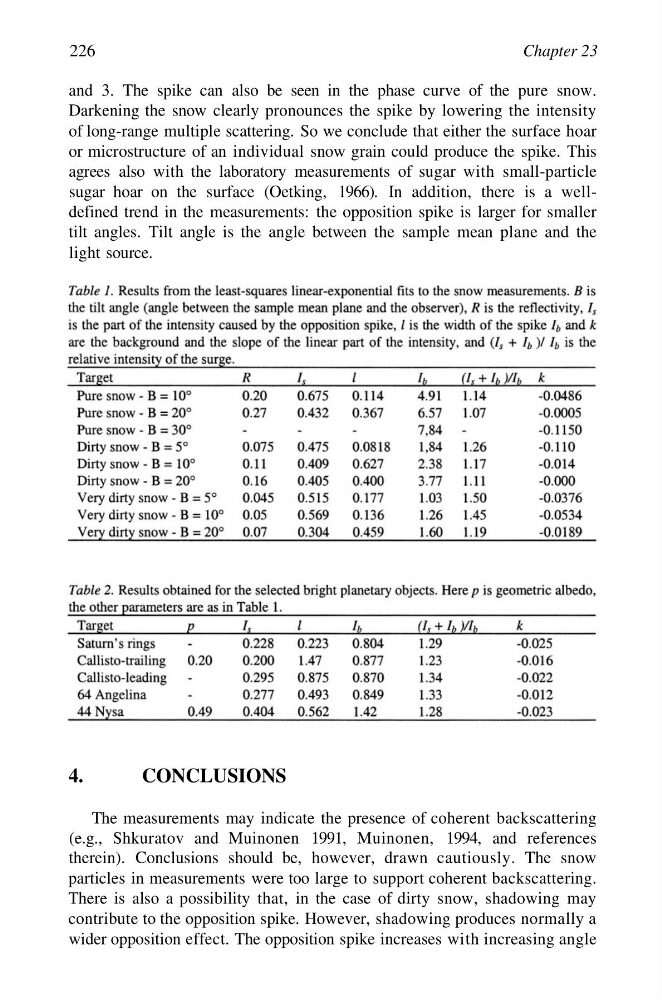
and 3. The spike can also be seen in the phase curve of the pure snow.
Darkening the snow clearly pronounces the spike by lowering the intensity
of long-range multiple scattering. So we conclude that either the surface hoar
or microstructure of an individual snow grain could produce the spike. This
agrees also with the laboratory measurements of sugar with small-particle
sugar hoar on the surface (Oetking, 1966). In addition, there is a welldefined trend in the measurements: the opposition spike is larger for smaller
tilt angles. Tilt angle is the angle between the sample mean plane and the
light source.
4.
CONCLUSIONS
The measurements may indicate the presence of coherent backscattering
(e.g., Shkuratov and Muinonen 1991, Muinonen, 1994, and references
therein). Conclusions should be, however, drawn cautiously. The snow
particles in measurements were too large to support coherent backscattering.
There is also a possibility that, in the case of dirty snow, shadowing may
contribute to the opposition spike. However, shadowing produces normally a
wider opposition effect. The opposition spike increases with increasing angle
Chapter 23
and 3. The spike can also be seen in the phase curve of the pure snow.
Darkening the snow clearly pronounces the spike by lowering the intensity
of long-range multiple scattering. So we conclude that either the surface hoar
or microstructure of an individual snow grain could produce the spike. This
agrees also with the laboratory measurements of sugar with small-particle
sugar hoar on the surface (Oetking, 1966). In addition, there is a welldefined trend in the measurements: the opposition spike is larger for smaller
tilt angles. Tilt angle is the angle between the sample mean plane and the
light source.
4.
CONCLUSIONS
The measurements may indicate the presence of coherent backscattering
(e.g., Shkuratov and Muinonen 1991, Muinonen, 1994, and references
therein). Conclusions should be, however, drawn cautiously. The snow
particles in measurements were too large to support coherent backscattering.
There is also a possibility that, in the case of dirty snow, shadowing may
contribute to the opposition spike. However, shadowing produces normally a
wider opposition effect. The opposition spike increases with increasing angle