

216
Chapter 22
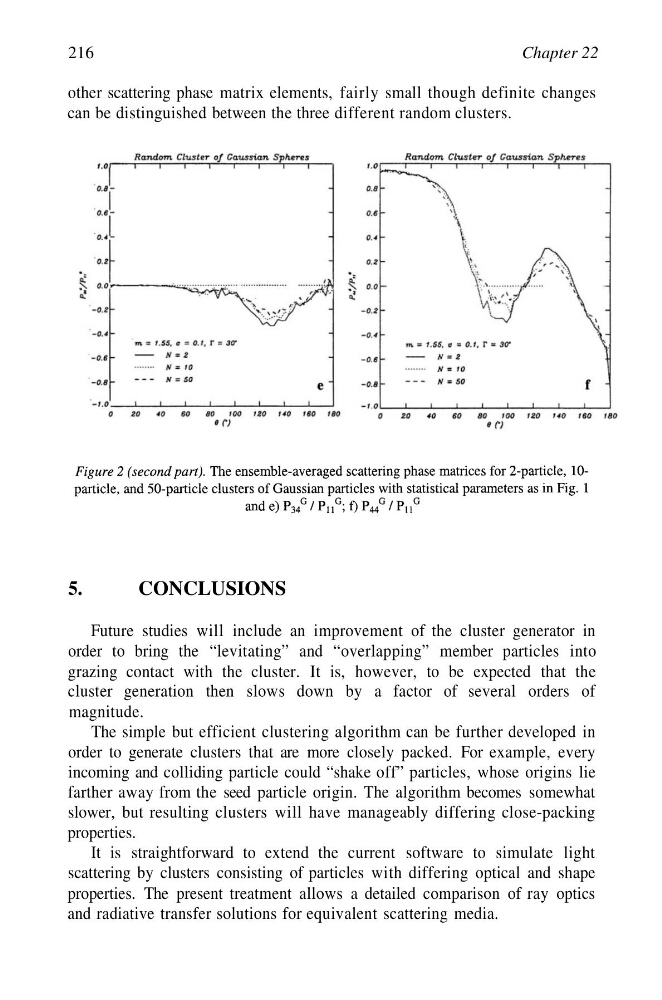
other scattering phase matrix elements, fairly small though definite changes
can be distinguished between the three different random clusters.
5.
CONCLUSIONS
Future studies will include an improvement of the cluster generator in
order to bring the “levitating” and “overlapping” member particles into
grazing contact with the cluster. It is, however, to be expected that the
cluster generation then slows down by a factor of several orders of
magnitude.
The simple but efficient clustering algorithm can be further developed in
order to generate clusters that are more closely packed. For example, every
incoming and colliding particle could “shake off” particles, whose origins lie
farther away from the seed particle origin. The algorithm becomes somewhat
slower, but resulting clusters will have manageably differing close-packing
properties.
It is straightforward to extend the current software to simulate light
scattering by clusters consisting of particles with differing optical and shape
properties. The present treatment allows a detailed comparison of ray optics
and radiative transfer solutions for equivalent scattering media.
Chapter 22
other scattering phase matrix elements, fairly small though definite changes
can be distinguished between the three different random clusters.
5.
CONCLUSIONS
Future studies will include an improvement of the cluster generator in
order to bring the “levitating” and “overlapping” member particles into
grazing contact with the cluster. It is, however, to be expected that the
cluster generation then slows down by a factor of several orders of
magnitude.
The simple but efficient clustering algorithm can be further developed in
order to generate clusters that are more closely packed. For example, every
incoming and colliding particle could “shake off” particles, whose origins lie
farther away from the seed particle origin. The algorithm becomes somewhat
slower, but resulting clusters will have manageably differing close-packing
properties.
It is straightforward to extend the current software to simulate light
scattering by clusters consisting of particles with differing optical and shape
properties. The present treatment allows a detailed comparison of ray optics
and radiative transfer solutions for equivalent scattering media.