

192
Chapter 20
Vertical profiles of downward and upward radiation fluxes were
determined (Fig. 5) using averaged results of the measurements at heights of
40, 126, 180, 240 and 320 cm. The rapid decreases of the downward fluxes
of Q, PAR (Q), B and
occur in the layer between 120 and 250 cm, in
which the largest part of the leaf area is concentrated. The profiles of net
radiation B and short-wave net radiation
are quite similar, implying that
the contribution of the long-wave radiation is small. In the lower forest
showing that the soil is cooler than foliage. The situation is reversed in the
upper forest layers—the cloudless atmosphere is cooler than the foliage. In
comparison with other fluxes, the reflected PAR is practically zero. The
vertical distribution of the leaf area density in the canopy, expressed in
is shown on the left side of Fig. 5. The smoothed curves of
short-wave radiation characteristics near noon for the entire forest canopy
(Fig. 6) have been estimated using data from all measurements made on
cloudless days during the 1994-1995 vegetation growing period. Errors in
estimating such smoothed curves should be evaluated at ±5%. The analysis
of Fig. 6 shows that the albedo of the system “willow forest-ground surface”
slightly increased in both years, and, during the period of maximum growth,
equaled 23%. The lower values of albedo in May 1995, compared to May
1994, are caused by the existence of the ‘skeleton’ part of the forest in 1995.
At the beginning of the growing period in 1995, some 89% of incoming
global radiation Q penetrated the forest skeleton (stems and branches
without leaves), while 10% were absorbed, the albedo being 15%. In 1995,
due to a drought period in July, the growth was disturbed and LAI started to
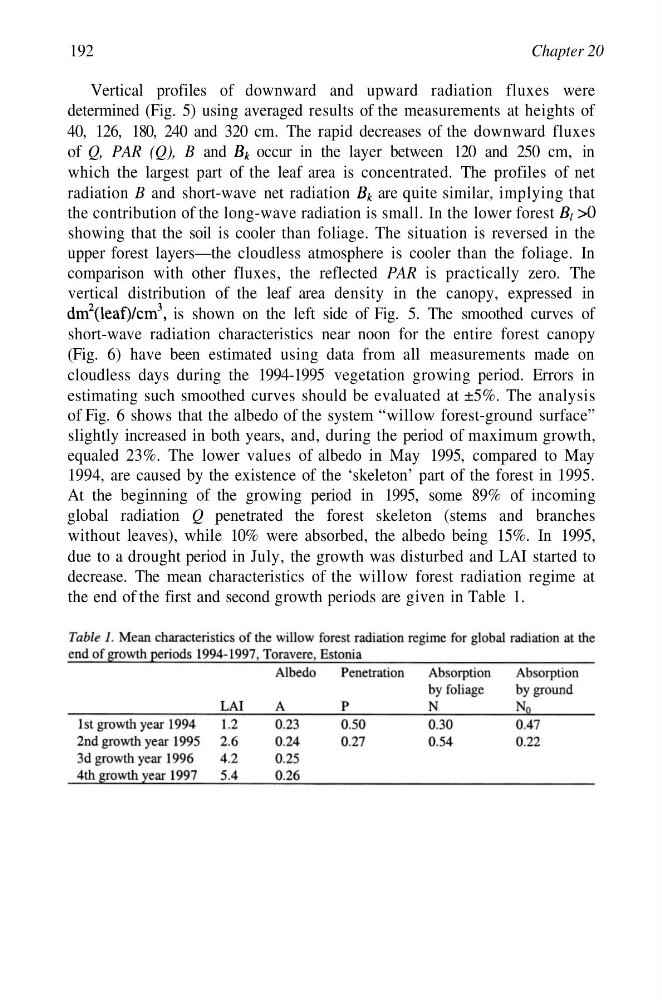
decrease. The mean characteristics of the willow forest radiation regime at
the end of the first and second growth periods are given in Table 1.
Chapter 20
Vertical profiles of downward and upward radiation fluxes were
determined (Fig. 5) using averaged results of the measurements at heights of
40, 126, 180, 240 and 320 cm. The rapid decreases of the downward fluxes
of Q, PAR (Q), B and
occur in the layer between 120 and 250 cm, in
which the largest part of the leaf area is concentrated. The profiles of net
radiation B and short-wave net radiation
are quite similar, implying that
the contribution of the long-wave radiation is small. In the lower forest
showing that the soil is cooler than foliage. The situation is reversed in the
upper forest layers—the cloudless atmosphere is cooler than the foliage. In
comparison with other fluxes, the reflected PAR is practically zero. The
vertical distribution of the leaf area density in the canopy, expressed in
is shown on the left side of Fig. 5. The smoothed curves of
short-wave radiation characteristics near noon for the entire forest canopy
(Fig. 6) have been estimated using data from all measurements made on
cloudless days during the 1994-1995 vegetation growing period. Errors in
estimating such smoothed curves should be evaluated at ±5%. The analysis
of Fig. 6 shows that the albedo of the system “willow forest-ground surface”
slightly increased in both years, and, during the period of maximum growth,
equaled 23%. The lower values of albedo in May 1995, compared to May
1994, are caused by the existence of the ‘skeleton’ part of the forest in 1995.
At the beginning of the growing period in 1995, some 89% of incoming
global radiation Q penetrated the forest skeleton (stems and branches
without leaves), while 10% were absorbed, the albedo being 15%. In 1995,
due to a drought period in July, the growth was disturbed and LAI started to
decrease. The mean characteristics of the willow forest radiation regime at
the end of the first and second growth periods are given in Table 1.