

20. EXPERIMENTAL STUDY OF STATISTICAL
CHARACTERISTICS OF PLANT CANOPY RADIATION REGIME
191
The radiation field inside the canopy is extremely variable. The spatial
and temporal variability is due to the architecture of the plantation as well as
of individual plants, the passage of the Sun, and the movement of plants and
leaves caused by the wind. An example of a record during one measurement
scan is presented in Fig. 4. Different shapes of the Q and PAR (Q) curves are
caused by the different time constant of the sensors. Therefore the records
generated by the pyranometer and the net radiometer do not give true
information on the variability of the irradiance inside the canopy. The
maximum values in Fig. 4 correspond to radiation values in sun flecks, while
the minimum ones correspond to values in the shaded area. The penumbra
created by narrow leaves can also represent an important area for radiation
field studies inside the canopy. Fig. 7 presents the distribution functions of
PAR (Q) fluxes, calculated using the data shown in Fig. 4. From Fig. 7, it
can be concluded that inside the canopy, the irradiance distribution function
is bimodal: the primary maximum (high PAR (Q) values) corresponds to sun
flecks while the secondary maximum results from lower values of irradiance
in the shaded area. Between these lies a large penumbra area. This area
depends on the spatial distribution of leaves, the leaves’ linear dimensions
and the distance between the sensor and leaves. The distribution function for
global radiation Q is similar to that of PAR (Q), but it is smoothed due to the
greater time constant of the pyranometer.
CHARACTERISTICS OF PLANT CANOPY RADIATION REGIME
191
The radiation field inside the canopy is extremely variable. The spatial
and temporal variability is due to the architecture of the plantation as well as
of individual plants, the passage of the Sun, and the movement of plants and
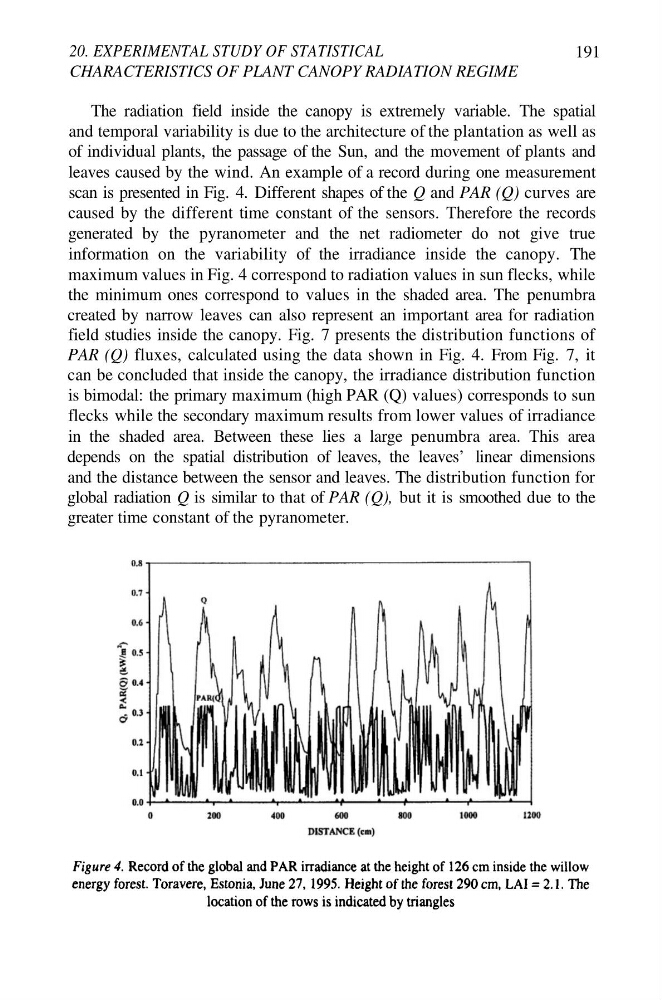
leaves caused by the wind. An example of a record during one measurement
scan is presented in Fig. 4. Different shapes of the Q and PAR (Q) curves are
caused by the different time constant of the sensors. Therefore the records
generated by the pyranometer and the net radiometer do not give true
information on the variability of the irradiance inside the canopy. The
maximum values in Fig. 4 correspond to radiation values in sun flecks, while
the minimum ones correspond to values in the shaded area. The penumbra
created by narrow leaves can also represent an important area for radiation
field studies inside the canopy. Fig. 7 presents the distribution functions of
PAR (Q) fluxes, calculated using the data shown in Fig. 4. From Fig. 7, it
can be concluded that inside the canopy, the irradiance distribution function
is bimodal: the primary maximum (high PAR (Q) values) corresponds to sun
flecks while the secondary maximum results from lower values of irradiance
in the shaded area. Between these lies a large penumbra area. This area
depends on the spatial distribution of leaves, the leaves’ linear dimensions
and the distance between the sensor and leaves. The distribution function for
global radiation Q is similar to that of PAR (Q), but it is smoothed due to the
greater time constant of the pyranometer.