

34
1: Richard Lucas, Aled Rowlands, Olaf Niemann, Ray Merton
Leaf I
Cell
I
pigments:
structure
:
Water content
__ -_ . . : ... - - - -__ :_.-------~~--I
I
80
I
I
70
Chlorophyll
~ 60
~
o
-; 50
o
c:
~ 40
CD
'$ 30
a:
20
10
absorption
NIR
plateau
+
Water
absorption
\
O~-.--,--.--.--,-,,-.--.--,--.~~
0.4 0.6 0.8
I
III"
Visible:
~ 55 i:
05 ~ r:c:
o
I
1.0
NIR
1.2 1.4 1.6 1.8 2.0
Wavrlength (lim)
11"1 4
I
SWIR
I
I
I
I
I
I
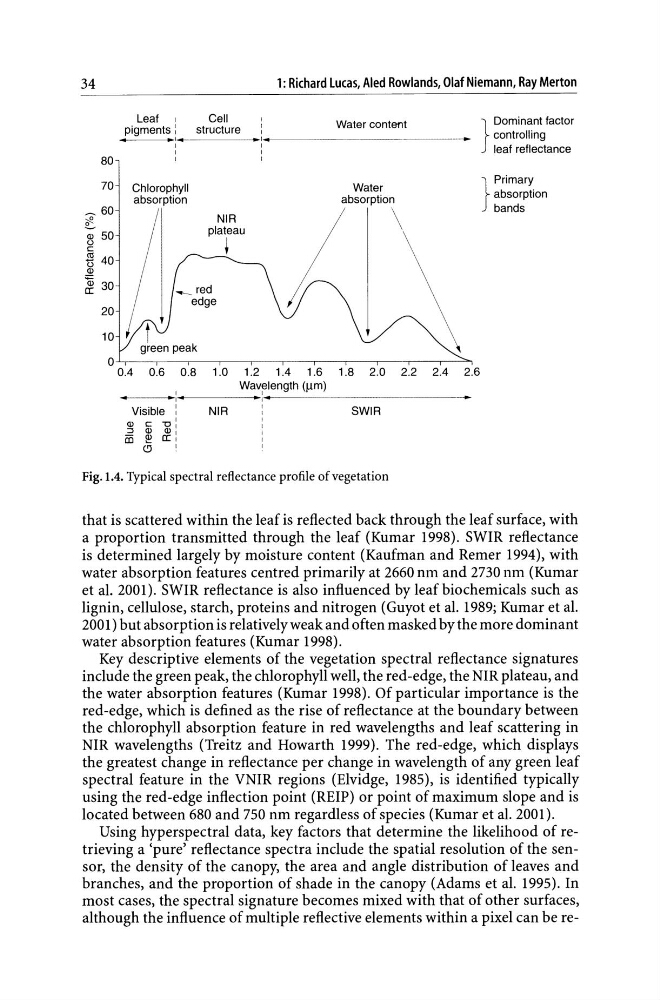
Fig. 1.4. Typical spectral reflectance profile of vegetation
2.2 2.4 2.6
}
Dominant factor
controlling
leaf reflectance
}
Primary
absorption
bands
that is scattered within the leaf is reflected back through the leaf surface, with
a proportion transmitted through the leaf (Kumar 1998). SWIR reflectance
is determined largely by moisture content (Kaufman and Remer 1994), with
water absorption features centred primarily at 2660 nm and 2730 nm (Kumar
et al. 2001). SWIR reflectance is also influenced by leaf biochemicals such as
lignin, cellulose, starch, proteins and nitrogen (Guyot et al. 1989; Kumar et al.
2001) but absorption is relatively weak and often masked by the more dominant
water absorption features (Kumar 1998).
Key descriptive elements of the vegetation spectral reflectance signatures
include the green peak, the chlorophyll well, the red-edge, the NIR plateau, and
the water absorption features (Kumar 1998). Of particular importance is the
red-edge, which is defined as the rise of reflectance at the boundary between
the chlorophyll absorption feature in red wavelengths and leaf scattering in
NIR wavelengths (Treitz and Howarth 1999). The red-edge, which displays
the greatest change in reflectance per change in wavelength of any green leaf
spectral feature in the VNIR regions (Elvidge, 1985), is identified typically
using the red-edge inflection point (REIP) or point of maximum slope and is
located between 680 and 750 nm regardless of species (Kumar et al. 2001).
Using hyperspectral data, key factors that determine the likelihood of retrieving a 'pure' reflectance spectra include the spatial resolution of the sensor, the density of the canopy, the area and angle distribution of leaves and
branches, and the proportion of shade in the canopy (Adams et al. 1995). In
most cases, the spectral signature becomes mixed with that of other surfaces,
although the influence of multiple reflective elements within a pixel can be re-
1: Richard Lucas, Aled Rowlands, Olaf Niemann, Ray Merton
Leaf I
Cell
I
pigments:
structure
:
Water content
__ -_ . . : ... - - - -__ :_.-------~~--I
I
80
I
I
70
Chlorophyll
~ 60
~
o
-; 50
o
c:
~ 40
CD
'$ 30
a:
20
10
absorption
NIR
plateau
+
Water
absorption
\
O~-.--,--.--.--,-,,-.--.--,--.~~
0.4 0.6 0.8
I
III"
Visible:
~ 55 i:
05 ~ r:c:
o
I
1.0
NIR
1.2 1.4 1.6 1.8 2.0
Wavrlength (lim)
11"1 4
I
SWIR
I
I
I
I
I
I
Fig. 1.4. Typical spectral reflectance profile of vegetation
2.2 2.4 2.6
}
Dominant factor
controlling
leaf reflectance
}
Primary
absorption
bands
that is scattered within the leaf is reflected back through the leaf surface, with
a proportion transmitted through the leaf (Kumar 1998). SWIR reflectance
is determined largely by moisture content (Kaufman and Remer 1994), with
water absorption features centred primarily at 2660 nm and 2730 nm (Kumar
et al. 2001). SWIR reflectance is also influenced by leaf biochemicals such as
lignin, cellulose, starch, proteins and nitrogen (Guyot et al. 1989; Kumar et al.
2001) but absorption is relatively weak and often masked by the more dominant
water absorption features (Kumar 1998).
Key descriptive elements of the vegetation spectral reflectance signatures
include the green peak, the chlorophyll well, the red-edge, the NIR plateau, and
the water absorption features (Kumar 1998). Of particular importance is the
red-edge, which is defined as the rise of reflectance at the boundary between
the chlorophyll absorption feature in red wavelengths and leaf scattering in
NIR wavelengths (Treitz and Howarth 1999). The red-edge, which displays
the greatest change in reflectance per change in wavelength of any green leaf
spectral feature in the VNIR regions (Elvidge, 1985), is identified typically
using the red-edge inflection point (REIP) or point of maximum slope and is
located between 680 and 750 nm regardless of species (Kumar et al. 2001).
Using hyperspectral data, key factors that determine the likelihood of retrieving a 'pure' reflectance spectra include the spatial resolution of the sensor, the density of the canopy, the area and angle distribution of leaves and
branches, and the proportion of shade in the canopy (Adams et al. 1995). In
most cases, the spectral signature becomes mixed with that of other surfaces,
although the influence of multiple reflective elements within a pixel can be re-