

28
,: Richard lucas, Aled Rowlands, Olaf Niemann, Ray Merton
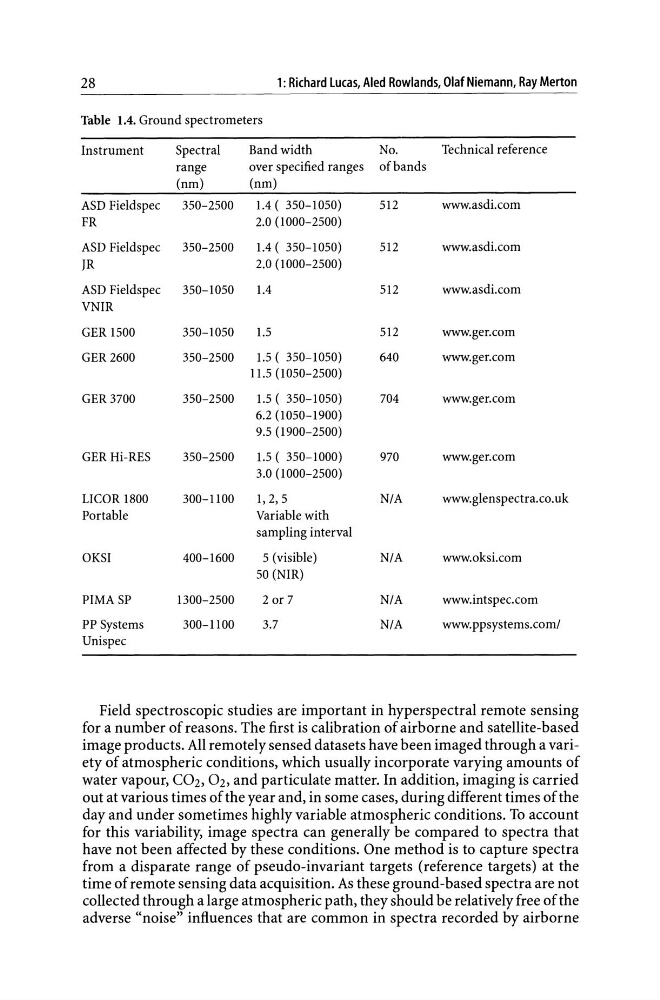
Table 1.4. Ground spectrometers
Instrument
Spectral
Band width
No.
Technical reference
range
over specified ranges of bands
(nm)
(nm)
ASD Fieldspec
350-2500
1.4 ( 350-1050)
512
www.asdLcom
FR
2.0 (1000-2500)
ASD Fieldspec
350-2500
1.4 ( 350-1050)
512
www.asdLcom
JR
2.0 (1000-2500)
ASD Fieldspec
350-1050
1.4
512
www.asdLcom
VNIR
GER 1500
350-1050
l.5
512
www.ger.com
GER2600
350-2500
l.5 ( 350-1050)
640
www.ger.com
11.5 (1050-2500)
GER3700
350-2500
l.5 ( 350-1050)
704
www.ger.com
6.2 (1050-1900)
9.5 (1900-2500)
GER Hi-RES
350-2500
l.5 ( 350-1000)
970
www.ger.com
3.0 (1000-2500)
LICOR 1800
300-1100
1,2,5
N/A
www.glenspectra.co.uk
Portable
Variable with
sampling interval
OKSI
400-1600
5 (visible)
N/A
www.oksLcom
50 (NIR)
PIMASP
1300-2500
2or7
N/A
www.intspec.com
PP Systems
300-1100
3.7
N/A
www.ppsystems.com/
Unispec
Field spectroscopic studies are important in hyperspectral remote sensing
for a number of reasons. The first is calibration of airborne and satellite-based
image products. All remotely sensed datasets have been imaged through a variety of atmospheric conditions, which usually incorporate varying amounts of
water vapour, C02, 02, and particulate matter. In addition, imaging is carried
out at various times of the year and, in some cases, during different times of the
day and under sometimes highly variable atmospheric conditions. To account
for this variability, image spectra can generally be compared to spectra that
have not been affected by these conditions. One method is to capture spectra
from a disparate range of pseudo-invariant targets (reference targets) at the
time of remote sensing data acquisition. As these ground-based spectra are not
collected through a large atmospheric path, they should be relatively free of the
adverse "noise" influences that are common in spectra recorded by airborne
,: Richard lucas, Aled Rowlands, Olaf Niemann, Ray Merton
Table 1.4. Ground spectrometers
Instrument
Spectral
Band width
No.
Technical reference
range
over specified ranges of bands
(nm)
(nm)
ASD Fieldspec
350-2500
1.4 ( 350-1050)
512
www.asdLcom
FR
2.0 (1000-2500)
ASD Fieldspec
350-2500
1.4 ( 350-1050)
512
www.asdLcom
JR
2.0 (1000-2500)
ASD Fieldspec
350-1050
1.4
512
www.asdLcom
VNIR
GER 1500
350-1050
l.5
512
www.ger.com
GER2600
350-2500
l.5 ( 350-1050)
640
www.ger.com
11.5 (1050-2500)
GER3700
350-2500
l.5 ( 350-1050)
704
www.ger.com
6.2 (1050-1900)
9.5 (1900-2500)
GER Hi-RES
350-2500
l.5 ( 350-1000)
970
www.ger.com
3.0 (1000-2500)
LICOR 1800
300-1100
1,2,5
N/A
www.glenspectra.co.uk
Portable
Variable with
sampling interval
OKSI
400-1600
5 (visible)
N/A
www.oksLcom
50 (NIR)
PIMASP
1300-2500
2or7
N/A
www.intspec.com
PP Systems
300-1100
3.7
N/A
www.ppsystems.com/
Unispec
Field spectroscopic studies are important in hyperspectral remote sensing
for a number of reasons. The first is calibration of airborne and satellite-based
image products. All remotely sensed datasets have been imaged through a variety of atmospheric conditions, which usually incorporate varying amounts of
water vapour, C02, 02, and particulate matter. In addition, imaging is carried
out at various times of the year and, in some cases, during different times of the
day and under sometimes highly variable atmospheric conditions. To account
for this variability, image spectra can generally be compared to spectra that
have not been affected by these conditions. One method is to capture spectra
from a disparate range of pseudo-invariant targets (reference targets) at the
time of remote sensing data acquisition. As these ground-based spectra are not
collected through a large atmospheric path, they should be relatively free of the
adverse "noise" influences that are common in spectra recorded by airborne