

282
12: Teerasit Kasetkasem, Pramod K. Varshney
Hb k E {O, 1, ... , K - I}, correspond to the kth CI which is a binary image
whose intensity values are either 0 or 1. Here, we use the notation Hk(a) = 1 to
indicate a change at site a in the kth CI. When xi(a) = xj(a), we have Hk(a) = 0
to indicate no change. We assume that all CIs satisfy MRF properties with the
Gibbs potential UdHk) (defined in Chap. 6). We can write the marginal PDFs
for Xi and Hk as
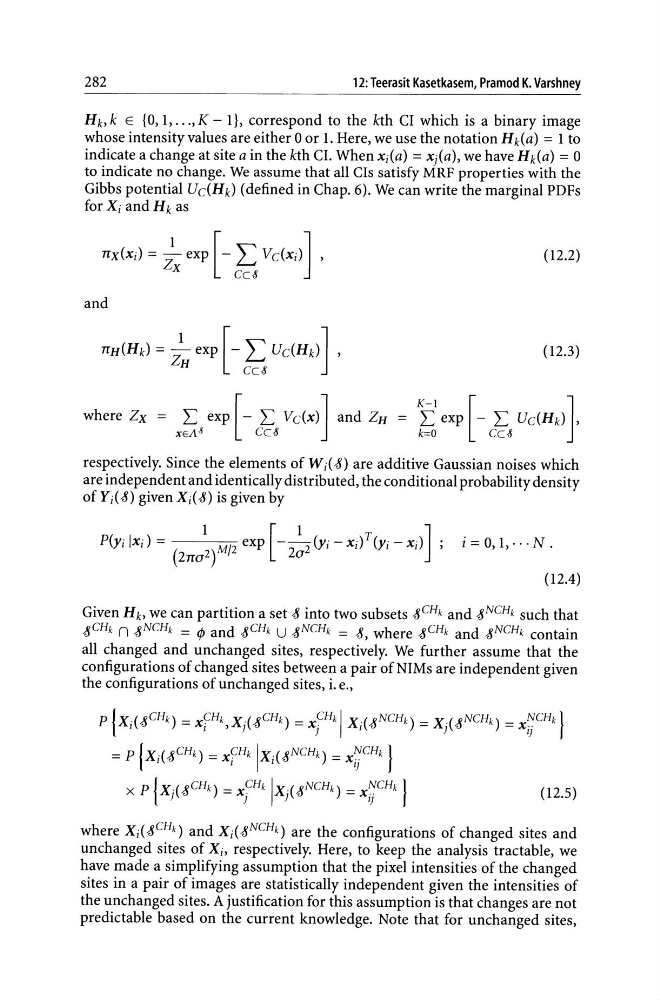
(12.2)
and
(12.3)
where Zx = L exp [- L VdX)] and ZH = ~1 exp [- L UdHk)] ,
XEA'8
CcS
k=O
CcS
respectively. Since the elements of Wi( J) are additive Gaussian noises which
are independent and identically distributed, the conditional probability density
ofYi(J) givenXi(J) is given by
i=O,I,···N.
(12.4)
Given Hb we can partition a set J into two subsets JCHk and JNCHk such that
JCHk n JNCHk = I/J and JCHk U JNCHk = J, where JCHk and JNCHk contain
all changed and unchanged sites, respectively. We further assume that the
configurations of changed sites between a pair ofNIMs are independent given
the configurations of unchanged sites, i. e.,
P {Xi(JCHk) = XfHk,Xj(JCHk) = XfHkl Xi(JNCHk) = Xj(JNCHk) = x~CHk}
= P {Xi(JCHk) = XfHk IXi(JNCHk) = x~CHk }
X P {Xj(JCHk) = XfHk IXj(JNCHk) = x~CHk }
(12.5)
where Xi( JCHk) and Xi( JNCHk) are the configurations of changed sites and
unchanged sites of Xi, respectively. Here, to keep the analysis tractable, we
have made a simplifying assumption that the pixel intensities of the changed
sites in a pair of images are statistically independent given the intensities of
the unchanged sites. A justification for this assumption is that changes are not
predictable based on the current knowledge. Note that for unchanged sites,
12: Teerasit Kasetkasem, Pramod K. Varshney
Hb k E {O, 1, ... , K - I}, correspond to the kth CI which is a binary image
whose intensity values are either 0 or 1. Here, we use the notation Hk(a) = 1 to
indicate a change at site a in the kth CI. When xi(a) = xj(a), we have Hk(a) = 0
to indicate no change. We assume that all CIs satisfy MRF properties with the
Gibbs potential UdHk) (defined in Chap. 6). We can write the marginal PDFs
for Xi and Hk as
(12.2)
and
(12.3)
where Zx = L exp [- L VdX)] and ZH = ~1 exp [- L UdHk)] ,
XEA'8
CcS
k=O
CcS
respectively. Since the elements of Wi( J) are additive Gaussian noises which
are independent and identically distributed, the conditional probability density
ofYi(J) givenXi(J) is given by
i=O,I,···N.
(12.4)
Given Hb we can partition a set J into two subsets JCHk and JNCHk such that
JCHk n JNCHk = I/J and JCHk U JNCHk = J, where JCHk and JNCHk contain
all changed and unchanged sites, respectively. We further assume that the
configurations of changed sites between a pair ofNIMs are independent given
the configurations of unchanged sites, i. e.,
P {Xi(JCHk) = XfHk,Xj(JCHk) = XfHkl Xi(JNCHk) = Xj(JNCHk) = x~CHk}
= P {Xi(JCHk) = XfHk IXi(JNCHk) = x~CHk }
X P {Xj(JCHk) = XfHk IXj(JNCHk) = x~CHk }
(12.5)
where Xi( JCHk) and Xi( JNCHk) are the configurations of changed sites and
unchanged sites of Xi, respectively. Here, to keep the analysis tractable, we
have made a simplifying assumption that the pixel intensities of the changed
sites in a pair of images are statistically independent given the intensities of
the unchanged sites. A justification for this assumption is that changes are not
predictable based on the current knowledge. Note that for unchanged sites,