

Support Vector Machines for Classification of Multi- and Hyperspectral Data
245
the multiclass method used for the classification of a certain dataset. Thus, the
choice of C is highly data dependent.
10.4.2
Choice of Optimizer
The selection of an optimization method is of paramount importance to implement SVM classification in an efficient manner. Though, there are a number of
optimization methods (see Sect. 5.5), only two have been considered here: the
chunking-decomposition (CD) method (Vapnik 1982), which has been widely
used, and the recently developed LSVM method (Mangasarian and Musicant
2000). Several classifications using the pairwise classification approach and
the linear kernel for different C values are performed.
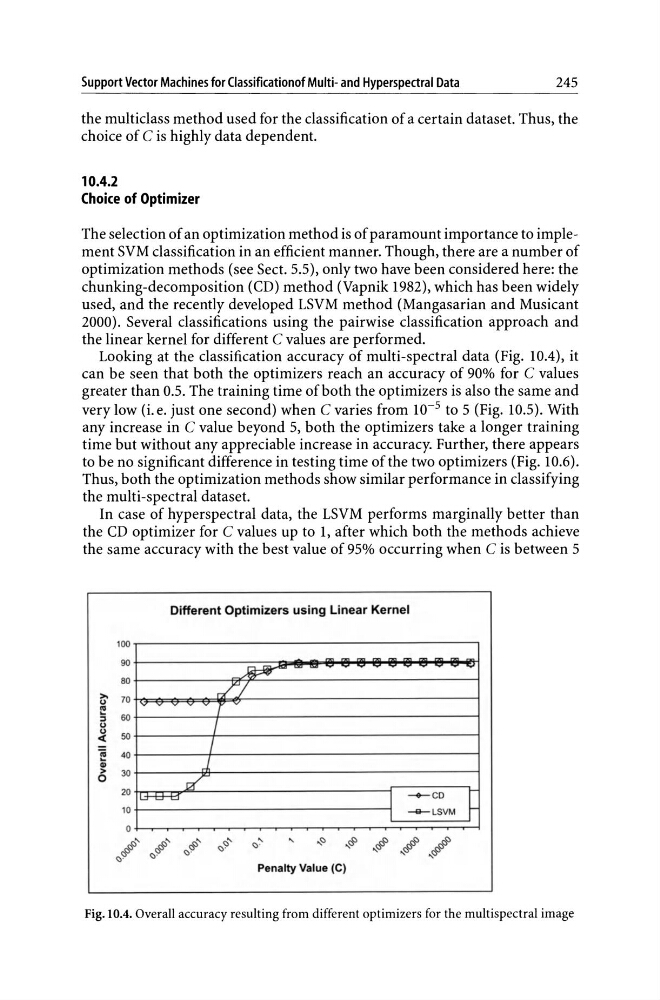
Looking at the classification accuracy of multi-spectral data (Fig. lOA), it
can be seen that both the optimizers reach an accuracy of 90% for C values
greater than 0.5. The training time of both the optimizers is also the same and
very low (i. e. just one second) when C varies from 10- 5 to 5 (Fig. 10.5). With
any increase in C value beyond 5, both the optimizers take a longer training
time but without any appreciable increase in accuracy. Further, there appears
to be no significant difference in testing time of the two optimizers (Fig. 10.6).
Thus, both the optimization methods show similar performance in classifying
the multi-spectral dataset.
In case of hyperspectral data, the LSVM performs marginally better than
the CD optimizer for C values up to 1, after which both the methods achieve
the same accuracy with the best value of 95% occurring when C is between 5
Different Optimizers using Linear Kernel
100
90
80
>- 70
U
co
... 60
:::I
U
U
50
ct
iii 40
a;
> 30
0
20
10
~~
~
/ /
r
/
I
J,
if
I.3--l:::t--tf
I
_ _ CD
~
I
.......... lSVM
"'
Penalty Value (C)
Fig. lOA. Overall accuracy resulting from different optimizers for the multispectral image
245
the multiclass method used for the classification of a certain dataset. Thus, the
choice of C is highly data dependent.
10.4.2
Choice of Optimizer
The selection of an optimization method is of paramount importance to implement SVM classification in an efficient manner. Though, there are a number of
optimization methods (see Sect. 5.5), only two have been considered here: the
chunking-decomposition (CD) method (Vapnik 1982), which has been widely
used, and the recently developed LSVM method (Mangasarian and Musicant
2000). Several classifications using the pairwise classification approach and
the linear kernel for different C values are performed.
Looking at the classification accuracy of multi-spectral data (Fig. lOA), it
can be seen that both the optimizers reach an accuracy of 90% for C values
greater than 0.5. The training time of both the optimizers is also the same and
very low (i. e. just one second) when C varies from 10- 5 to 5 (Fig. 10.5). With
any increase in C value beyond 5, both the optimizers take a longer training
time but without any appreciable increase in accuracy. Further, there appears
to be no significant difference in testing time of the two optimizers (Fig. 10.6).
Thus, both the optimization methods show similar performance in classifying
the multi-spectral dataset.
In case of hyperspectral data, the LSVM performs marginally better than
the CD optimizer for C values up to 1, after which both the methods achieve
the same accuracy with the best value of 95% occurring when C is between 5
Different Optimizers using Linear Kernel
100
90
80
>- 70
U
co
... 60
:::I
U
U
50
ct
iii 40
a;
> 30
0
20
10
~~
~
/ /
r
/
I
J,
if
I.3--l:::t--tf
I
_ _ CD
~
I
.......... lSVM
"'
Penalty Value (C)
Fig. lOA. Overall accuracy resulting from different optimizers for the multispectral image