

234
9: Chintan A. Shah
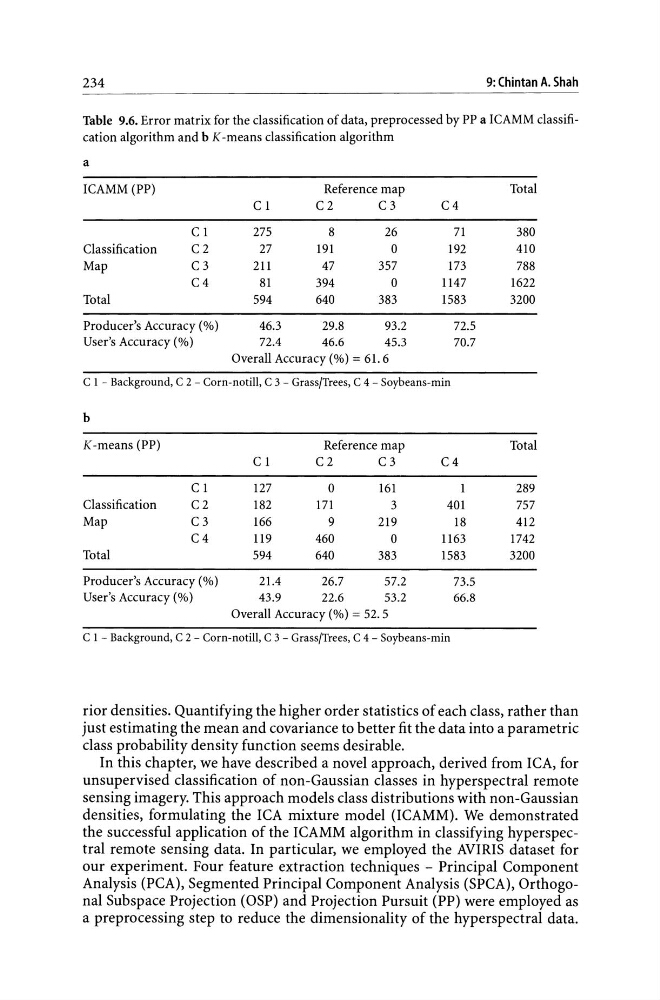
Table 9.6. Error matrix for the classification of data, preprocessed by PP a ICAMM classification algorithm and b K-means classification algorithm
a
ICAMM(PP)
Reference map
Total
Cl
C2
C3
C4
Cl
275
8
26
71
380
Classification
C2
27
191
0
192
410
Map
C3
211
47
357
173
788
C4
81
394
0
1147
1622
Total
594
640
383
1583
3200
Producer's Accuracy (%)
46.3
29.8
93.2
72.5
User's Accuracy (%)
72.4
46.6
45.3
70.7
Overall Accuracy (%) = 6l. 6
C 1 - Background, C 2 - Corn-notill, C 3 - Grass/Trees, C 4 - Soybeans-min
b
K-means (PP)
Reference map
Total
Cl
C2
C3
C4
Cl
127
0
161
1
289
Classification
C2
182
171
3
401
757
Map
C3
166
9
219
18
412
C4
119
460
0
1163
1742
Total
594
640
383
1583
3200
Producer's Accuracy (%)
2l.4
26.7
57.2
73.5
User's Accuracy (%)
43.9
22.6
53.2
66.8
Overall Accuracy (%) = 52.5
C 1 - Background, C 2 - Corn-notill, C 3 - Grass/Trees, C 4 - Soybeans-min
rior densities. Quantifying the higher order statistics of each class, rather than
just estimating the mean and covariance to better fit the data into a parametric
class probability density function seems desirable.
In this chapter, we have described a novel approach, derived from ICA, for
unsupervised classification of non-Gaussian classes in hyperspectral remote
sensing imagery. This approach models class distributions with non-Gaussian
densities, formulating the ICA mixture model (ICAMM). We demonstrated
the successful application of the ICAMM algorithm in classifying hyperspectral remote sensing data. In particular, we employed the AVIRIS dataset for
our experiment. Four feature extraction techniques - Principal Component
Analysis (PCA), Segmented Principal Component Analysis (SPCA), Orthogonal Subspace Projection (aSP) and Projection Pursuit (PP) were employed as
a preprocessing step to reduce the dimensionality of the hyperspectral data.
9: Chintan A. Shah
Table 9.6. Error matrix for the classification of data, preprocessed by PP a ICAMM classification algorithm and b K-means classification algorithm
a
ICAMM(PP)
Reference map
Total
Cl
C2
C3
C4
Cl
275
8
26
71
380
Classification
C2
27
191
0
192
410
Map
C3
211
47
357
173
788
C4
81
394
0
1147
1622
Total
594
640
383
1583
3200
Producer's Accuracy (%)
46.3
29.8
93.2
72.5
User's Accuracy (%)
72.4
46.6
45.3
70.7
Overall Accuracy (%) = 6l. 6
C 1 - Background, C 2 - Corn-notill, C 3 - Grass/Trees, C 4 - Soybeans-min
b
K-means (PP)
Reference map
Total
Cl
C2
C3
C4
Cl
127
0
161
1
289
Classification
C2
182
171
3
401
757
Map
C3
166
9
219
18
412
C4
119
460
0
1163
1742
Total
594
640
383
1583
3200
Producer's Accuracy (%)
2l.4
26.7
57.2
73.5
User's Accuracy (%)
43.9
22.6
53.2
66.8
Overall Accuracy (%) = 52.5
C 1 - Background, C 2 - Corn-notill, C 3 - Grass/Trees, C 4 - Soybeans-min
rior densities. Quantifying the higher order statistics of each class, rather than
just estimating the mean and covariance to better fit the data into a parametric
class probability density function seems desirable.
In this chapter, we have described a novel approach, derived from ICA, for
unsupervised classification of non-Gaussian classes in hyperspectral remote
sensing imagery. This approach models class distributions with non-Gaussian
densities, formulating the ICA mixture model (ICAMM). We demonstrated
the successful application of the ICAMM algorithm in classifying hyperspectral remote sensing data. In particular, we employed the AVIRIS dataset for
our experiment. Four feature extraction techniques - Principal Component
Analysis (PCA), Segmented Principal Component Analysis (SPCA), Orthogonal Subspace Projection (aSP) and Projection Pursuit (PP) were employed as
a preprocessing step to reduce the dimensionality of the hyperspectral data.