

Support Vector Machines
141
The solution to the corresponding dual problem is obtained by minimizing
the primal Lagrangian with respect to wand b and maximizing with respect
tOA:
minmaxL (w, b,A) ,
w,b A
subject to the constraints
y;( w . Xi + b) - 1 ::: 0
and
Ai::: 0 for i = 1, ... ,k.
(5.16)
(5.17)
(5.18)
By differentiating (5.15) with respect to wand b and equating them to zero,
the following equations are obtained:
oL (w,b,A)
ow =0,
(5.19)
oL (w,b,A)
ob
= o.
(5.20)
After differentiating and rearranging (5.19) and (5.20), the optimality conditions become
k
w= LAiYixi,
i=1
k
LAiYi =0.
i=1
(5.21)
(5.22)
From (5.21), the weight vector w is obtained from the Lagrange multipliers
corresponding to the k training samples.
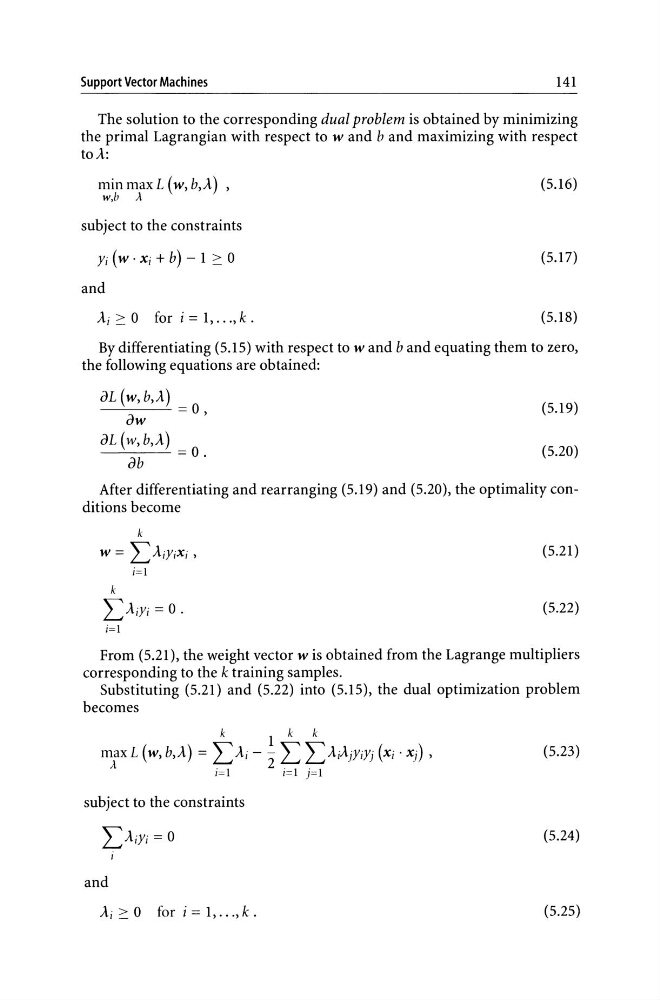
Substituting (5.21) and (5.22) into (5.15), the dual optimization problem
becomes
(5.23)
subject to the constraints
LAiYi = 0
(5.24)
and
Ai ::: 0 for i = 1, ... , k .
(5.25)
141
The solution to the corresponding dual problem is obtained by minimizing
the primal Lagrangian with respect to wand b and maximizing with respect
tOA:
minmaxL (w, b,A) ,
w,b A
subject to the constraints
y;( w . Xi + b) - 1 ::: 0
and
Ai::: 0 for i = 1, ... ,k.
(5.16)
(5.17)
(5.18)
By differentiating (5.15) with respect to wand b and equating them to zero,
the following equations are obtained:
oL (w,b,A)
ow =0,
(5.19)
oL (w,b,A)
ob
= o.
(5.20)
After differentiating and rearranging (5.19) and (5.20), the optimality conditions become
k
w= LAiYixi,
i=1
k
LAiYi =0.
i=1
(5.21)
(5.22)
From (5.21), the weight vector w is obtained from the Lagrange multipliers
corresponding to the k training samples.
Substituting (5.21) and (5.22) into (5.15), the dual optimization problem
becomes
(5.23)
subject to the constraints
LAiYi = 0
(5.24)
and
Ai ::: 0 for i = 1, ... , k .
(5.25)