

126
4: Stefan A. Robila
of the leA model that the model is allowed to have one of the components as
Gaussian.
In the linear mixture model, for each image pixel, the corresponding endmember abundances need to be positive and should sum to one. Neither of the
conditions may be satisfied by the leA generated components. The positivity
of the abundances can be achieved by simple transformations that preserve
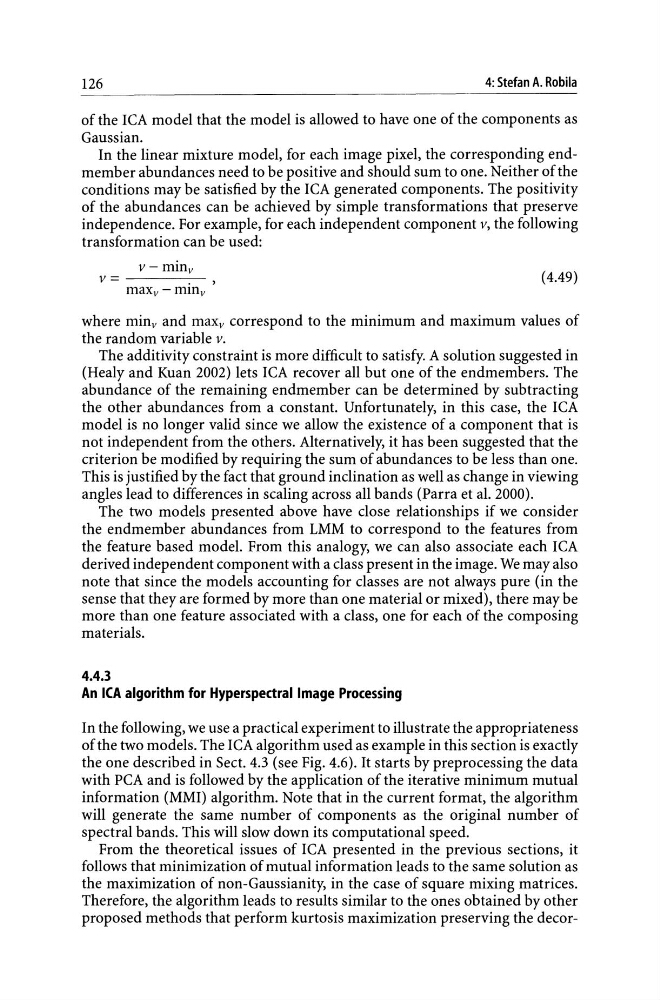
independence. For example, for each independent component v, the following
transformation can be used:
v= maxy-miny
v - miny
(4.49)
where miny and maxy correspond to the minimum and maximum values of
the random variable v.
The additivity constraint is more difficult to satisfy. A solution suggested in
(Healy and Kuan 2002) lets leA recover all but one of the endmembers. The
abundance of the remaining endmember can be determined by subtracting
the other abundances from a constant. Unfortunately, in this case, the leA
model is no longer valid since we allow the existence of a component that is
not independent from the others. Alternatively, it has been suggested that the
criterion be modified by requiring the sum of abundances to be less than one.
This is justified by the fact that ground inclination as well as change in viewing
angles lead to differences in scaling across all bands (Parra et al. 2000).
The two models presented above have close relationships if we consider
the endmember abundances from LMM to correspond to the features from
the feature based model. From this analogy, we can also associate each leA
derived independent component with a class present in the image. We may also
note that since the models accounting for classes are not always pure (in the
sense that they are formed by more than one material or mixed), there may be
more than one feature associated with a class, one for each of the composing
materials.
4.4.3
An leA algorithm for Hyperspectral Image Processing
In the following, we use a practical experiment to illustrate the appropriateness
of the two models. The leA algorithm used as example in this section is exactly
the one described in Sect. 4.3 (see Fig. 4.6). It starts by preprocessing the data
with peA and is followed by the application of the iterative minimum mutual
information (MMI) algorithm. Note that in the current format, the algorithm
will generate the same number of components as the original number of
spectral bands. This will slow down its computational speed.
From the theoretical issues of leA presented in the previous sections, it
follows that minimization of mutual information leads to the same solution as
the maximization of non-Gaussianity, in the case of square mixing matrices.
Therefore, the algorithm leads to results similar to the ones obtained by other
proposed methods that perform kurtosis maximization preserving the decor-
4: Stefan A. Robila
of the leA model that the model is allowed to have one of the components as
Gaussian.
In the linear mixture model, for each image pixel, the corresponding endmember abundances need to be positive and should sum to one. Neither of the
conditions may be satisfied by the leA generated components. The positivity
of the abundances can be achieved by simple transformations that preserve
independence. For example, for each independent component v, the following
transformation can be used:
v= maxy-miny
v - miny
(4.49)
where miny and maxy correspond to the minimum and maximum values of
the random variable v.
The additivity constraint is more difficult to satisfy. A solution suggested in
(Healy and Kuan 2002) lets leA recover all but one of the endmembers. The
abundance of the remaining endmember can be determined by subtracting
the other abundances from a constant. Unfortunately, in this case, the leA
model is no longer valid since we allow the existence of a component that is
not independent from the others. Alternatively, it has been suggested that the
criterion be modified by requiring the sum of abundances to be less than one.
This is justified by the fact that ground inclination as well as change in viewing
angles lead to differences in scaling across all bands (Parra et al. 2000).
The two models presented above have close relationships if we consider
the endmember abundances from LMM to correspond to the features from
the feature based model. From this analogy, we can also associate each leA
derived independent component with a class present in the image. We may also
note that since the models accounting for classes are not always pure (in the
sense that they are formed by more than one material or mixed), there may be
more than one feature associated with a class, one for each of the composing
materials.
4.4.3
An leA algorithm for Hyperspectral Image Processing
In the following, we use a practical experiment to illustrate the appropriateness
of the two models. The leA algorithm used as example in this section is exactly
the one described in Sect. 4.3 (see Fig. 4.6). It starts by preprocessing the data
with peA and is followed by the application of the iterative minimum mutual
information (MMI) algorithm. Note that in the current format, the algorithm
will generate the same number of components as the original number of
spectral bands. This will slow down its computational speed.
From the theoretical issues of leA presented in the previous sections, it
follows that minimization of mutual information leads to the same solution as
the maximization of non-Gaussianity, in the case of square mixing matrices.
Therefore, the algorithm leads to results similar to the ones obtained by other
proposed methods that perform kurtosis maximization preserving the decor-