

Mutuallnformation:A Similarity Measure for Intensity Based Image Registration
lOS
c
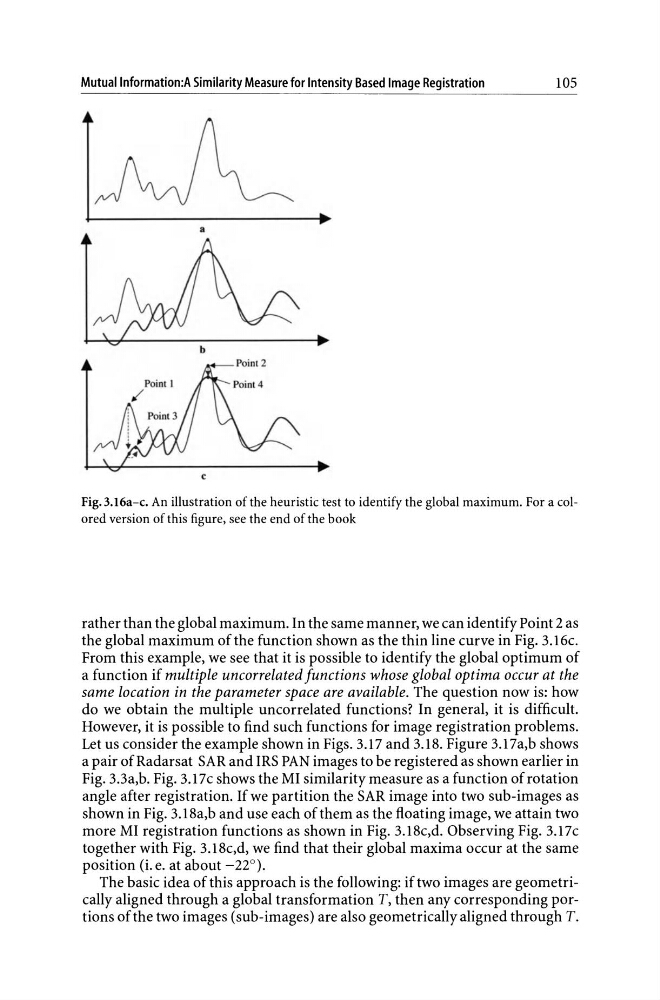
Fig. 3.16a-c. An illustration of the heuristic test to identify the global maximum. For a colored version of this figure, see the end of the book
rather than the global maximum. In the same manner, we can identify Point 2 as
the global maximum of the function shown as the thin line curve in Fig. 3.16c.
From this example, we see that it is possible to identify the global optimum of
a function if multiple uncorrelated functions whose global optima occur at the
same location in the parameter space are available. The question now is: how
do we obtain the multiple uncorrelated functions? In general, it is difficult.
However, it is possible to find such functions for image registration problems.
Let us consider the example shown in Figs. 3.17 and 3.18. Figure 3.17a,b shows
a pair of Radarsat SAR and IRS PAN images to be registered as shown earlier in
Fig. 3.3a,b. Fig. 3.17 c shows the MI similarity measure as a function of rotation
angle after registration. If we partition the SAR image into two sub-images as
shown in Fig. 3.18a,b and use each of them as the floating image, we attain two
more MI registration functions as shown in Fig. 3.18c,d. Observing Fig. 3.17c
together with Fig. 3.18c,d, we find that their global maxima occur at the same
position (i.e. at about -22° ).
The basic idea of this approach is the following: if two images are geometrically aligned through a global transformation T, then any corresponding portions of the two images (sub-images) are also geometrically aligned through T.
lOS
c
Fig. 3.16a-c. An illustration of the heuristic test to identify the global maximum. For a colored version of this figure, see the end of the book
rather than the global maximum. In the same manner, we can identify Point 2 as
the global maximum of the function shown as the thin line curve in Fig. 3.16c.
From this example, we see that it is possible to identify the global optimum of
a function if multiple uncorrelated functions whose global optima occur at the
same location in the parameter space are available. The question now is: how
do we obtain the multiple uncorrelated functions? In general, it is difficult.
However, it is possible to find such functions for image registration problems.
Let us consider the example shown in Figs. 3.17 and 3.18. Figure 3.17a,b shows
a pair of Radarsat SAR and IRS PAN images to be registered as shown earlier in
Fig. 3.3a,b. Fig. 3.17 c shows the MI similarity measure as a function of rotation
angle after registration. If we partition the SAR image into two sub-images as
shown in Fig. 3.18a,b and use each of them as the floating image, we attain two
more MI registration functions as shown in Fig. 3.18c,d. Observing Fig. 3.17c
together with Fig. 3.18c,d, we find that their global maxima occur at the same
position (i.e. at about -22° ).
The basic idea of this approach is the following: if two images are geometrically aligned through a global transformation T, then any corresponding portions of the two images (sub-images) are also geometrically aligned through T.