

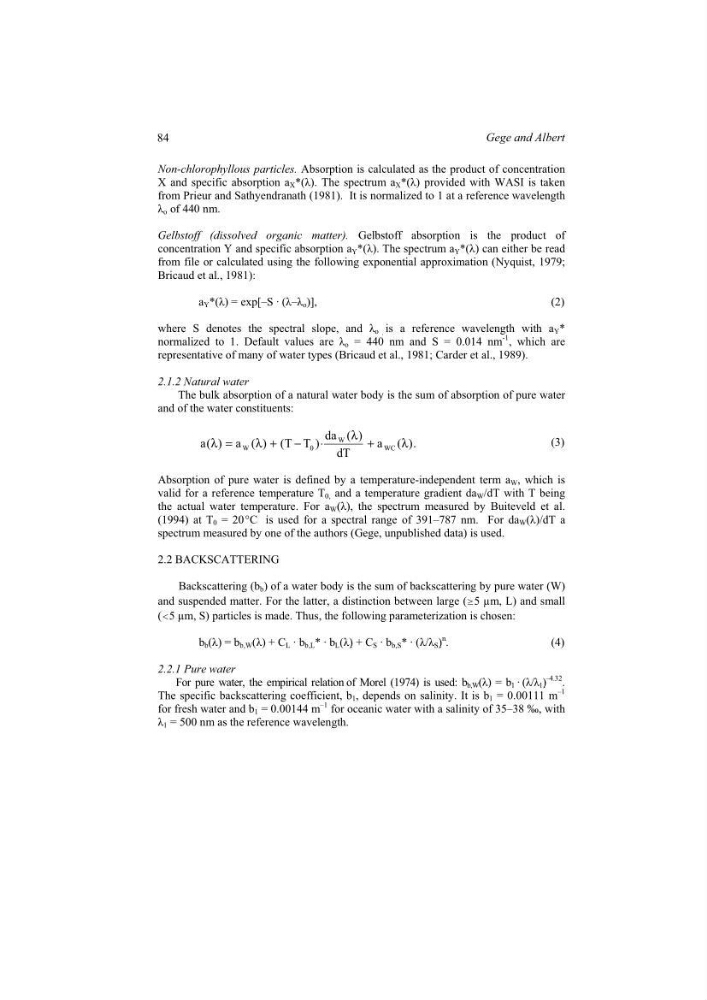
Non-chlorophyllous particles. Absorption is calculated as the product of concentration
X and specific absorption a X *(Ȝ). The spectrum a X *(Ȝ) provided with WASI is taken
from Prieur and Sathyendranath (1981). It is normalized to 1 at a reference wavelength
Ȝ Ƞ of 440 nm.
Gelbstoff (dissolved organic matter). Gelbstoff absorption is the product of
concentration Y and specific absorption a Y *(Ȝ). The spectrum a Y *(Ȝ) can either be read
from file or calculated using the following exponential approximation (Nyquist, 1979;
Bricaud et al., 1981):
a Y *(Ȝ) = exp[–S · (Ȝ–Ȝ Ƞ )],
(2)
where S denotes the spectral slope, and Ȝ Ƞ ҏ is a reference wavelength with a Y *
normalized to 1. Default values are Ȝ Ƞ = 440 nm and S = 0.014 nm
-1
, which are
representative of many of water types (Bricaud et al., 1981; Carder et al., 1989).
2.1.2 Natural water
The bulk absorption of a natural water body is the sum of absorption of pure water
and of the water constituents:
.
)
(
a
dT
)
(
da
)
T
T
(
)
(
a
)
(
a
WC
W
0
W
λ
+
λ
⋅
−
+
λ
=
λ
(3)
Absorption of pure water is defined by a temperature-independent term a W , which is
valid for a reference temperature T 0, and a temperature gradient da W /dT with T being
the actual water temperature. For a W (Ȝ), the spectrum measured by Buiteveld et al.
(1994) at T 0 = 20 °C is used for a spectral range of 391–787 nm. For da W (Ȝ)/dT a
spectrum measured by one of the authors (Gege, unpublished data) is used.
2.2 BACKSCATTERING
Backscattering (b b ) of a water body is the sum of backscattering by pure water (W)
and suspended matter. For the latter, a distinction between large (5 µm, L) and small
(<5 µm, S) particles is made. Thus, the following parameterization is chosen:
b b (Ȝ) = b b,W (Ȝ) + C L · b b,L * · b L (Ȝ)җ + C S · b b,S * · (Ȝ/Ȝ S )җ
n
.
(4)
2.2.1 Pure water
For pure water, the empirical relation of Morel (1974) is used: b b,W (Ȝ) = b 1 · (Ȝ/Ȝ 1 )җ
–4.32 .
The specific backscattering coefficient, b 1 , depends on salinity. It is b 1 = 0.00111 m
–1
for fresh water and b 1 = 0.00144 m
–1 for oceanic water with a salinity of 35–38 ‰, with
Ȝ 1 = 500 nm as the reference wavelength.
84
Gege and Albert
X and specific absorption a X *(Ȝ). The spectrum a X *(Ȝ) provided with WASI is taken
from Prieur and Sathyendranath (1981). It is normalized to 1 at a reference wavelength
Ȝ Ƞ of 440 nm.
Gelbstoff (dissolved organic matter). Gelbstoff absorption is the product of
concentration Y and specific absorption a Y *(Ȝ). The spectrum a Y *(Ȝ) can either be read
from file or calculated using the following exponential approximation (Nyquist, 1979;
Bricaud et al., 1981):
a Y *(Ȝ) = exp[–S · (Ȝ–Ȝ Ƞ )],
(2)
where S denotes the spectral slope, and Ȝ Ƞ ҏ is a reference wavelength with a Y *
normalized to 1. Default values are Ȝ Ƞ = 440 nm and S = 0.014 nm
-1
, which are
representative of many of water types (Bricaud et al., 1981; Carder et al., 1989).
2.1.2 Natural water
The bulk absorption of a natural water body is the sum of absorption of pure water
and of the water constituents:
.
)
(
a
dT
)
(
da
)
T
T
(
)
(
a
)
(
a
WC
W
0
W
λ
+
λ
⋅
−
+
λ
=
λ
(3)
Absorption of pure water is defined by a temperature-independent term a W , which is
valid for a reference temperature T 0, and a temperature gradient da W /dT with T being
the actual water temperature. For a W (Ȝ), the spectrum measured by Buiteveld et al.
(1994) at T 0 = 20 °C is used for a spectral range of 391–787 nm. For da W (Ȝ)/dT a
spectrum measured by one of the authors (Gege, unpublished data) is used.
2.2 BACKSCATTERING
Backscattering (b b ) of a water body is the sum of backscattering by pure water (W)
and suspended matter. For the latter, a distinction between large (5 µm, L) and small
(<5 µm, S) particles is made. Thus, the following parameterization is chosen:
b b (Ȝ) = b b,W (Ȝ) + C L · b b,L * · b L (Ȝ)җ + C S · b b,S * · (Ȝ/Ȝ S )җ
n
.
(4)
2.2.1 Pure water
For pure water, the empirical relation of Morel (1974) is used: b b,W (Ȝ) = b 1 · (Ȝ/Ȝ 1 )җ
–4.32 .
The specific backscattering coefficient, b 1 , depends on salinity. It is b 1 = 0.00111 m
–1
for fresh water and b 1 = 0.00144 m
–1 for oceanic water with a salinity of 35–38 ‰, with
Ȝ 1 = 500 nm as the reference wavelength.
84
Gege and Albert