

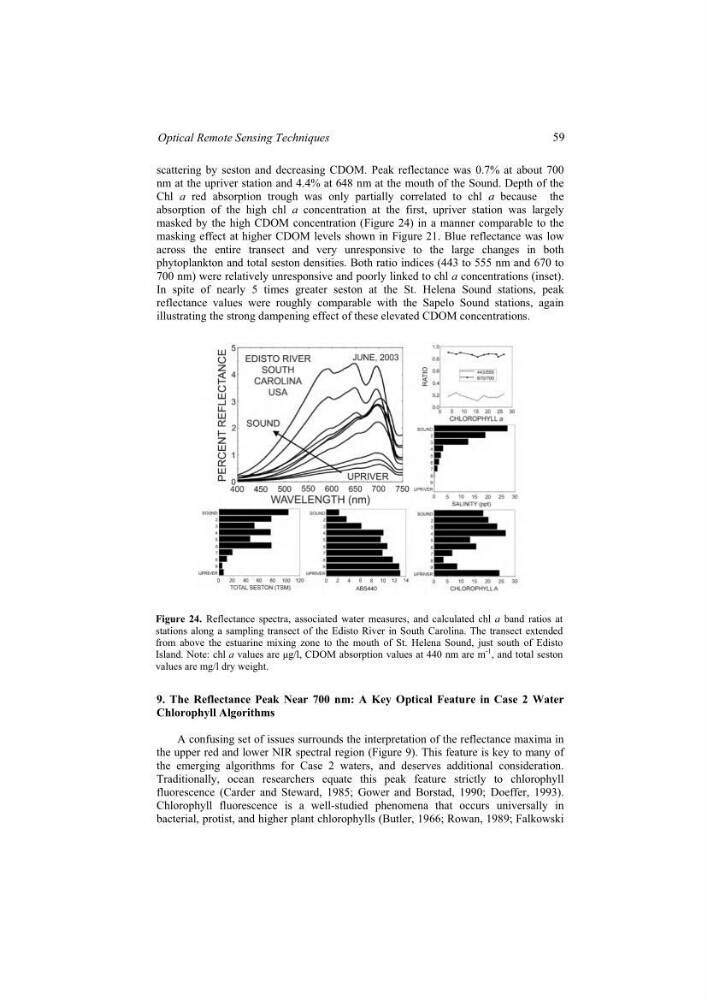
scattering by seston and decreasing CDOM. Peak reflectance was 0.7% at about 700
nm at the upriver station and 4.4% at 648 nm at the mouth of the Sound. Depth of the
Chl a red absorption trough was only partially correlated to chl a because the
absorption of the high chl a concentration at the first, upriver station was largely
masked by the high CDOM concentration (Figure 24) in a manner comparable to the
masking effect at higher CDOM levels shown in Figure 21. Blue reflectance was low
across the entire transect and very unresponsive to the large changes in both
phytoplankton and total seston densities. Both ratio indices (443 to 555 nm and 670 to
700 nm) were relatively unresponsive and poorly linked to chl a concentrations (inset).
In spite of nearly 5 times greater seston at the St. Helena Sound stations, peak
reflectance values were roughly comparable with the Sapelo Sound stations, again
illustrating the strong dampening effect of these elevated CDOM concentrations.
Figure 24. Reflectance spectra, associated water measures, and calculated chl a band ratios at
stations along a sampling transect of the Edisto River in South Carolina. The transect extended
from above the estuarine mixing zone to the mouth of St. Helena Sound, just south of Edisto
Island. Note: chl a values are µg/l, CDOM absorption values at 440 nm are m
-1 , and total seston
values are mg/l dry weight.
9. The Reflectance Peak Near 700 nm: A Key Optical Feature in Case 2 Water
Chlorophyll Algorithms
A confusing set of issues surrounds the interpretation of the reflectance maxima in
the upper red and lower NIR spectral region (Figure 9). This feature is key to many of
the emerging algorithms for Case 2 waters, and deserves additional consideration.
Traditionally, ocean researchers equate this peak feature strictly to chlorophyll
fluorescence (Carder and Steward, 1985; Gower and Borstad, 1990; Doeffer, 1993).
Chlorophyll fluorescence is a well-studied phenomena that occurs universally in
bacterial, protist, and higher plant chlorophylls (Butler, 1966; Rowan, 1989; Falkowski
59
Optical Remote Sensing Techniques
nm at the upriver station and 4.4% at 648 nm at the mouth of the Sound. Depth of the
Chl a red absorption trough was only partially correlated to chl a because the
absorption of the high chl a concentration at the first, upriver station was largely
masked by the high CDOM concentration (Figure 24) in a manner comparable to the
masking effect at higher CDOM levels shown in Figure 21. Blue reflectance was low
across the entire transect and very unresponsive to the large changes in both
phytoplankton and total seston densities. Both ratio indices (443 to 555 nm and 670 to
700 nm) were relatively unresponsive and poorly linked to chl a concentrations (inset).
In spite of nearly 5 times greater seston at the St. Helena Sound stations, peak
reflectance values were roughly comparable with the Sapelo Sound stations, again
illustrating the strong dampening effect of these elevated CDOM concentrations.
Figure 24. Reflectance spectra, associated water measures, and calculated chl a band ratios at
stations along a sampling transect of the Edisto River in South Carolina. The transect extended
from above the estuarine mixing zone to the mouth of St. Helena Sound, just south of Edisto
Island. Note: chl a values are µg/l, CDOM absorption values at 440 nm are m
-1 , and total seston
values are mg/l dry weight.
9. The Reflectance Peak Near 700 nm: A Key Optical Feature in Case 2 Water
Chlorophyll Algorithms
A confusing set of issues surrounds the interpretation of the reflectance maxima in
the upper red and lower NIR spectral region (Figure 9). This feature is key to many of
the emerging algorithms for Case 2 waters, and deserves additional consideration.
Traditionally, ocean researchers equate this peak feature strictly to chlorophyll
fluorescence (Carder and Steward, 1985; Gower and Borstad, 1990; Doeffer, 1993).
Chlorophyll fluorescence is a well-studied phenomena that occurs universally in
bacterial, protist, and higher plant chlorophylls (Butler, 1966; Rowan, 1989; Falkowski
59
Optical Remote Sensing Techniques