

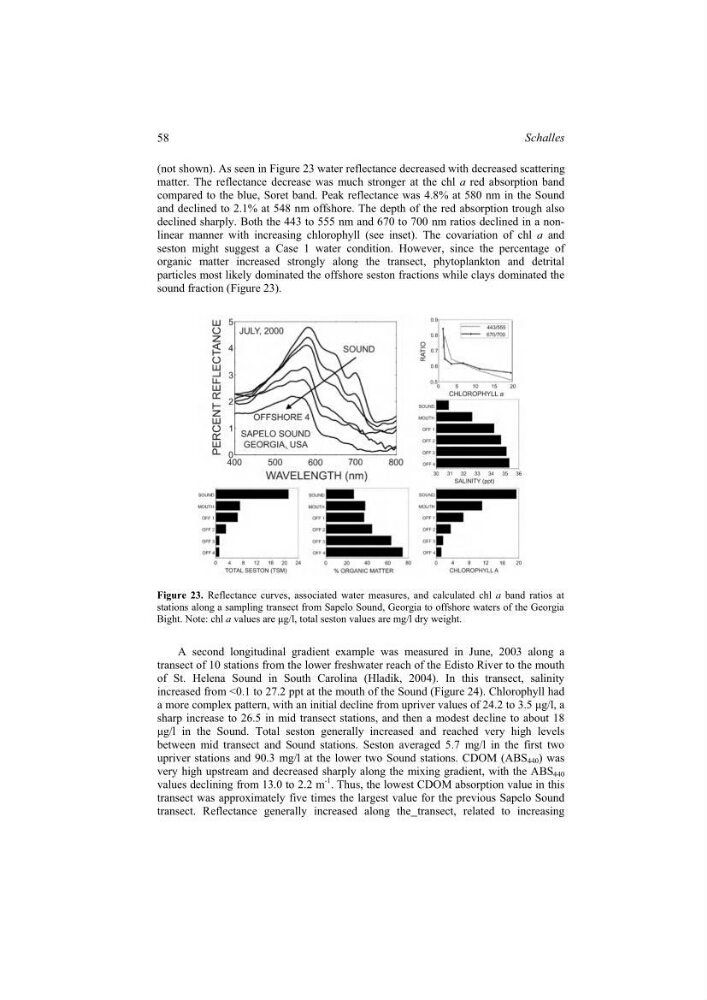
(not shown). As seen in Figure 23 water reflectance decreased with decreased scattering
matter. The reflectance decrease was much stronger at the chl a red absorption band
compared to the blue, Soret band. Peak reflectance was 4.8% at 580 nm in the Sound
and declined to 2.1% at 548 nm offshore. The depth of the red absorption trough also
declined sharply. Both the 443 to 555 nm and 670 to 700 nm ratios declined in a nonlinear manner with increasing chlorophyll (see inset). The covariation of chl a and
seston might suggest a Case 1 water condition. However, since the percentage of
organic matter increased strongly along the transect, phytoplankton and detrital
particles most likely dominated the offshore seston fractions while clays dominated the
sound fraction (Figure 23).
Figure 23. Reflectance curves, associated water measures, and calculated chl a band ratios at
stations along a sampling transect from Sapelo Sound, Georgia to offshore waters of the Georgia
Bight. Note: chl a values are µg/l, total seston values are mg/l dry weight.
A second longitudinal gradient example was measured in June, 2003 along a
transect of 10 stations from the lower freshwater reach of the Edisto River to the mouth
of St. Helena Sound in South Carolina (Hladik, 2004). In this transect, salinity
increased from <0.1 to 27.2 ppt at the mouth of the Sound (Figure 24). Chlorophyll had
a more complex pattern, with an initial decline from upriver values of 24.2 to 3.5 µg/l, a
sharp increase to 26.5 in mid transect stations, and then a modest decline to about 18
µg/l in the Sound. Total seston generally increased and reached very high levels
between mid transect and Sound stations. Seston averaged 5.7 mg/l in the first two
upriver stations and 90.3 mg/l at the lower two Sound stations. CDOM (ABS 440 ) was
very high upstream and decreased sharply along the mixing gradient, with the ABS 440
values declining from 13.0 to 2.2 m
-1 . Thus, the lowest CDOM absorption value in this
transect was approximately five times the largest value for the previous Sapelo Sound
transect. Reflectance generally increased along the transect, related to increasing
58
Schalles
matter. The reflectance decrease was much stronger at the chl a red absorption band
compared to the blue, Soret band. Peak reflectance was 4.8% at 580 nm in the Sound
and declined to 2.1% at 548 nm offshore. The depth of the red absorption trough also
declined sharply. Both the 443 to 555 nm and 670 to 700 nm ratios declined in a nonlinear manner with increasing chlorophyll (see inset). The covariation of chl a and
seston might suggest a Case 1 water condition. However, since the percentage of
organic matter increased strongly along the transect, phytoplankton and detrital
particles most likely dominated the offshore seston fractions while clays dominated the
sound fraction (Figure 23).
Figure 23. Reflectance curves, associated water measures, and calculated chl a band ratios at
stations along a sampling transect from Sapelo Sound, Georgia to offshore waters of the Georgia
Bight. Note: chl a values are µg/l, total seston values are mg/l dry weight.
A second longitudinal gradient example was measured in June, 2003 along a
transect of 10 stations from the lower freshwater reach of the Edisto River to the mouth
of St. Helena Sound in South Carolina (Hladik, 2004). In this transect, salinity
increased from <0.1 to 27.2 ppt at the mouth of the Sound (Figure 24). Chlorophyll had
a more complex pattern, with an initial decline from upriver values of 24.2 to 3.5 µg/l, a
sharp increase to 26.5 in mid transect stations, and then a modest decline to about 18
µg/l in the Sound. Total seston generally increased and reached very high levels
between mid transect and Sound stations. Seston averaged 5.7 mg/l in the first two
upriver stations and 90.3 mg/l at the lower two Sound stations. CDOM (ABS 440 ) was
very high upstream and decreased sharply along the mixing gradient, with the ABS 440
values declining from 13.0 to 2.2 m
-1 . Thus, the lowest CDOM absorption value in this
transect was approximately five times the largest value for the previous Sapelo Sound
transect. Reflectance generally increased along the transect, related to increasing
58
Schalles