

6.2 CLAY SUSPENSIONS AND THEIR EFFECT ON REFLECTANCE
In general, inorganic tripton particles such as clays and carbonate minerals increase
the albedo of water in a density dependent manner, due to strong scattering efficiency
and comparatively low absorption. In contrast, absorption by organic tripton often
resembles CDOM, with a strongly inverse correlation between wavelength and
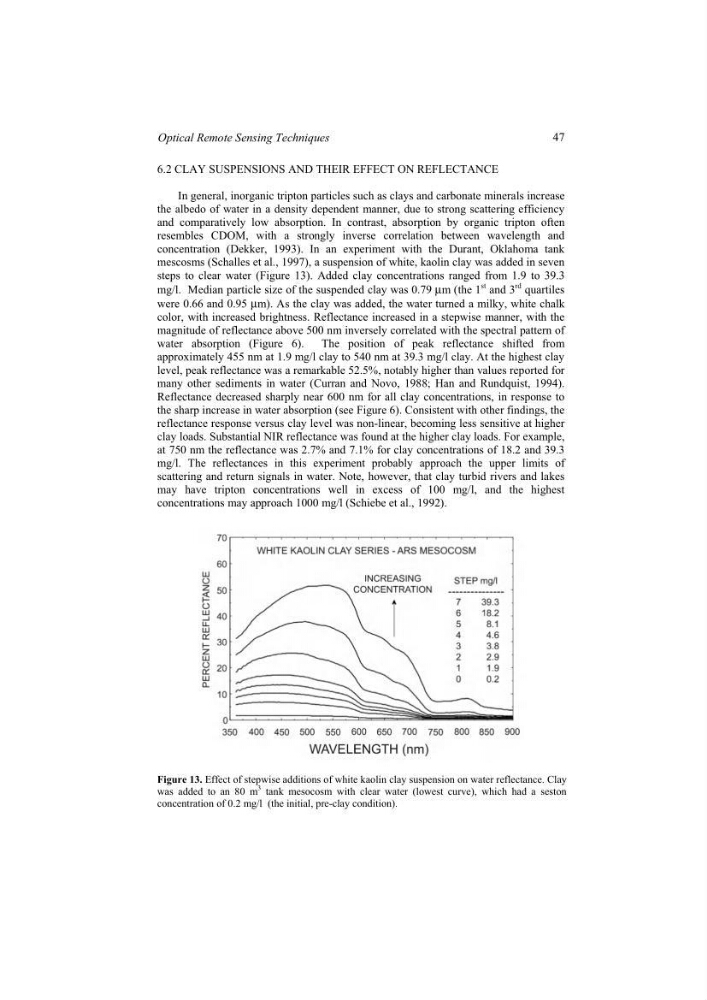
concentration (Dekker, 1993). In an experiment with the Durant, Oklahoma tank
mescosms (Schalles et al., 1997), a suspension of white, kaolin clay was added in seven
steps to clear water (Figure 13). Added clay concentrations ranged from 1.9 to 39.3
mg/l. Median particle size of the suspended clay was 0.79 µm (the 1
st and 3
rd quartiles
were 0.66 and 0.95 µm). As the clay was added, the water turned a milky, white chalk
color, with increased brightness. Reflectance increased in a stepwise manner, with the
magnitude of reflectance above 500 nm inversely correlated with the spectral pattern of
water absorption (Figure 6). The position of peak reflectance shifted from
approximately 455 nm at 1.9 mg/l clay to 540 nm at 39.3 mg/l clay. At the highest clay
level, peak reflectance was a remarkable 52.5%, notably higher than values reported for
many other sediments in water (Curran and Novo, 1988; Han and Rundquist, 1994).
Reflectance decreased sharply near 600 nm for all clay concentrations, in response to
the sharp increase in water absorption (see Figure 6). Consistent with other findings, the
reflectance response versus clay level was non-linear, becoming less sensitive at higher
clay loads. Substantial NIR reflectance was found at the higher clay loads. For example,
at 750 nm the reflectance was 2.7% and 7.1% for clay concentrations of 18.2 and 39.3
mg/l. The reflectances in this experiment probably approach the upper limits of
scattering and return signals in water. Note, however, that clay turbid rivers and lakes
may have tripton concentrations well in excess of 100 mg/l, and the highest
concentrations may approach 1000 mg/l (Schiebe et al., 1992).
Figure 13. Effect of stepwise additions of white kaolin clay suspension on water reflectance. Clay
was added to an 80 m
3 tank mesocosm with clear water (lowest curve), which had a seston
concentration of 0.2 mg/l (the initial, pre-clay condition).
47
Optical Remote Sensing Techniques
In general, inorganic tripton particles such as clays and carbonate minerals increase
the albedo of water in a density dependent manner, due to strong scattering efficiency
and comparatively low absorption. In contrast, absorption by organic tripton often
resembles CDOM, with a strongly inverse correlation between wavelength and
concentration (Dekker, 1993). In an experiment with the Durant, Oklahoma tank
mescosms (Schalles et al., 1997), a suspension of white, kaolin clay was added in seven
steps to clear water (Figure 13). Added clay concentrations ranged from 1.9 to 39.3
mg/l. Median particle size of the suspended clay was 0.79 µm (the 1
st and 3
rd quartiles
were 0.66 and 0.95 µm). As the clay was added, the water turned a milky, white chalk
color, with increased brightness. Reflectance increased in a stepwise manner, with the
magnitude of reflectance above 500 nm inversely correlated with the spectral pattern of
water absorption (Figure 6). The position of peak reflectance shifted from
approximately 455 nm at 1.9 mg/l clay to 540 nm at 39.3 mg/l clay. At the highest clay
level, peak reflectance was a remarkable 52.5%, notably higher than values reported for
many other sediments in water (Curran and Novo, 1988; Han and Rundquist, 1994).
Reflectance decreased sharply near 600 nm for all clay concentrations, in response to
the sharp increase in water absorption (see Figure 6). Consistent with other findings, the
reflectance response versus clay level was non-linear, becoming less sensitive at higher
clay loads. Substantial NIR reflectance was found at the higher clay loads. For example,
at 750 nm the reflectance was 2.7% and 7.1% for clay concentrations of 18.2 and 39.3
mg/l. The reflectances in this experiment probably approach the upper limits of
scattering and return signals in water. Note, however, that clay turbid rivers and lakes
may have tripton concentrations well in excess of 100 mg/l, and the highest
concentrations may approach 1000 mg/l (Schiebe et al., 1992).
Figure 13. Effect of stepwise additions of white kaolin clay suspension on water reflectance. Clay
was added to an 80 m
3 tank mesocosm with clear water (lowest curve), which had a seston
concentration of 0.2 mg/l (the initial, pre-clay condition).
47
Optical Remote Sensing Techniques