

3. Inherent Optical Properties and Constituent Absorption and Scattering
Chlorophyll remote sensing is based on detectable patterns within apparent optical
properties. Radiative transfer equations describe the interactions between the inherent
optical properties, or IOPs (e.g. absorption and scattering coefficients) and apparent
optical properties, or AOPs (e.g. downwelling scalar irradiance attenuation, irradiance
reflectance) for a given time, location, and atmospheric condition. Barnard et al. (1998)
used a pair of in situ profiling ac-9 transmissometers (9 wavelengths; WET Labs, Inc),
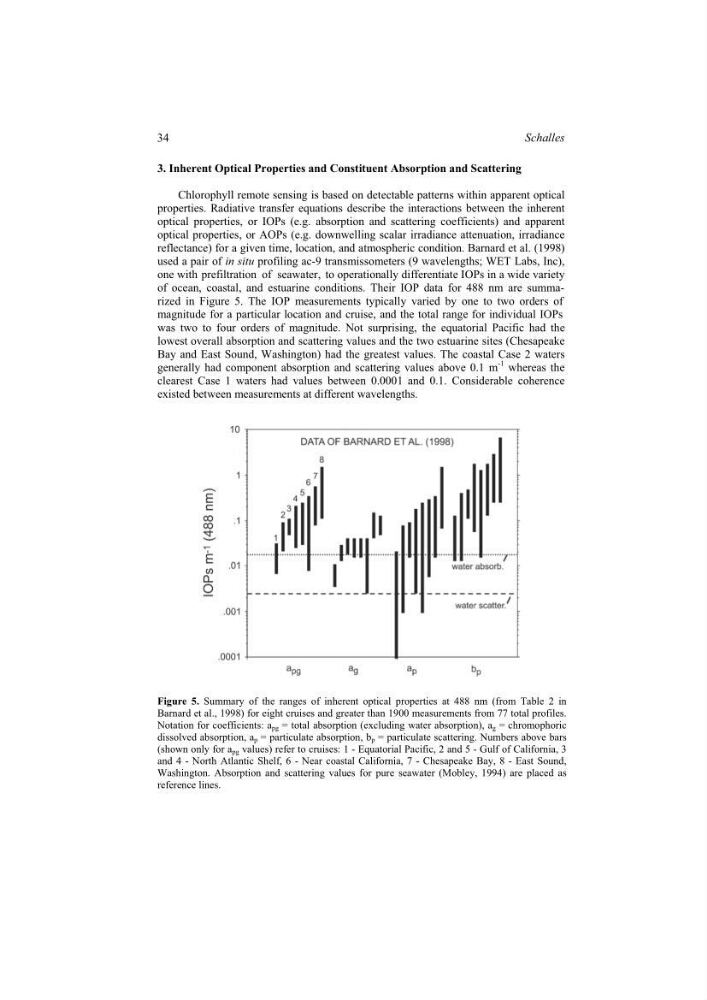
was two to four orders of magnitude. Not surprising, the equatorial Pacific had the
Bay and East Sound, Washington) had the greatest values. The coastal Case 2 waters
generally had component absorption and scattering values above 0.1 m
-1 whereas the
clearest Case 1 waters had values between 0.0001 and 0.1. Considerable coherence
existed between measurements at different wavelengths.
Figure 5. Summary of the ranges of inherent optical properties at 488 nm (from Table 2 in
Barnard et al., 1998) for eight cruises and greater than 1900 measurements from 77 total profiles.
Notation for coefficients: a pg = total absorption (excluding water absorption), a g = chromophoric
dissolved absorption, a p = particulate absorption, b p = particulate scattering. Numbers above bars
(shown only for a pg values) refer to cruises: 1 - Equatorial Pacific, 2 and 5 - Gulf of California, 3
and 4 - North Atlantic Shelf, 6 - Near coastal California, 7 - Chesapeake Bay, 8 - East Sound,
Washington. Absorption and scattering values for pure seawater (Mobley, 1994) are placed as
reference lines.
34
Schalles
lowest overall absorption and scattering values and the two estuarine sites (Chesapeake
magnitude for a particular location and cruise, and the total range for individual IOPs
rized in Figure 5. The IOP measurements typically varied by one to two orders of
of ocean, coastal, and estuarine conditions. Their IOP data for 488 nm are summaone with prefiltration of seawater, to operationally differentiate IOPs in a wide variety
Chlorophyll remote sensing is based on detectable patterns within apparent optical
properties. Radiative transfer equations describe the interactions between the inherent
optical properties, or IOPs (e.g. absorption and scattering coefficients) and apparent
optical properties, or AOPs (e.g. downwelling scalar irradiance attenuation, irradiance
reflectance) for a given time, location, and atmospheric condition. Barnard et al. (1998)
used a pair of in situ profiling ac-9 transmissometers (9 wavelengths; WET Labs, Inc),
was two to four orders of magnitude. Not surprising, the equatorial Pacific had the
Bay and East Sound, Washington) had the greatest values. The coastal Case 2 waters
generally had component absorption and scattering values above 0.1 m
-1 whereas the
clearest Case 1 waters had values between 0.0001 and 0.1. Considerable coherence
existed between measurements at different wavelengths.
Figure 5. Summary of the ranges of inherent optical properties at 488 nm (from Table 2 in
Barnard et al., 1998) for eight cruises and greater than 1900 measurements from 77 total profiles.
Notation for coefficients: a pg = total absorption (excluding water absorption), a g = chromophoric
dissolved absorption, a p = particulate absorption, b p = particulate scattering. Numbers above bars
(shown only for a pg values) refer to cruises: 1 - Equatorial Pacific, 2 and 5 - Gulf of California, 3
and 4 - North Atlantic Shelf, 6 - Near coastal California, 7 - Chesapeake Bay, 8 - East Sound,
Washington. Absorption and scattering values for pure seawater (Mobley, 1994) are placed as
reference lines.
34
Schalles
lowest overall absorption and scattering values and the two estuarine sites (Chesapeake
magnitude for a particular location and cruise, and the total range for individual IOPs
rized in Figure 5. The IOP measurements typically varied by one to two orders of
of ocean, coastal, and estuarine conditions. Their IOP data for 488 nm are summaone with prefiltration of seawater, to operationally differentiate IOPs in a wide variety