

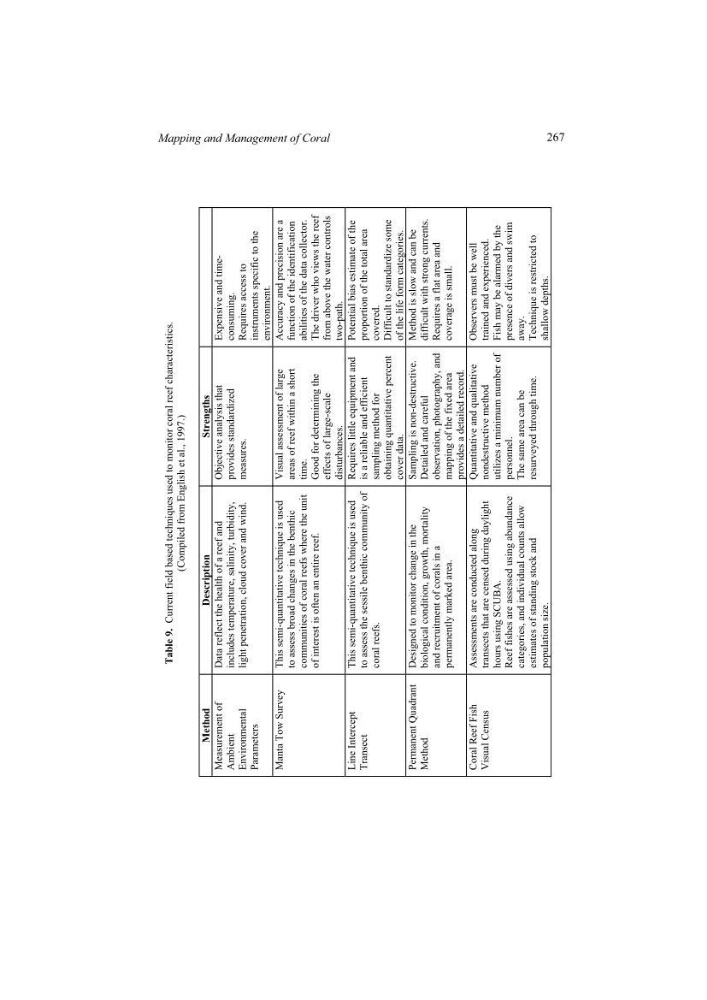
Table 9.
Current field based techniques used to monitor coral reef characteristics.
(Compiled from English et al., 1997.)
Method Description
Strengths
Measurement of
Ambient Environmental
Parameters
Data reflect the health of a reef and
includes temperature, salinity, turbidity,
light penetration, cloud cover and wind.
Objective analysis that
provides standardized
measures.
Expensive and timeconsuming.
Requires access to
instruments specific to the
environment.
Manta Tow Survey This semi-quantitative technique is used
to assess broad changes in the benthic
communities of coral reefs where the unit
of interest is often an entire reef.
Visual assessment of large
areas of reef within a short
time. Good for determining the
effects of large-scale
disturbances.
Accuracy and precision are a
function of the identification
abilities of the data collector.
The driver who views the reef
from above the water controls two-path.
Line Intercept
Transect
This semi-quantitative technique is used
to assess the sessile benthic community of
coral reefs.
Requires little equipment and
is a reliable and efficient
sampling method for
obtaining quantitative percent
cover data.
Potential bias estimate of the proportion of the total area covered. Difficult to standardize some of the life form categories.
Permanent Quadrant
Method
Designed to monitor change in the
biological condition, growth, mortality
and recruitment of corals in a
permanently marked area.
Sampling is non-destructive.
Detailed and careful
observation, photography, and
mapping of the fixed area provides a detailed record.
Method is slow and can be difficult with strong currents. Requires a flat area and coverage is small.
Coral Reef Fish
Visual Census
Assessments are conducted along
transects that are censed during daylight
hours using SCUBA.
Reef fishes are assessed using abundance
categories, and individual counts allow
estimates of standing stock and
population size.
Quantitative and qualitative nondestructive method utilizes a minimum number of personnel. The same area can be resurveyed through time.
Observers must be well trained and experienced. Fish may be alarmed by the presence of divers and swim away. Technique is restricted to shallow depths.
267
Mapping and Management of Coral
Current field based techniques used to monitor coral reef characteristics.
(Compiled from English et al., 1997.)
Method Description
Strengths
Measurement of
Ambient Environmental
Parameters
Data reflect the health of a reef and
includes temperature, salinity, turbidity,
light penetration, cloud cover and wind.
Objective analysis that
provides standardized
measures.
Expensive and timeconsuming.
Requires access to
instruments specific to the
environment.
Manta Tow Survey This semi-quantitative technique is used
to assess broad changes in the benthic
communities of coral reefs where the unit
of interest is often an entire reef.
Visual assessment of large
areas of reef within a short
time. Good for determining the
effects of large-scale
disturbances.
Accuracy and precision are a
function of the identification
abilities of the data collector.
The driver who views the reef
from above the water controls two-path.
Line Intercept
Transect
This semi-quantitative technique is used
to assess the sessile benthic community of
coral reefs.
Requires little equipment and
is a reliable and efficient
sampling method for
obtaining quantitative percent
cover data.
Potential bias estimate of the proportion of the total area covered. Difficult to standardize some of the life form categories.
Permanent Quadrant
Method
Designed to monitor change in the
biological condition, growth, mortality
and recruitment of corals in a
permanently marked area.
Sampling is non-destructive.
Detailed and careful
observation, photography, and
mapping of the fixed area provides a detailed record.
Method is slow and can be difficult with strong currents. Requires a flat area and coverage is small.
Coral Reef Fish
Visual Census
Assessments are conducted along
transects that are censed during daylight
hours using SCUBA.
Reef fishes are assessed using abundance
categories, and individual counts allow
estimates of standing stock and
population size.
Quantitative and qualitative nondestructive method utilizes a minimum number of personnel. The same area can be resurveyed through time.
Observers must be well trained and experienced. Fish may be alarmed by the presence of divers and swim away. Technique is restricted to shallow depths.
267
Mapping and Management of Coral