

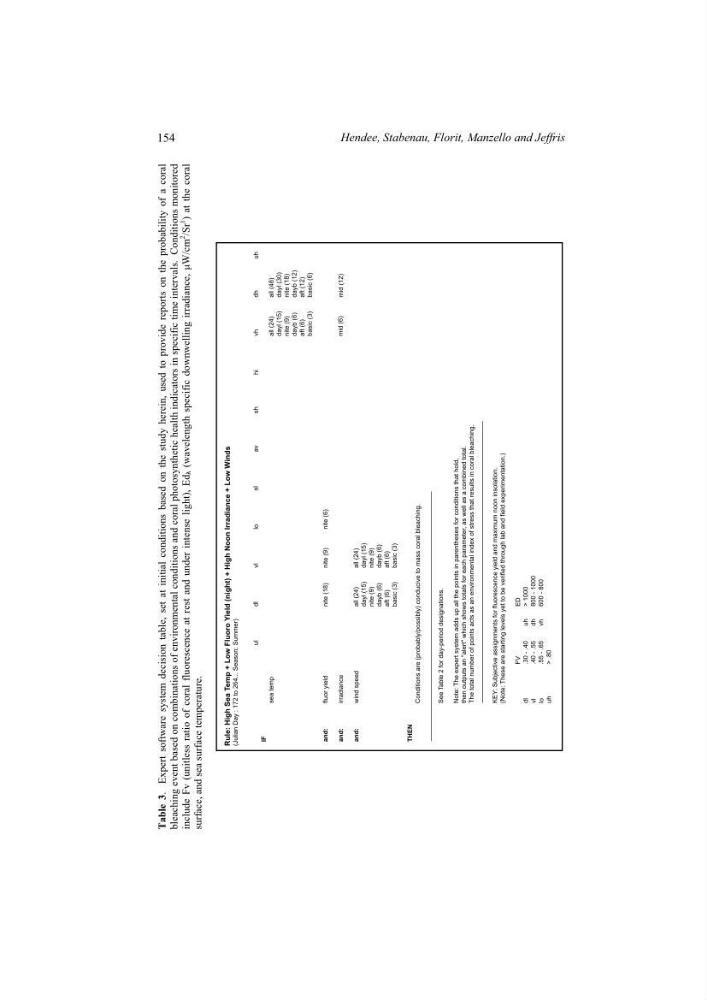
Table 3.
Expert software system decision table, set at initial conditions based
on the study herein, used to provide reports on the probability
of a coral
bleaching event based on combinations of environmental conditions and coral photosynthetic health indicators in specific time intervals.
Conditions monitored
include Fv (unitless ratio of coral fluorescence at rest and under
intense light), Ed Ȝ
(wavelength specific downwelling irradiance, µW/cm
2
/Sr
1
) at the coral
surface, and sea surface temperature.
Rule: High Sea Temp + Low Fluoro Yield (night) + High Noon Irradiance + Low Winds
(Julian Day : 172 to 264... Season: Summer)
IF sea temp
and:
and:
and:
fluor yield
irradiance
wind speed
ul dl vl lo
sl av sh hi
vh dh uh
all (24)
dayl (15)
nite (9)
dayb (6)
aft (6)
basic (3)
all (48)
dayl (30)
nite (18) dayb (12) aft (12) basic (6)
mid (6) mid (12)
nite (18) nite (9) nite (6)
all (24)
dayl (15)
nite (9)
dayb (6)
aft (6)
basic (3)
all (24)
dayl (15)
nite (9)
dayb (6)
aft (6)
basic (3)
Conditions are (probably/possibly) conducive to mass coral bleaching.
See Table 2 for day-period designations.
Note: The expert system adds up all the points in parentheses for conditions that hold,
then outputs an "alert" which shows totals for each parameter,
as well as a combined total.
The total number of points acts as an environmental index of stress that results in coral bleaching.
KEY: Subjective assignments for fluorescence yield and maximum noon insolation.
(Note: These are starting levels yet to be verified through lab and field experimentation.)
dl
vl lo uh
FV .30 - .40
.40 - .55
.55 - .65
> .80
uh dh
vh
ED
> 1000
800 - 1000
600 - 800
THEN
154
Hendee, Stabenau, Florit, Manzello and Jeffris
Expert software system decision table, set at initial conditions based
on the study herein, used to provide reports on the probability
of a coral
bleaching event based on combinations of environmental conditions and coral photosynthetic health indicators in specific time intervals.
Conditions monitored
include Fv (unitless ratio of coral fluorescence at rest and under
intense light), Ed Ȝ
(wavelength specific downwelling irradiance, µW/cm
2
/Sr
1
) at the coral
surface, and sea surface temperature.
Rule: High Sea Temp + Low Fluoro Yield (night) + High Noon Irradiance + Low Winds
(Julian Day : 172 to 264... Season: Summer)
IF sea temp
and:
and:
and:
fluor yield
irradiance
wind speed
ul dl vl lo
sl av sh hi
vh dh uh
all (24)
dayl (15)
nite (9)
dayb (6)
aft (6)
basic (3)
all (48)
dayl (30)
nite (18) dayb (12) aft (12) basic (6)
mid (6) mid (12)
nite (18) nite (9) nite (6)
all (24)
dayl (15)
nite (9)
dayb (6)
aft (6)
basic (3)
all (24)
dayl (15)
nite (9)
dayb (6)
aft (6)
basic (3)
Conditions are (probably/possibly) conducive to mass coral bleaching.
See Table 2 for day-period designations.
Note: The expert system adds up all the points in parentheses for conditions that hold,
then outputs an "alert" which shows totals for each parameter,
as well as a combined total.
The total number of points acts as an environmental index of stress that results in coral bleaching.
KEY: Subjective assignments for fluorescence yield and maximum noon insolation.
(Note: These are starting levels yet to be verified through lab and field experimentation.)
dl
vl lo uh
FV .30 - .40
.40 - .55
.55 - .65
> .80
uh dh
vh
ED
> 1000
800 - 1000
600 - 800
THEN
154
Hendee, Stabenau, Florit, Manzello and Jeffris