

AISA
Excess Production (Kg C)
Calcification (Kg CaCO 3
)
200
150
100
50
0
-50
-100
-120
-100
-80
-60
-40
-20
0
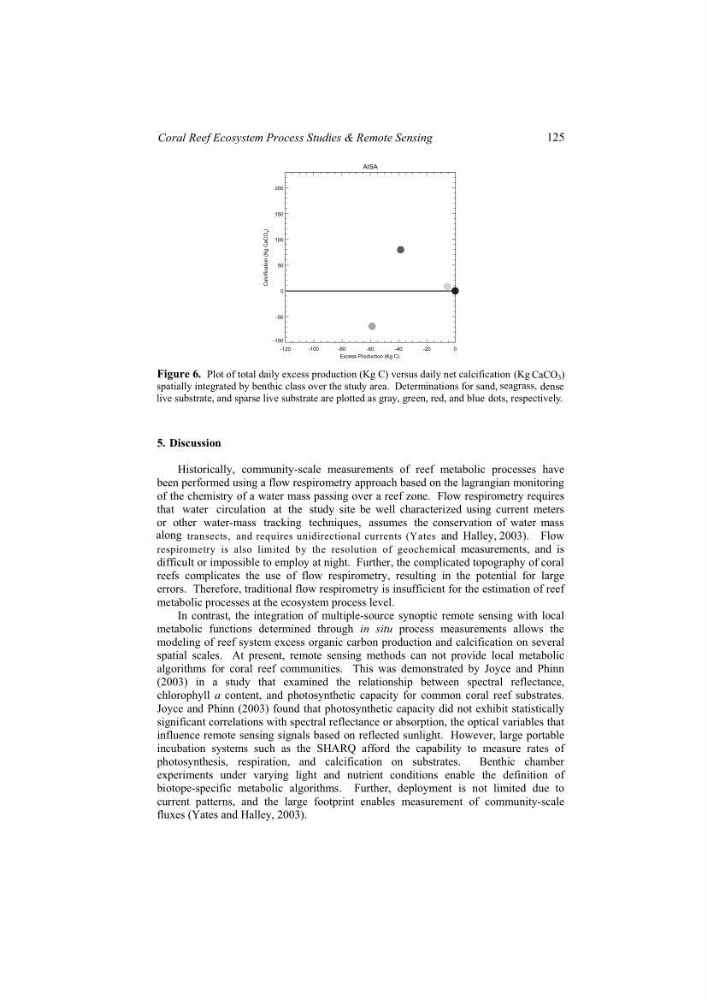
Figure 6. Plot of total daily excess production (Kg C) versus daily net calcification (Kg CaCO 3 )
spatially integrated by benthic class over the study area. Determinations for sand, seagrass, dense
live substrate, and sparse live substrate are plotted as gray, green, red, and blue dots, respectively.
5. Discussion
Historically, community-scale measurements of reef metabolic processes have
been performed using a flow respirometry approach based on the lagrangian monitoring
of the chemistry of a water mass passing over a reef zone. Flow respirometry requires
that water circulation at the study site be well characterized using current meters
or other water-mass tracking techniques, assumes the conservation of water mass
along transects, and requires unidirectional currents (Yates and Halley, 2003). Flow
respirometry is also limited by the resolution of geochemical measurements, and is
difficult or impossible to employ at night. Further, the complicated topography of coral
reefs complicates the use of flow respirometry, resulting in the potential for large
errors. Therefore, traditional flow respirometry is insufficient for the estimation of reef
metabolic processes at the ecosystem process level.
In contrast, the integration of multiple-source synoptic remote sensing with local
metabolic functions determined through in situ process measurements allows the
modeling of reef system excess organic carbon production and calcification on several
spatial scales. At present, remote sensing methods can not provide local metabolic
algorithms for coral reef communities. This was demonstrated by Joyce and Phinn
(2003) in a study that examined the relationship between spectral reflectance,
chlorophyll a content, and photosynthetic capacity for common coral reef substrates.
Joyce and Phinn (2003) found that photosynthetic capacity did not exhibit statistically
significant correlations with spectral reflectance or absorption, the optical variables that
influence remote sensing signals based on reflected sunlight. However, large portable
incubation systems such as the SHARQ afford the capability to measure rates of
photosynthesis, respiration, and calcification on substrates.
Benthic chamber
experiments under varying light and nutrient conditions enable the definition of
biotope-specific metabolic algorithms. Further, deployment is not limited due to
current patterns, and the large footprint enables measurement of community-scale
fluxes (Yates and Halley, 2003).
125
Coral Reef Ecosystem Process Studies & Remote Sensing
Excess Production (Kg C)
Calcification (Kg CaCO 3
)
200
150
100
50
0
-50
-100
-120
-100
-80
-60
-40
-20
0
Figure 6. Plot of total daily excess production (Kg C) versus daily net calcification (Kg CaCO 3 )
spatially integrated by benthic class over the study area. Determinations for sand, seagrass, dense
live substrate, and sparse live substrate are plotted as gray, green, red, and blue dots, respectively.
5. Discussion
Historically, community-scale measurements of reef metabolic processes have
been performed using a flow respirometry approach based on the lagrangian monitoring
of the chemistry of a water mass passing over a reef zone. Flow respirometry requires
that water circulation at the study site be well characterized using current meters
or other water-mass tracking techniques, assumes the conservation of water mass
along transects, and requires unidirectional currents (Yates and Halley, 2003). Flow
respirometry is also limited by the resolution of geochemical measurements, and is
difficult or impossible to employ at night. Further, the complicated topography of coral
reefs complicates the use of flow respirometry, resulting in the potential for large
errors. Therefore, traditional flow respirometry is insufficient for the estimation of reef
metabolic processes at the ecosystem process level.
In contrast, the integration of multiple-source synoptic remote sensing with local
metabolic functions determined through in situ process measurements allows the
modeling of reef system excess organic carbon production and calcification on several
spatial scales. At present, remote sensing methods can not provide local metabolic
algorithms for coral reef communities. This was demonstrated by Joyce and Phinn
(2003) in a study that examined the relationship between spectral reflectance,
chlorophyll a content, and photosynthetic capacity for common coral reef substrates.
Joyce and Phinn (2003) found that photosynthetic capacity did not exhibit statistically
significant correlations with spectral reflectance or absorption, the optical variables that
influence remote sensing signals based on reflected sunlight. However, large portable
incubation systems such as the SHARQ afford the capability to measure rates of
photosynthesis, respiration, and calcification on substrates.
Benthic chamber
experiments under varying light and nutrient conditions enable the definition of
biotope-specific metabolic algorithms. Further, deployment is not limited due to
current patterns, and the large footprint enables measurement of community-scale
fluxes (Yates and Halley, 2003).
125
Coral Reef Ecosystem Process Studies & Remote Sensing