

given to shorter wavelengths. A good choice is Ȝ 2 = Ȝ 0 since S errors don’t affect
Gelbstoff absorption at Ȝ 0 . For Ȝ 3 no separate wavelength must be chosen, and it can be
set as Ȝ 3 = Ȝ 2 . Consequently, selection of only two wavelengths is implemented in
WASI. Their default values are: Ȝ 1 = 413 nm, Ȝ 2 = 440 nm.
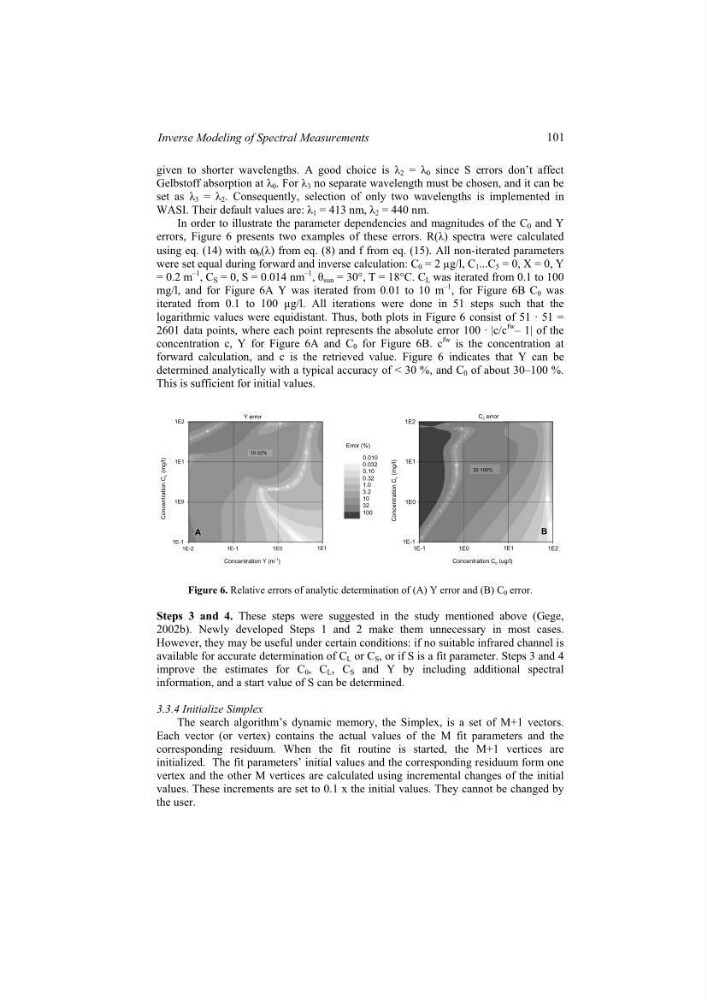
In order to illustrate the parameter dependencies and magnitudes of the C 0 and Y
errors, Figure 6 presents two examples of these errors. R(Ȝ) spectra were calculated
using eq. (14) with ω b (Ȝ) from eq. (8) and f from eq. (15). All non-iterated parameters
were set equal during forward and inverse calculation: C 0 = 2 µg/l, C 1 ...C 5 = 0, X = 0, Y
= 0.2 m
–1
, C S = 0, S = 0.014 nm
–1 , ș sun = 30°, T = 18°C. C L was iterated from 0.1 to 100
mg/l, and for Figure 6A Y was iterated from 0.01 to 10 m
–1 , for Figure 6B C 0 was
iterated from 0.1 to 100 µg/l. All iterations were done in 51 steps such that the
logarithmic values were equidistant. Thus, both plots in Figure 6 consist of 51 · 51 =
2601 data points, where each point represents the absolute error 100 · |c/c
fw
– 1| of the
concentration c, Y for Figure 6A and C 0 for Figure 6B. c
fw is the concentration at
forward calculation, and c is the retrieved value. Figure 6 indicates that Y can be
determined analytically with a typical accuracy of < 30 %, and C 0 of about 30–100 %.
This is sufficient for initial values.
1E-2
1E-1
1E0
1E1
1E-1
1E0
1E1
1E2
Concentration Y (m -1 )
Y error
10-32%
Concentration C
L (mg/l)
Error (%)
100
32
10
3.2
1.0
0.32
0.10
0.032
0.010
Concentration C
L (mg/l)
C 0 error
Concentration C 0 (ug/l)
1E2
1E1
1E0
1E-1
1E-1
1E0
1E1
1E2
32-100%
B
A
Figure 6. Relative errors of analytic determination of (A) Y error and (B) C 0 error.
Steps 3 and 4. These steps were suggested in the study mentioned above (Gege,
2002b). Newly developed Steps 1 and 2 make them unnecessary in most cases.
However, they may be useful under certain conditions: if no suitable infrared channel is
available for accurate determination of C L or C S , or if S is a fit parameter. Steps 3 and 4
improve the estimates for C 0 , C L , C S and Y by including additional spectral
information, and a start value of S can be determined.
3.3.4 Initialize Simplex
The search algorithm’s dynamic memory, the Simplex, is a set of M+1 vectors.
Each vector (or vertex) contains the actual values of the M fit parameters and the
corresponding residuum. When the fit routine is started, the M+1 vertices are
initialized. The fit parameters’ initial values and the corresponding residuum form one
vertex and the other M vertices are calculated using incremental changes of the initial
values. These increments are set to 0.1 x the initial values. They cannot be changed by
the user.
101
Inverse Modeling of Spectral Measurements
Gelbstoff absorption at Ȝ 0 . For Ȝ 3 no separate wavelength must be chosen, and it can be
set as Ȝ 3 = Ȝ 2 . Consequently, selection of only two wavelengths is implemented in
WASI. Their default values are: Ȝ 1 = 413 nm, Ȝ 2 = 440 nm.
In order to illustrate the parameter dependencies and magnitudes of the C 0 and Y
errors, Figure 6 presents two examples of these errors. R(Ȝ) spectra were calculated
using eq. (14) with ω b (Ȝ) from eq. (8) and f from eq. (15). All non-iterated parameters
were set equal during forward and inverse calculation: C 0 = 2 µg/l, C 1 ...C 5 = 0, X = 0, Y
= 0.2 m
–1
, C S = 0, S = 0.014 nm
–1 , ș sun = 30°, T = 18°C. C L was iterated from 0.1 to 100
mg/l, and for Figure 6A Y was iterated from 0.01 to 10 m
–1 , for Figure 6B C 0 was
iterated from 0.1 to 100 µg/l. All iterations were done in 51 steps such that the
logarithmic values were equidistant. Thus, both plots in Figure 6 consist of 51 · 51 =
2601 data points, where each point represents the absolute error 100 · |c/c
fw
– 1| of the
concentration c, Y for Figure 6A and C 0 for Figure 6B. c
fw is the concentration at
forward calculation, and c is the retrieved value. Figure 6 indicates that Y can be
determined analytically with a typical accuracy of < 30 %, and C 0 of about 30–100 %.
This is sufficient for initial values.
1E-2
1E-1
1E0
1E1
1E-1
1E0
1E1
1E2
Concentration Y (m -1 )
Y error
10-32%
Concentration C
L (mg/l)
Error (%)
100
32
10
3.2
1.0
0.32
0.10
0.032
0.010
Concentration C
L (mg/l)
C 0 error
Concentration C 0 (ug/l)
1E2
1E1
1E0
1E-1
1E-1
1E0
1E1
1E2
32-100%
B
A
Figure 6. Relative errors of analytic determination of (A) Y error and (B) C 0 error.
Steps 3 and 4. These steps were suggested in the study mentioned above (Gege,
2002b). Newly developed Steps 1 and 2 make them unnecessary in most cases.
However, they may be useful under certain conditions: if no suitable infrared channel is
available for accurate determination of C L or C S , or if S is a fit parameter. Steps 3 and 4
improve the estimates for C 0 , C L , C S and Y by including additional spectral
information, and a start value of S can be determined.
3.3.4 Initialize Simplex
The search algorithm’s dynamic memory, the Simplex, is a set of M+1 vectors.
Each vector (or vertex) contains the actual values of the M fit parameters and the
corresponding residuum. When the fit routine is started, the M+1 vertices are
initialized. The fit parameters’ initial values and the corresponding residuum form one
vertex and the other M vertices are calculated using incremental changes of the initial
values. These increments are set to 0.1 x the initial values. They cannot be changed by
the user.
101
Inverse Modeling of Spectral Measurements