

1E1
1E0
1E-1
1E-2
1E-1
1E0
1E1
1E2
Concentration C L (mg/l)
0
-0.5
-1
-2
-3
-4
Concentration Y (m
-1
)
Concentration C L (mg/l)
1E1
1E0
1E-1
1E-2
1E-1
1E0
1E1
1E2
0
-0.50
-1.0
-1.0
-1.5 -2.0
Concentration Y (m
-1
)
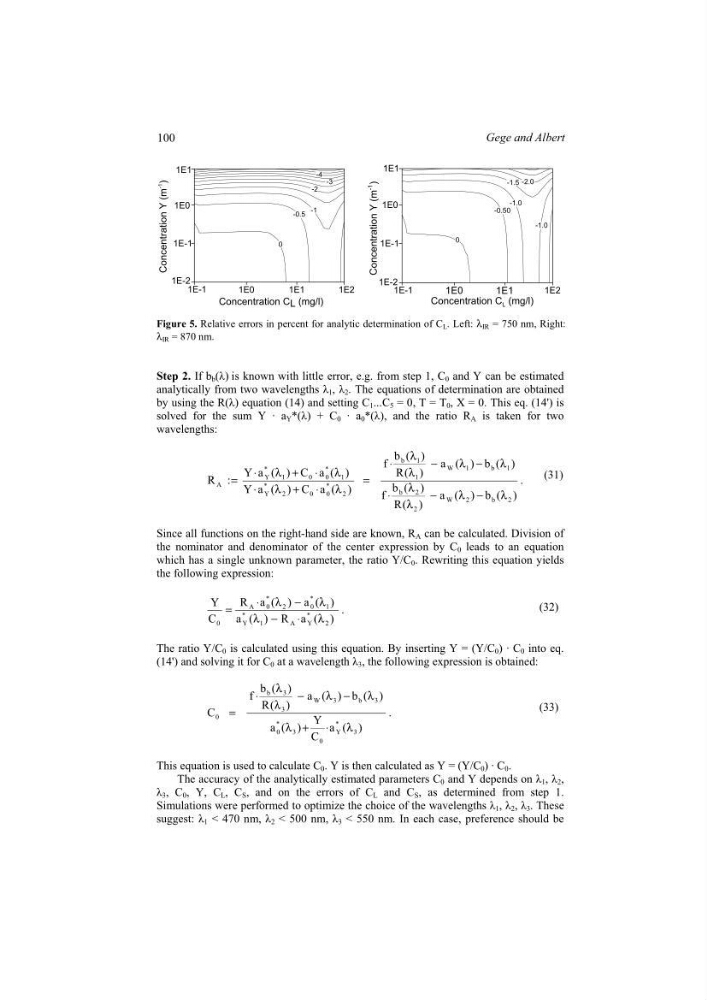
Figure 5. Relative errors in percent for analytic determination of C L . Left: λ IR = 750 nm, Right:
λ IR = 870 nm.
Step 2. If b b (Ȝ) is known with little error, e.g. from step 1, C 0 and Y can be estimated
analytically from two wavelengths Ȝ 1 , Ȝ 2 . The equations of determination are obtained
by using the R(Ȝ) equation (14) and setting C 1 ...C 5 = 0, T = T 0 , X = 0. This eq. (14') is
solved for the sum Y · a Y *(Ȝ) + C 0 · a 0 *(Ȝ), and the ratio R A is taken for two
wavelengths:
.
)
(
b
)
(
a
)
(
R
)
(
b
f
)
(
b
)
(
a
)
(
R
)
(
b
f
)
(
a
C
)
(
a
Y
)
(
a
C
)
(
a
Y
:
R
2
b
2
W
2
2
b
1
b
1
W
1
1
b
2
*
0
0
2
*
Y
1
*
0
0
1
*
Y
A
λ
−
λ
−
λ
λ
⋅
λ
−
λ
−
λ
λ
⋅
=
λ
⋅
+
λ
⋅
λ
⋅
+
λ
⋅
=
(31)
Since all functions on the right-hand side are known, R A can be calculated. Division of
the nominator and denominator of the center expression by C 0 leads to an equation
which has a single unknown parameter, the ratio Y/C 0 . Rewriting this equation yields
the following expression:
.
)
(
a
R
)
(
a
)
(
a
)
(
a
R
C
Y
2
*
Y
A
1
*
Y
1
*
0
2
*
0
A
0
λ
⋅
−
λ
λ
−
λ
⋅
=
(32)
The ratio Y/C 0 is calculated using this equation. By inserting Y = (Y/C 0 ) · C 0 into eq.
(14') and solving it for C 0 at a wavelength Ȝ 3 , the following expression is obtained:
.
)
(
a
C
Y
)
(
a
)
(
b
)
(
a
)
(
R
)
(
b
f
C
3
*
Y
0
3
*
0
3
b
3
W
3
3
b
0
λ
⋅
+
λ
λ
−
λ
−
λ
λ
⋅
=
(33)
This equation is used to calculate C 0 . Y is then calculated as Y = (Y/C 0 ) · C 0 .
The accuracy of the analytically estimated parameters C 0 and Y depends on Ȝ 1 , Ȝ 2 ,
Ȝ 3 , C 0 , Y, C L , C S , and on the errors of C L and C S , as determined from step 1.
Simulations were performed to optimize the choice of the wavelengths Ȝ 1 , Ȝ 2 , Ȝ 3 . These
suggest: Ȝ 1 < 470 nm, Ȝ 2 < 500 nm, Ȝ 3 < 550 nm. In each case, preference should be
100
Gege and Albert
1E0
1E-1
1E-2
1E-1
1E0
1E1
1E2
Concentration C L (mg/l)
0
-0.5
-1
-2
-3
-4
Concentration Y (m
-1
)
Concentration C L (mg/l)
1E1
1E0
1E-1
1E-2
1E-1
1E0
1E1
1E2
0
-0.50
-1.0
-1.0
-1.5 -2.0
Concentration Y (m
-1
)
Figure 5. Relative errors in percent for analytic determination of C L . Left: λ IR = 750 nm, Right:
λ IR = 870 nm.
Step 2. If b b (Ȝ) is known with little error, e.g. from step 1, C 0 and Y can be estimated
analytically from two wavelengths Ȝ 1 , Ȝ 2 . The equations of determination are obtained
by using the R(Ȝ) equation (14) and setting C 1 ...C 5 = 0, T = T 0 , X = 0. This eq. (14') is
solved for the sum Y · a Y *(Ȝ) + C 0 · a 0 *(Ȝ), and the ratio R A is taken for two
wavelengths:
.
)
(
b
)
(
a
)
(
R
)
(
b
f
)
(
b
)
(
a
)
(
R
)
(
b
f
)
(
a
C
)
(
a
Y
)
(
a
C
)
(
a
Y
:
R
2
b
2
W
2
2
b
1
b
1
W
1
1
b
2
*
0
0
2
*
Y
1
*
0
0
1
*
Y
A
λ
−
λ
−
λ
λ
⋅
λ
−
λ
−
λ
λ
⋅
=
λ
⋅
+
λ
⋅
λ
⋅
+
λ
⋅
=
(31)
Since all functions on the right-hand side are known, R A can be calculated. Division of
the nominator and denominator of the center expression by C 0 leads to an equation
which has a single unknown parameter, the ratio Y/C 0 . Rewriting this equation yields
the following expression:
.
)
(
a
R
)
(
a
)
(
a
)
(
a
R
C
Y
2
*
Y
A
1
*
Y
1
*
0
2
*
0
A
0
λ
⋅
−
λ
λ
−
λ
⋅
=
(32)
The ratio Y/C 0 is calculated using this equation. By inserting Y = (Y/C 0 ) · C 0 into eq.
(14') and solving it for C 0 at a wavelength Ȝ 3 , the following expression is obtained:
.
)
(
a
C
Y
)
(
a
)
(
b
)
(
a
)
(
R
)
(
b
f
C
3
*
Y
0
3
*
0
3
b
3
W
3
3
b
0
λ
⋅
+
λ
λ
−
λ
−
λ
λ
⋅
=
(33)
This equation is used to calculate C 0 . Y is then calculated as Y = (Y/C 0 ) · C 0 .
The accuracy of the analytically estimated parameters C 0 and Y depends on Ȝ 1 , Ȝ 2 ,
Ȝ 3 , C 0 , Y, C L , C S , and on the errors of C L and C S , as determined from step 1.
Simulations were performed to optimize the choice of the wavelengths Ȝ 1 , Ȝ 2 , Ȝ 3 . These
suggest: Ȝ 1 < 470 nm, Ȝ 2 < 500 nm, Ȝ 3 < 550 nm. In each case, preference should be
100
Gege and Albert